
Why Is Fertilizer Urea Important for Global Buyers?
FLUID HANDLING EXPERTS

Blog, all our news

Why Is Fertilizer Urea Important for Global Buyers?

Fertilizer Urea remains a critical nitrogen source for farmers and agricultural distributors worldwide. Its high nitrogen content supports crop growth, leaf development, and yield formation. Global buyers value its concentrated composition, familiar handling requirements, and broad compatibility with modern farming systems. A single shipment can influence planting schedules, storage capacity, and seasonal cash flow. These practical consequences make procurement decisions more important than a simple price comparison.

Reliable purchasing requires more than checking a supplier’s quotation. Buyers should examine nitrogen content, moisture level, biuret percentage, granule size, packaging quality, and inspection records. Product consistency matters when urea moves through spreaders, blending facilities, ports, and warehouses. Experienced procurement teams also assess shipping terms, delivery timing, documentation, and local application needs. Small specification differences can create visible problems in the field. Uneven granules may spread poorly. Excess moisture may increase handling difficulties.

Yet assumptions can mislead. The cheapest offer is not always the most economical choice. Weather, freight delays, exchange rates, and storage losses may change the final cost. Buyers should request recent laboratory results and confirm quality through independent inspection when appropriate. Regional agronomists can also help match product decisions with soil conditions and crop requirements. This approach supports transparent, defensible purchasing. It also acknowledges an uncomfortable truth: no supplier relationship is perfect. Continuous review remains necessary. Understanding these details explains why Fertilizer Urea continues to matter in global agricultural trade.
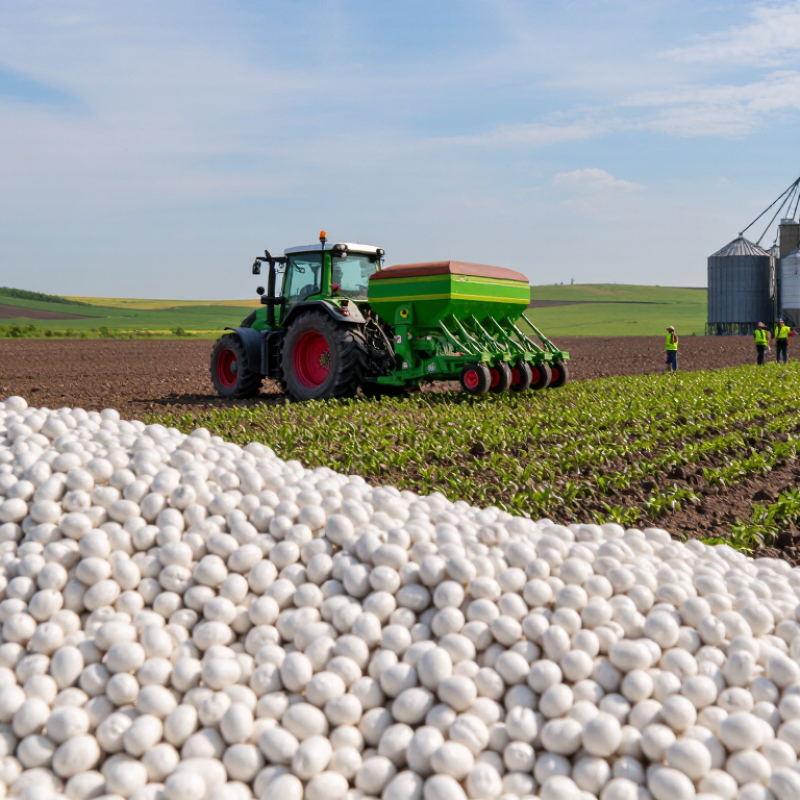
Why Is Fertilizer Urea Important for Global Buyers?

What Is Fertilizer Urea and How Is It Made?

Fertilizer urea is a concentrated nitrogen fertilizer, usually identified by its 46% nitrogen content. It begins with ammonia and carbon dioxide. Industrial plants combine them under high pressure to form ammonium carbamate. Heat then removes water, producing urea. The final melt becomes small, hard granules through prilling or granulation.

The chemistry is elegant. The energy demand is not. The International Energy Agency reports that ammonia production consumes about 2% of global final energy and creates roughly 1.3% of energy-related carbon dioxide emissions. Because ammonia is urea’s main feedstock, natural gas prices, electricity reliability, and plant efficiency strongly influence export availability. A cold storage shed, dusty loading point, or damp vessel can also affect product condition.

For buyers, the specification sheet matters beyond the 46% figure. Moisture, biuret, particle size, crushing strength, and caking behavior influence spreading performance. The International Fertilizer Association’s Medium-Term Fertilizer Outlook 2024–2028 expects global fertilizer demand to approach 205 million tonnes of nutrients by 2028. That growth makes consistent production important. Yet forecasts are not guarantees. Weather, trade restrictions, and unexpected shutdowns can quickly change regional supply. I would not treat a low quoted price as proof of value; laboratory testing and shipment inspection remain practical safeguards.

How Urea Supports Crop Growth and Agricultural Productivity

Why Is Fertilizer Urea Important for Global Buyers?

Urea supports crop growth by supplying nitrogen, a key nutrient for leaves, stems, and grain formation. After application, soil microbes convert urea into forms plant roots can absorb. This process can improve crop color, canopy development, and yield potential when moisture and soil conditions are suitable. In field practice, farmers often see greener leaves within days, although results vary by crop, weather, and soil health.

Urea is also practical for global agricultural supply chains. It contains a high concentration of nitrogen, so buyers can transport and store more nutrient with less volume. However, efficiency depends on careful handling and application. Surface-applied urea may lose nitrogen through volatilization, especially in warm, windy conditions. Heavy rain can also move nutrients beyond shallow roots. It is not a magic answer. Relying on urea alone may overlook phosphorus, potassium, organic matter, or poor irrigation. That mistake can reduce productivity and waste resources.

Tips: Test soil before purchasing large quantities. Match rates to crop demand and local guidance. Apply urea before light rain, or incorporate it into the soil when possible. Keep bags dry and sealed. A small field trial can reveal more than a confident assumption.

Why Global Buyers Choose Urea for International Trade

Why Is Fertilizer Urea Important for Global Buyers?

Global buyers choose urea because it delivers a high nitrogen concentration of about 46 percent. This reduces the volume needed for many crop nutrition programs. Lower shipment volume can simplify handling and improve freight efficiency. Urea is also widely traded in granular and prilled forms. These formats suit bulk vessels, containers, and regional warehouses. International buyers often value its familiar specifications, because consistent grades make supplier comparisons easier.

Yet urea is not always the cheapest practical choice. Freight rates, port conditions, moisture, and seasonal demand can change the final cost. A buyer may compare the purchase price and miss storage losses. That mistake is common. Reliable procurement requires checking nitrogen content, particle size, moisture levels, packaging, and inspection records. Buyers should also review import rules, safety documents, customs requirements, and delivery terms before signing contracts.

Tips: Request an independent quality certificate. Confirm the loading port and shipment schedule. Store bags on pallets, away from rain and open air. Compare landed cost, not only the quoted price. Test a sample when the supply relationship is new. Crop needs differ, so local agronomic advice still matters. Urea can support efficient farming, but only when timing, application rates, and field conditions are carefully managed.

What Factors Influence Urea Quality, Pricing, and Supply?

Why Is Fertilizer Urea Important for Global Buyers?

For global buyers, urea quality begins with chemistry, not appearance. Standard fertilizer urea contains about 46% nitrogen. Yet nitrogen content alone is insufficient. Buyers should check biuret, moisture, particle size, dust, and insoluble matter. These details affect spreading, storage, and crop safety. A reliable purchase file includes a certificate of analysis, batch number, sampling method, and independent laboratory verification. Granules may look uniform at the port. They can still bridge inside a humid warehouse. That risk is easy to underestimate.

Pricing reflects more than the quoted tonne value. Natural gas remains a major cost driver for nitrogen production. The World Bank Commodity Markets Outlook reports that fertilizer prices can move sharply during energy and logistics disruptions. Freight, port congestion, currency changes, and trade restrictions add pressure. Supply also follows plant maintenance, gas availability, weather, and regional demand. The International Fertilizer Association’s Medium-Term Fertilizer Outlook 2024–2028 projects global fertilizer demand rising toward roughly 205 million tonnes of nutrients by 2027/28, from about 194 million tonnes in 2022/23. This demand can tighten urea availability during planting seasons. Forecasts are not guarantees. A cheaper offer may hide higher moisture, inconsistent granules, or delayed shipment. Buyers should compare delivered cost, test results, lead time, and contract remedies. Price alone is not enough.

How to Evaluate Urea Suppliers and Manage Import Risks

For global buyers, fertilizer urea supports crop nutrition, but supply quality matters as much as price. A low quotation can hide moisture problems, delayed loading, or unclear specifications. Experienced buyers compare nitrogen content, granule condition, packaging strength, and storage history. They also request a recent certificate of analysis from an independent laboratory. A document alone is not proof. Physical inspection still matters.

Evaluate suppliers through verifiable records, not confident promises. Check company registration, export experience, production capacity, and references from comparable shipments. Ask for batch numbers, inspection procedures, loading photographs, and clear contract terms. Payment stages should match agreed milestones. Confirm the delivery basis, port responsibilities, insurance, and claims process before signing. Small wording differences can create large financial exposure.

Tips: Request a pre-shipment inspection. Test a retained sample after arrival. Verify customs and fertilizer rules in both countries. Keep every document in one controlled file. Build time for port congestion and seasonal demand. No checklist is perfect. I have seen buyers focus heavily on price while overlooking inconsistent bag weights and weak communication. That mistake can delay planting schedules. Supplier evaluation should remain active after the first successful shipment, because one good cargo does not prove long-term reliability.

Copyright 2025 Fluidra S.A. | Created by BCM Marketing Agencia Privacy Policy Legal note | Cookie policy |

Technical cookies are strictly necessary for our website to work and you can navigate through it. These types of cookies are those that, for example, allow us to identify you, give you access to certain restricted parts of the page if necessary, or remember different options or services already selected by you, such as your privacy preferences. Therefore, they are activated by default, your authorization not being necessary in this regard. Through the configuration of your browser, you can block or alert the presence of this type of cookies, although such blocking will affect the proper functioning of the different functionalities of our website.


The analysis cookies allow us to study the navigation of the users of our website in general (for example, which sections of the page are the most visited, which services are used most and if they work correctly, etc.). From the statistical information on navigation on our website, we can improve both the operation of the page itself and the different services it offers. Therefore, these cookies do not have an advertising purpose, but only serve to make our website work better, adapting to our users in general. By activating them you will contribute to this continuous improvement. You can enable or disable these cookies by checking the corresponding box, being disabled by default.


Functionality cookies allow us to remember your preferences, to personalize certain characteristics and general options of our website, every time you access it (for example, the language in which the information is presented to you, the sections marked as favorites, your browser type, etc.) Therefore, this type of cookies does not have an advertising purpose, but by activating them you will improve the functionality of the website (for example, adapting to your type of browser) and the customization of it based on your preferences (for example, by presenting the information in the language that you have chosen in previous occasions), which will contribute to the ease, usability and comfort of our page during your navigation. You can enable or disable these cookies by checking the corresponding box, being disabled by default.


Advertising cookies allow us to manage the advertising spaces included in our website based on criteria such as the content shown or the frequency in which the ads are displayed. For example, if you have been shown the same ad several times on our website, and you have not shown a personal interest by clicking on it, it will not appear again. In summary, by activating this type of cookies, the advertising shown on our website will be more useful and diverse, and less repetitive. You can enable or disable these cookies by checking the corresponding box, being disabled by default.


Behavioral advertising cookies allow us to obtain information based on the observation of your browsing habits and behaviors on the web, in order to show you advertising content that best suits your personal tastes and interests. To understand it in a very simple way, we will give you a fictitious example: if your last searches on the web were related to suspense literature, we would show you advertising about suspense books. Therefore, activating this type of cookies, the advertising that we show you on our website will not be generic, but will be oriented to your searches, tastes and interests, therefore adjusting exclusively to you. You can enable or disable these cookies by checking the corresponding box, being disabled by default.
To understand it in a very simple way, we will give you a fictitious example: if your last searches on the web were related to suspense literature, we would show you advertising about suspense books. Therefore, activating this type of cookies, the advertising that we show you on our website will not be generic, but will be oriented to your searches, tastes and interests, therefore adjusting exclusively to you. You can enable or disable these cookies by checking the corresponding box, being disabled by default.

SAVE

We use our own and third-party cookies to ensure the proper functioning of the website and to analyse our services, improve your experience on our website and show you advertisements related to your interests according to profiling based on your browsing habits (e.g. websites visited). You can accept all cookies by clicking "ACCEPT" or set or reject them by clicking here. If you would like to know more about the use of cookies, please see our COOKIE POLICY.


ACCEPT ALL
Reject no essentials


