
Why Choose a Cleanroom Chiller System?
FLUID HANDLING EXPERTS

Blog, all our news

Why Choose a Cleanroom Chiller System?

A Cleanroom Chiller System helps hold process temperatures steady when equipment, people, and outdoor conditions change the room’s heat load. In a pharmaceutical suite, that may mean keeping chilled water stable while production equipment runs and doors open for material transfer. The chiller also supports humidity control and reliable operation of air-handling equipment. It is not a substitute for suitable filtration, airflow design, or monitoring.

MarketsandMarkets estimated the cleanroom technology market at USD 6.5 billion in 2023 and projected USD 10.5 billion by 2028. This is a market forecast, not evidence that every facility needs the same cooling design. Lawrence Berkeley National Laboratory building-energy expert Dale Sartor has emphasized measurement-led efficiency in his work. A useful paraphrase for cleanroom projects is: “Measure the load before sizing the cooling plant.” Treat that as a design principle, not a verified verbatim quotation. Actual loads depend on process equipment, room classification, occupancy, and operating schedules. A chiller selected from floor area alone can be poorly matched. Oversizing may increase cycling; undersizing can threaten temperature stability during peak demand. Ask for logged load data, operating limits, and a commissioning plan. Then compare energy use and redundancy needs. The details matter. Even a careful design deserves review after the room is running.
Why Choose a Cleanroom Chiller System?

What Is a Cleanroom Chiller System?

A cleanroom chiller system removes heat from chilled water and circulates it to equipment that cools the room. Its main parts typically include a chiller, pumps, pipes, and air-handling coils. Warm air passes over the coils, transferring heat to the water. The chiller then rejects that heat outside the controlled space. The loop runs again.

This system supports stable conditions, but it does not control cleanliness by itself. Filters, airflow patterns, pressure relationships, and room controls also matter. A chiller may help maintain temperature, while humidity control often depends on the wider air-conditioning design. Small changes in equipment heat output can affect room conditions. That matters. A technician may check supply-water temperatures, pump operation, and coil performance during routine inspections. Condensation on a pipe or coil can signal that insulation or control settings need attention.

The right arrangement depends on the cleanroom’s process, heat load, operating schedule, and required environmental limits. Some facilities use dedicated loops; others share chilled-water infrastructure. In practice, the arrangement is not always elegant. Shared systems may be efficient, yet they can make troubleshooting less direct. Design decisions should be based on measured loads and documented requirements, not room size alone. A qualified HVAC engineer can assess these factors and coordinate the chiller with the cleanroom’s ventilation and control systems.

Why Choose a Cleanroom Chiller System? - What Is a Cleanroom Chiller System?
Dimension What It Is or Does Why It Matters in a Cleanroom Practical Design Consideration
System definition A cleanroom chiller system removes heat from a water or water-glycol loop. The chilled fluid supplies cooling coils in air-handling units or other process equipment. It provides controlled cooling for the room’s air-conditioning system and, where required, temperature-sensitive equipment. Chillers are one part of the HVAC system; they do not independently create or maintain a cleanroom classification.
Temperature control The chiller cools circulating fluid, while coils, valves, sensors, and controls help regulate the temperature of supply air and the space. Stable temperatures can support product, process, and equipment requirements. Setpoints and allowable variation should be based on the process and room specification, not a universal cleanroom temperature.
Humidity management Cooling coils can remove moisture when air is cooled below its dew point. Reheat or other humidity-control equipment may also be needed. Humidity can affect materials, processes, personnel comfort, and electrostatic behavior. A chiller alone does not guarantee humidity control. Design should account for outdoor air, latent loads, coil conditions, and control strategy.
Particle cleanliness The chiller provides cooling; filtration and cleanroom airflow systems handle airborne particle control. Separating these functions helps ensure that cooling equipment is not mistaken for a particle-removal system. Use appropriate air filtration, airflow patterns, room pressure relationships, and validated operating procedures for the required cleanliness level.
Heat-load capacity Chiller capacity is selected to meet the calculated cooling load from equipment, lighting, people, envelope heat gain, ventilation, and process requirements. An undersized system may struggle to meet conditions; an oversized system can cycle or operate inefficiently if not properly controlled. Base sizing on a documented load assessment and expected operating conditions rather than floor area alone.
Temperature resilience Controls monitor operating conditions and can adjust chiller output or chilled-water flow to respond to changing demand. Responsive control can help maintain specified room conditions as process and occupancy loads change. Define alarm thresholds, sensor locations, control sequences, and response procedures as part of commissioning.
Reliability and redundancy Multiple chillers, pumps, or other standby components can be arranged to provide backup capacity, when required. Redundancy can reduce the impact of equipment failure or maintenance on critical operations. Determine whether N+1 or another redundancy approach is appropriate through a risk assessment and continuity requirements.
Energy performance Chiller efficiency depends on equipment design, operating load, chilled-water temperatures, heat-rejection conditions, and system controls. Cooling can be a significant facility energy use, so efficient operation can help reduce energy demand. Compare performance at relevant operating conditions and assess the complete system, including pumps, cooling towers where applicable, and controls.
Maintenance and monitoring Routine work may include inspecting components, checking fluid conditions, cleaning heat-transfer surfaces, and reviewing alarms and trends. Preventive maintenance helps identify performance issues before they affect controlled conditions. Set maintenance intervals according to equipment documentation, site conditions, and the facility’s quality and operational procedures.
Best-fit applications Chilled-water systems are commonly considered for facilities with substantial or continuous cooling loads, multiple air handlers, or centralized cooling needs. A central system can serve several loads, while other cooling approaches may suit smaller or specialized applications. Compare lifecycle cost, available space, heat-rejection options, water use, service access, and applicable building requirements before selection.

How Does a Cleanroom Chiller System Work?

Why Choose a Cleanroom Chiller System?

How Does a Cleanroom Chiller System Work?

A cleanroom chiller system removes heat from water, then circulates that cooled water through the facility’s HVAC equipment. In the chiller, refrigerant absorbs heat from the water in an evaporator. A compressor raises the refrigerant’s pressure, and a condenser releases the captured heat outdoors or into a cooling-water loop. The refrigerant then returns to the evaporator, and the cycle repeats.

Pumps move chilled water through insulated pipes to cooling coils in air-handling units. Warm room air passes over those coils, giving up heat before it is filtered and supplied back to the cleanroom. The chiller cools the air indirectly; it does not remove particles by itself. Filters and carefully designed airflow do that work. This distinction matters.

Sensors track water temperature and system conditions, while controls adjust chiller output to match changing heat loads. For example, equipment may warm one room more than another, so the cooling demand can shift during a production day. Setpoints need careful commissioning. A lower water temperature is not automatically better; it can waste energy or complicate humidity control. In practice, small mismatches between sensors and actual room conditions can persist, so operators should review readings and verify them on site.

Which Components and Design Features Support Cleanroom Use?

A cleanroom chiller is more than a cooling unit placed beside a controlled space. Its components and layout should help protect temperature stability without adding avoidable contamination risks. A closed water or glycol circuit limits exposure to the process environment. Insulated piping, cleanable exterior surfaces, and carefully sealed connections help reduce condensation, dust, and leak concerns. Small details matter.

Temperature sensors should be positioned to reflect actual operating conditions, not just the chiller’s outlet reading. Variable-speed pumps can adjust flow as equipment loads change, while alarms can flag unusual temperatures, pressure changes, or low fluid levels. A historian or monitoring system also gives operators useful trends. Still, more sensors do not automatically mean better control; placement and calibration need regular review.

Low-vibration compressors and pumps can help where sensitive instruments are nearby. Service panels should be accessible from outside the cleanroom whenever the facility layout allows it, reducing maintenance traffic through controlled areas. Materials exposed to cleaning agents should resist corrosion, and drains should be planned for safe inspection. No layout is perfect. A design may look tidy on paper, yet leave little room to replace a pump or inspect a joint. Reviewing maintenance access early can prevent that awkward surprise.

Why Choose a Cleanroom Chiller System?

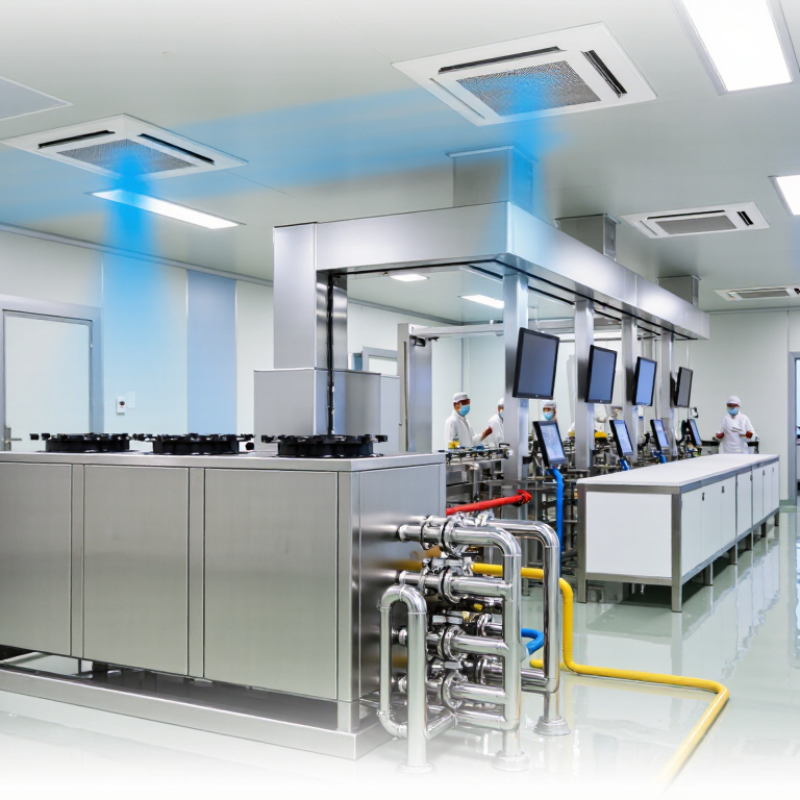
A cleanroom chiller supports stable temperature control by supplying chilled water to air-handling units and process equipment. The chart shows ISO 14644-1 particle concentration limits; a chiller alone does not determine a room’s cleanliness class.

Design features to consider: stable chilled-water control, appropriately sized cooling capacity, corrosion-resistant components, leak detection, maintainable access, and backup capacity where required. Filtration, airflow, and monitoring are also essential to cleanroom performance.

Reference: ISO 14644-1:2015 maximum concentration limits for particles ≥0.5 μm, in particles per cubic metre.

What Benefits Does It Provide for Temperature and Process Control?

A cleanroom chiller system supports more than basic cooling. It helps keep air-handling coils supplied with steady chilled water as equipment, people, and process loads add heat. When water temperature fluctuates, supply-air conditions can drift, affecting sensitive steps such as weighing, coating, or instrument calibration. Small changes matter.

The ISO 14644-1:2015 classification table sets an ISO Class 7 limit of 352,000 airborne particles per cubic metre at particle sizes of 0.5 micrometres and larger. This is a particle-count limit, not a temperature requirement. Still, it shows why cleanroom control relies on several systems working together. Stable cooling helps the air-handling unit manage temperature and humidity without abrupt swings; filtration and pressure control remain essential too. The ASHRAE Handbook—HVAC Applications also treats temperature, humidity, and airflow as linked design considerations for clean spaces.

A properly selected chiller can respond to changing process heat while maintaining the chilled-water conditions the air system needs. That can reduce temperature variation around workstations and help protect repeatability between production batches. Operators should trend supply and return water temperatures, room conditions, and alarms—not just trust the setpoint. It is easy to overlook fouled coils or changing loads. And a chiller alone cannot fix poor airflow design.

How Should a Cleanroom Chiller System Be Selected and Maintained?

Why Choose a Cleanroom Chiller System?

How Should a Cleanroom Chiller System Be Selected and Maintained?

Selection should start with measured heat loads, not a rule-of-thumb tonnage. Include equipment, lighting, people, outdoor air, and future process changes. A cleanroom chiller must also hold stable supply-water temperatures during sudden load shifts. That stability supports room temperature and humidity control. Small fluctuations matter.

Cleanroom classification helps define the cooling challenge. ISO 14644-1:2015 sets a limit of 3,520 airborne particles per cubic metre at 0.5 micrometres for ISO Class 5; ISO Class 7 allows 352,000. These limits describe particle concentration, not cooling capacity, but they show why airflow and filtration needs differ by room. Ask the design team to model peak and part-load conditions, then compare chiller efficiency at both. Check redundancy, water quality, controls, and service access. A perfect model is rare.

Maintenance should follow logged operating data and the equipment manual. Trend leaving-water temperature, pressure drop, approach temperature, and compressor runtime. Clean heat-transfer surfaces, inspect strainers, and test sensors on a set schedule. ASHRAE’s HVAC guidance emphasizes maintaining heat exchangers and controls for reliable system performance. Record each adjustment. A fouled filter or drifting sensor can quietly raise energy use before alarms appear. Review the trend with facility staff; one missed reading can still happen.

Copyright 2025 Fluidra S.A. | Created by BCM Marketing Agencia Privacy Policy Legal note | Cookie policy |

Technical cookies are strictly necessary for our website to work and you can navigate through it. These types of cookies are those that, for example, allow us to identify you, give you access to certain restricted parts of the page if necessary, or remember different options or services already selected by you, such as your privacy preferences. Therefore, they are activated by default, your authorization not being necessary in this regard. Through the configuration of your browser, you can block or alert the presence of this type of cookies, although such blocking will affect the proper functioning of the different functionalities of our website.


The analysis cookies allow us to study the navigation of the users of our website in general (for example, which sections of the page are the most visited, which services are used most and if they work correctly, etc.). From the statistical information on navigation on our website, we can improve both the operation of the page itself and the different services it offers. Therefore, these cookies do not have an advertising purpose, but only serve to make our website work better, adapting to our users in general. By activating them you will contribute to this continuous improvement. You can enable or disable these cookies by checking the corresponding box, being disabled by default.


Functionality cookies allow us to remember your preferences, to personalize certain characteristics and general options of our website, every time you access it (for example, the language in which the information is presented to you, the sections marked as favorites, your browser type, etc.) Therefore, this type of cookies does not have an advertising purpose, but by activating them you will improve the functionality of the website (for example, adapting to your type of browser) and the customization of it based on your preferences (for example, by presenting the information in the language that you have chosen in previous occasions), which will contribute to the ease, usability and comfort of our page during your navigation. You can enable or disable these cookies by checking the corresponding box, being disabled by default.


Advertising cookies allow us to manage the advertising spaces included in our website based on criteria such as the content shown or the frequency in which the ads are displayed. For example, if you have been shown the same ad several times on our website, and you have not shown a personal interest by clicking on it, it will not appear again. In summary, by activating this type of cookies, the advertising shown on our website will be more useful and diverse, and less repetitive. You can enable or disable these cookies by checking the corresponding box, being disabled by default.


Behavioral advertising cookies allow us to obtain information based on the observation of your browsing habits and behaviors on the web, in order to show you advertising content that best suits your personal tastes and interests. To understand it in a very simple way, we will give you a fictitious example: if your last searches on the web were related to suspense literature, we would show you advertising about suspense books. Therefore, activating this type of cookies, the advertising that we show you on our website will not be generic, but will be oriented to your searches, tastes and interests, therefore adjusting exclusively to you. You can enable or disable these cookies by checking the corresponding box, being disabled by default.
To understand it in a very simple way, we will give you a fictitious example: if your last searches on the web were related to suspense literature, we would show you advertising about suspense books. Therefore, activating this type of cookies, the advertising that we show you on our website will not be generic, but will be oriented to your searches, tastes and interests, therefore adjusting exclusively to you. You can enable or disable these cookies by checking the corresponding box, being disabled by default.

SAVE

We use our own and third-party cookies to ensure the proper functioning of the website and to analyse our services, improve your experience on our website and show you advertisements related to your interests according to profiling based on your browsing habits (e.g. websites visited). You can accept all cookies by clicking "ACCEPT" or set or reject them by clicking here. If you would like to know more about the use of cookies, please see our COOKIE POLICY.


ACCEPT ALL
Reject no essentials



