
Why Choose Brass Die Casting for Your Manufacturing Needs?
FLUID HANDLING EXPERTS

Blog, all our news

Why Choose Brass Die Casting for Your Manufacturing Needs?

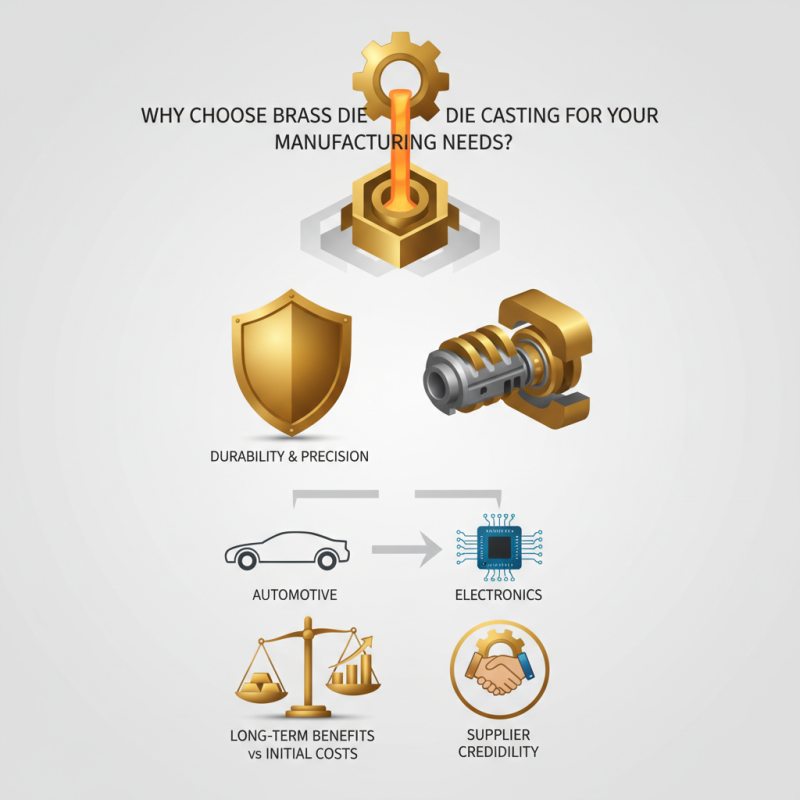
In today’s ever-evolving manufacturing landscape, the choice of materials and methods is crucial. Experts, like John Smith from Brass Innovations, emphasize the importance of reliability. He states, “Brass Die Casting offers unmatched durability and precision.” This insight highlights the growing preference for brass die casting in various industries.

Brass die casting is not just a mechanical process; it's about leveraging the right materials. This method enables manufacturers to create complex shapes with high dimensional accuracy. Many industries, such as automotive and electronics, are shifting to brass die casting. However, some overlook the initial costs and potential challenges.

Choosing brass die casting requires careful consideration. It’s essential to weigh long-term benefits against immediate expenses. Suppliers need to establish their credibility. In an industry where mistakes can be costly, understanding brass die casting is vital for optimal results.
Why Choose Brass Die Casting for Your Manufacturing Needs?

Benefits of Brass Die Casting in Product Manufacturing

Brass die casting offers numerous advantages for product manufacturing. Its strength and durability make it ideal for both small and large components. The lightweight nature of brass allows designers to create intricate parts without adding unnecessary weight to the final product. This can be especially beneficial in industries such as automotive and aerospace, where every gram counts.

Moreover, brass die casting provides excellent corrosion resistance. This makes it suitable for products exposed to harsh environments. The aesthetic appeal of brass also enhances the visual quality of the finished product. It can be polished to a high shine or left in its natural state for a more rustic look. This versatility is a key factor for designers aiming to create attractive products.

However, there are considerations to keep in mind. The initial tooling costs can be high. It’s crucial to evaluate the production volume to ensure cost-effectiveness. Additionally, while die casting allows for precise dimensional tolerances, imperfections may occur. Proper quality control measures should be in place to address any discrepancies in the casting process. Overall, brass die casting remains a compelling choice for manufacturers looking to balance aesthetics and functionality.

Comparison of Brass with Other Die Casting Materials

Brass die casting provides unique benefits that set it apart from other materials. Brass is known for its excellent strength and corrosion resistance. Many industries favor brass for applications requiring durability. Its favorable mechanical properties make it ideal for items like fittings and connectors. The aesthetic appeal of brass is also significant. Its golden hue adds value to decorative products.

When comparing brass to aluminum and zinc, distinct differences emerge. Aluminum is lighter, making it suitable for weight-sensitive applications. However, aluminum castings may lack the surface finish brass offers. Zinc, on the other hand, is more malleable but has lower corrosion resistance compared to brass. Each material has its pros and cons, and selecting the right one can be challenging.

For certain projects, brass may seem too costly. However, its long-term performance often justifies the initial investment. Understanding the specific requirements of a project is essential. Each material requires different processing techniques and has unique characteristics. Assessing the environment in which parts will be used is critical. These considerations ensure the best choice for manufacturing needs.

Why Choose Brass Die Casting for Your Manufacturing Needs? - Comparison of Brass with Other Die Casting Materials

Material Melting Point (°C) Density (g/cm³) Tensile Strength (MPa) Oxidation Resistance Machinability
Brass 900 - 940 8.4 350 - 700 Good Excellent
Aluminum 660 - 680 2.7 70 - 700 Moderate Very Good
Zinc 420 - 450 7.1 200 - 300 Excellent Good
Magnesium 650 - 700 1.8 200 - 250 Good Excellent

Applications of Brass Die Casting in Various Industries

Brass die casting has gained traction across various industries due to its versatility and durability. It is widely used in electrical fittings, musical instruments, and automotive components. The excellent conductivity of brass makes it ideal for electrical applications. Die-cast brass connectors and housings are common in electronic devices, ensuring reliable performance and safety.

In the automotive sector, brass die casting is crucial for components like gears and valves. These parts benefit from brass’s strength and resistance to corrosion. However, the casting process can sometimes introduce imperfections, which can be challenging to detect. It's important for manufacturers to recognize these flaws early on to avoid costly rework later.

Another area where brass die casting shines is in the creation of decorative items. From intricate jewelry to ornate doorknobs, the aesthetic appeal is undeniable. Yet, the market currently faces a challenge with sustainable sourcing of materials. Balancing quality with eco-friendly practices will require innovation and a commitment to ethical standards. As industries evolve, the potential for brass remains significant, but so does the need for improvement.

The Die Casting Process: How Brass Components Are Made

Die casting is a precision manufacturing process that produces intricate brass components. The method involves forcing molten brass into a mold cavity under high pressure. This enables the creation of complex shapes with excellent surface finishes. According to industry reports, die casting can achieve tolerances as tight as ±0.005 inches, making it suitable for demanding applications.

The die casting process includes several critical steps. First, operators melt brass at temperatures exceeding 900°C. Next, the molten metal is injected rapidly into a mold. Cooling occurs quickly, often within seconds, allowing parts to be ejected shortly after. This method can yield high production rates with minimal waste. Research indicates that die casting has a material utilization rate exceeding 90%, making it an efficient choice.

Despite its advantages, there are areas of improvement. Not all brass alloys are suitable for die casting. Some may experience issues like shrinkage or defects. Continuous monitoring of temperature and pressure is crucial. Operators need training to ensure optimal outcomes. Insights from professionals stress the importance of refining the process for better quality control. This is fundamental for industries relying on precision components, such as automotive or aerospace.

Cost Efficiency and Durability of Brass Die Cast Products

Brass die casting offers exceptional cost efficiency and durability, making it a popular choice in manufacturing. According to industry reports, brass components have a lifespan that exceeds that of many other materials. They resist corrosion, which translates to lower maintenance costs over time. This durability can reduce replacement frequency, offering long-term savings for manufacturers.

The production of brass die castings can be more economical than other metals. A recent study indicated that using brass can reduce material waste by up to 35% compared to aluminum castings. Additionally, die casting minimizes machining time, which further decreases overall production costs. However, some manufacturers might overlook the initial tooling expense. It's important to balance initial investment against long-term benefits.

The versatility of brass also contributes to its appeal. It can be easily molded into complex designs, allowing for more innovative product features. Yet, challenges exist in maintaining a consistent quality due to the variability in alloy compositions. Therefore, fine-tuning the casting process is crucial. Manufacturers should consider these aspects to maximize their efficiency and product lifespan.

Copyright 2025 Fluidra S.A. | Created by BCM Marketing Agencia Privacy Policy Legal note | Cookie policy |

Technical cookies are strictly necessary for our website to work and you can navigate through it. These types of cookies are those that, for example, allow us to identify you, give you access to certain restricted parts of the page if necessary, or remember different options or services already selected by you, such as your privacy preferences. Therefore, they are activated by default, your authorization not being necessary in this regard. Through the configuration of your browser, you can block or alert the presence of this type of cookies, although such blocking will affect the proper functioning of the different functionalities of our website.


The analysis cookies allow us to study the navigation of the users of our website in general (for example, which sections of the page are the most visited, which services are used most and if they work correctly, etc.). From the statistical information on navigation on our website, we can improve both the operation of the page itself and the different services it offers. Therefore, these cookies do not have an advertising purpose, but only serve to make our website work better, adapting to our users in general. By activating them you will contribute to this continuous improvement. You can enable or disable these cookies by checking the corresponding box, being disabled by default.


Functionality cookies allow us to remember your preferences, to personalize certain characteristics and general options of our website, every time you access it (for example, the language in which the information is presented to you, the sections marked as favorites, your browser type, etc.) Therefore, this type of cookies does not have an advertising purpose, but by activating them you will improve the functionality of the website (for example, adapting to your type of browser) and the customization of it based on your preferences (for example, by presenting the information in the language that you have chosen in previous occasions), which will contribute to the ease, usability and comfort of our page during your navigation. You can enable or disable these cookies by checking the corresponding box, being disabled by default.


Advertising cookies allow us to manage the advertising spaces included in our website based on criteria such as the content shown or the frequency in which the ads are displayed. For example, if you have been shown the same ad several times on our website, and you have not shown a personal interest by clicking on it, it will not appear again. In summary, by activating this type of cookies, the advertising shown on our website will be more useful and diverse, and less repetitive. You can enable or disable these cookies by checking the corresponding box, being disabled by default.


Behavioral advertising cookies allow us to obtain information based on the observation of your browsing habits and behaviors on the web, in order to show you advertising content that best suits your personal tastes and interests. To understand it in a very simple way, we will give you a fictitious example: if your last searches on the web were related to suspense literature, we would show you advertising about suspense books. Therefore, activating this type of cookies, the advertising that we show you on our website will not be generic, but will be oriented to your searches, tastes and interests, therefore adjusting exclusively to you. You can enable or disable these cookies by checking the corresponding box, being disabled by default.
To understand it in a very simple way, we will give you a fictitious example: if your last searches on the web were related to suspense literature, we would show you advertising about suspense books. Therefore, activating this type of cookies, the advertising that we show you on our website will not be generic, but will be oriented to your searches, tastes and interests, therefore adjusting exclusively to you. You can enable or disable these cookies by checking the corresponding box, being disabled by default.

SAVE

We use our own and third-party cookies to ensure the proper functioning of the website and to analyse our services, improve your experience on our website and show you advertisements related to your interests according to profiling based on your browsing habits (e.g. websites visited). You can accept all cookies by clicking "ACCEPT" or set or reject them by clicking here. If you would like to know more about the use of cookies, please see our COOKIE POLICY.


ACCEPT ALL
Reject no essentials


