
What Are the Top Types of Modular Conveyor Belts?
FLUID HANDLING EXPERTS

Blog, all our news

What Are the Top Types of Modular Conveyor Belts?

Conveyor selection rarely begins with the belt itself. It begins with the product: a wet food tray, a warm molded part, or a carton that must turn without slipping. A Modular Conveyor Belt can handle many of these tasks because its linked plastic modules form a durable, repairable surface. But “modular” does not mean one design fits every line.

The investment context is clear. MHI and Deloitte’s 2024 Annual Industry Report found that 55% of surveyed supply-chain professionals planned to increase investment in technology and innovation. That figure covers more than conveyors, yet it points to rising pressure for flexible material handling. Modular belts can support that flexibility through flat-top, flush-grid, open-grid, and raised-rib designs. Each shape changes grip, drainage, airflow, and cleanability. Small details matter. A belt that drains well under a washdown may be a poor choice for tiny components.

This guide compares the top modular conveyor belt types by structure, typical use, and practical trade-offs. It also considers hinge design, sprocket compatibility, temperature exposure, and cleaning needs. These factors influence maintenance as much as the belt’s headline strength. A useful caution: published product ratings rarely reproduce real operating conditions. Confirming performance with the actual product and conveyor layout is still essential.
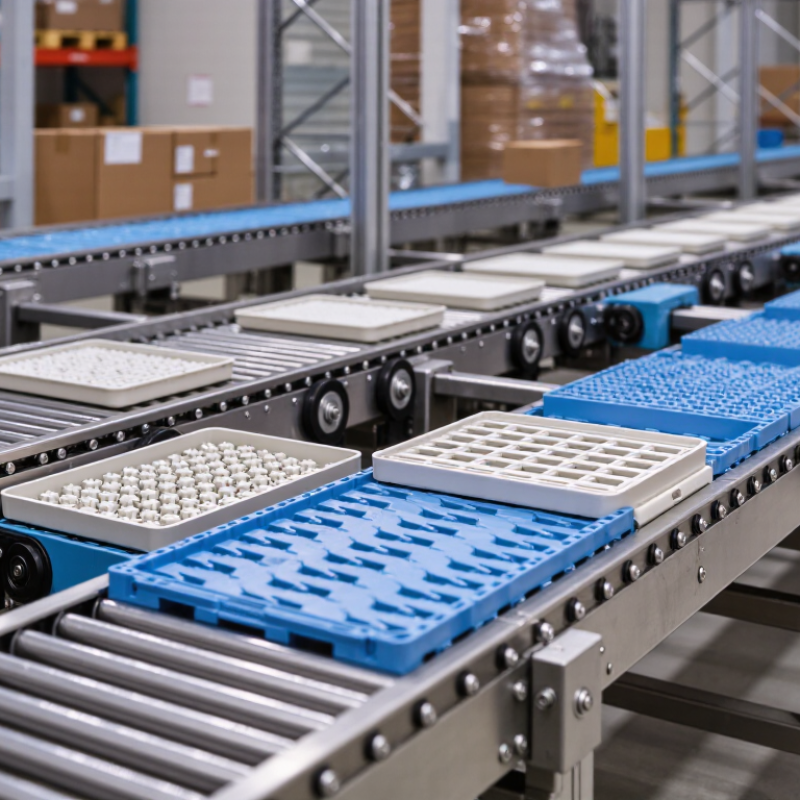
What Are the Top Types of Modular Conveyor Belts?

Common Modular Conveyor Belt Designs and Their Construction

Modular conveyor belts are built from small plastic modules joined by hinge rods, forming a continuous surface that can be repaired in sections. The module shape determines how the belt carries products and handles spills. Flat-top designs use closely spaced, smooth surfaces for cartons, trays, and other stable loads. They are easy to wipe down, though crumbs or liquid can collect near the hinges.

Open-grid belts have gaps between crossbars, allowing drainage and airflow. Their structure suits washing or cooling processes, but small items may need a tighter mesh. Raised-rib designs add ridges across the surface to help products move on inclined runs. The ribs provide grip, yet they can mark delicate packaging if pressure is uneven. Details matter.

Side-flexing modules are shaped to bend around horizontal curves. Their edges and hinge arrangement guide the belt through a turn, reducing the need for separate transfer points. Sprockets engage with the underside of the modules, while support rails carry the load along straight and curved sections. Correct alignment is essential; a poorly supported belt may wear unevenly or track off-center. That is easy to overlook.

Construction choices should match product size, temperature, cleaning method, and conveyor layout. A belt that performs well with rigid containers may not suit soft packages or fine materials. Even a sensible design can disappoint if gaps, speed, or support spacing are chosen without testing actual operating conditions.

Flat-Top Belts for General Material Handling

Flat-top modular conveyor belts suit general material handling because their broad, level surface supports cartons, totes, and packaged goods. Interlocking plastic modules form a belt that can be repaired in sections, rather than replaced as one continuous piece. In a distribution area, this can mean swapping a damaged module near a transfer point instead of removing the full belt.

Small detail, real downtime.

The flat surface also helps products track steadily across straight runs and gentle curves. Yet “flat-top” does not mean suitable for every load. Dust, oil, sharp edges, and wet conditions can affect grip, wear, or cleanability.

I have seen selection discussions focus on belt width while overlooking the product’s underside; that is an easy mistake. Check load weight, operating speed, transfer gaps, and cleaning routines against the belt maker’s technical specifications.

Industry investment trends reinforce the need to choose carefully. MHI and Deloitte’s 2024 Annual Industry Report found that 88% of surveyed supply-chain leaders planned to increase investment in technology over the following five years. That figure is not specific to conveyor belts, but it signals growing attention to material-flow systems.

For a flat-top application, measure actual product dimensions and observe transfers under normal operating conditions. A short trial can reveal snagging that a drawing misses.

Perforated and Open-Grid Belts for Drainage and Airflow

Perforated and open-grid modular belts are useful when products need to drain or cool during transport. A perforated belt has regularly spaced holes through a mostly solid surface. An open-grid belt uses a wider lattice, leaving more area open to air and liquid. Water moves quickly. This difference affects support: small or soft items may need closer belt spacing to avoid sagging or catching.

In a washdown line, perforations can let rinse water pass while the belt carries trays or firm produce. Open-grid designs can offer stronger airflow around baked goods, packaged products, or parts moving through a cooling zone. Air needs space. The actual result depends on hole size, belt speed, product spacing, and the direction of airflow. A visually open belt does not guarantee even cooling; crowded loads can block circulation.

Selection should reflect the product and the cleaning routine, not just the drainage requirement. Check whether crumbs, fibers, or sticky residue collect around hinge rods and openings. A quick visual inspection helps, but it may miss buildup inside joints. That assumption can be wrong. Test the belt with real products and operating conditions, including starts, stops, and wet loads. Also confirm that openings are small enough to support the product without trapping its edges.

Ribbed and Cleated Belts for Incline Conveying

Ribbed and cleated modular belts help carry products up slopes without relying on friction alone. The ribs create a textured surface; cleats act like small barriers that resist rollback. A carton may need low, closely spaced cleats, while loose produce often needs taller flights to contain shifting pieces. Short test runs matter. Wet surfaces can change grip more than expected.

The Conveyor Equipment Manufacturers Association’s Belt Conveyors for Bulk Materials explains that allowable incline depends on material, belt speed, and loading—not angle alone. That principle applies to modular systems too: test the actual product, not just an empty belt.

For example, a 20-degree incline carrying damp, irregular pieces may behave differently from the same belt moving dry, boxed goods. CEMA’s reference also stresses matching conveyor design to material characteristics.

Measure rollback, spillage, and product damage during trials; then adjust cleat height, spacing, and belt speed.
There is no single cleat pattern that suits every line.

A detail teams sometimes overlook: extra-tall cleats may stabilize a load, but can complicate cleaning and product transfer.

How to Match Belt Types to Operating Requirements

Choosing a modular conveyor belt starts with the product and the process, not the belt name. Flat-top belts support small parts and provide a stable surface for cartons or packaged goods. For wet lines, an open-grid belt lets water drain and air circulate. That can help after washing, but tiny items may catch between openings.

Match the belt’s surface to how products move. Raised-rib designs can improve grip on inclines, while roller-top modules allow packages to rotate or change direction with less manual handling. Check the product’s weight, footprint, and underside: a heavy load concentrates force, and an uneven base may rock on widely spaced supports. Small details matter.

Operating conditions narrow the choice further. In washdown areas, look for a design that allows access to hinge rods and belt edges; trapped residue is easy to overlook. For hot products, verify the belt material’s rated temperature rather than relying on a general label. Also consider sprocket spacing, conveyor width, and transfer gaps. A technically suitable belt can still perform poorly if installation is misaligned. Test a short section with actual products and cleaning procedures. That step takes time, but it can reveal a snag or drainage issue before the full line is fitted.

Top Modular Conveyor Belt Types: Matching Belts to Operating Requirements

Typical relative suitability for common applications. Ratings are a qualitative screening guide, not a standardized performance measure; actual suitability depends on belt design, product, and operating conditions.

How to use: Start with the operating requirement that matters most, then confirm the selected belt’s open area, surface style, turning capability, load limits, and cleaning requirements with its technical specifications.

Copyright 2025 Fluidra S.A. | Created by BCM Marketing Agencia Privacy Policy Legal note | Cookie policy |

Technical cookies are strictly necessary for our website to work and you can navigate through it. These types of cookies are those that, for example, allow us to identify you, give you access to certain restricted parts of the page if necessary, or remember different options or services already selected by you, such as your privacy preferences. Therefore, they are activated by default, your authorization not being necessary in this regard. Through the configuration of your browser, you can block or alert the presence of this type of cookies, although such blocking will affect the proper functioning of the different functionalities of our website.


The analysis cookies allow us to study the navigation of the users of our website in general (for example, which sections of the page are the most visited, which services are used most and if they work correctly, etc.). From the statistical information on navigation on our website, we can improve both the operation of the page itself and the different services it offers. Therefore, these cookies do not have an advertising purpose, but only serve to make our website work better, adapting to our users in general. By activating them you will contribute to this continuous improvement. You can enable or disable these cookies by checking the corresponding box, being disabled by default.


Functionality cookies allow us to remember your preferences, to personalize certain characteristics and general options of our website, every time you access it (for example, the language in which the information is presented to you, the sections marked as favorites, your browser type, etc.) Therefore, this type of cookies does not have an advertising purpose, but by activating them you will improve the functionality of the website (for example, adapting to your type of browser) and the customization of it based on your preferences (for example, by presenting the information in the language that you have chosen in previous occasions), which will contribute to the ease, usability and comfort of our page during your navigation. You can enable or disable these cookies by checking the corresponding box, being disabled by default.


Advertising cookies allow us to manage the advertising spaces included in our website based on criteria such as the content shown or the frequency in which the ads are displayed. For example, if you have been shown the same ad several times on our website, and you have not shown a personal interest by clicking on it, it will not appear again. In summary, by activating this type of cookies, the advertising shown on our website will be more useful and diverse, and less repetitive. You can enable or disable these cookies by checking the corresponding box, being disabled by default.


Behavioral advertising cookies allow us to obtain information based on the observation of your browsing habits and behaviors on the web, in order to show you advertising content that best suits your personal tastes and interests. To understand it in a very simple way, we will give you a fictitious example: if your last searches on the web were related to suspense literature, we would show you advertising about suspense books. Therefore, activating this type of cookies, the advertising that we show you on our website will not be generic, but will be oriented to your searches, tastes and interests, therefore adjusting exclusively to you. You can enable or disable these cookies by checking the corresponding box, being disabled by default.
To understand it in a very simple way, we will give you a fictitious example: if your last searches on the web were related to suspense literature, we would show you advertising about suspense books. Therefore, activating this type of cookies, the advertising that we show you on our website will not be generic, but will be oriented to your searches, tastes and interests, therefore adjusting exclusively to you. You can enable or disable these cookies by checking the corresponding box, being disabled by default.

SAVE

We use our own and third-party cookies to ensure the proper functioning of the website and to analyse our services, improve your experience on our website and show you advertisements related to your interests according to profiling based on your browsing habits (e.g. websites visited). You can accept all cookies by clicking "ACCEPT" or set or reject them by clicking here. If you would like to know more about the use of cookies, please see our COOKIE POLICY.


ACCEPT ALL
Reject no essentials


