
China Top Polymer Surge Arrester Manufacturers
FLUID HANDLING EXPERTS

Blog, all our news

China Top Polymer Surge Arrester Manufacturers

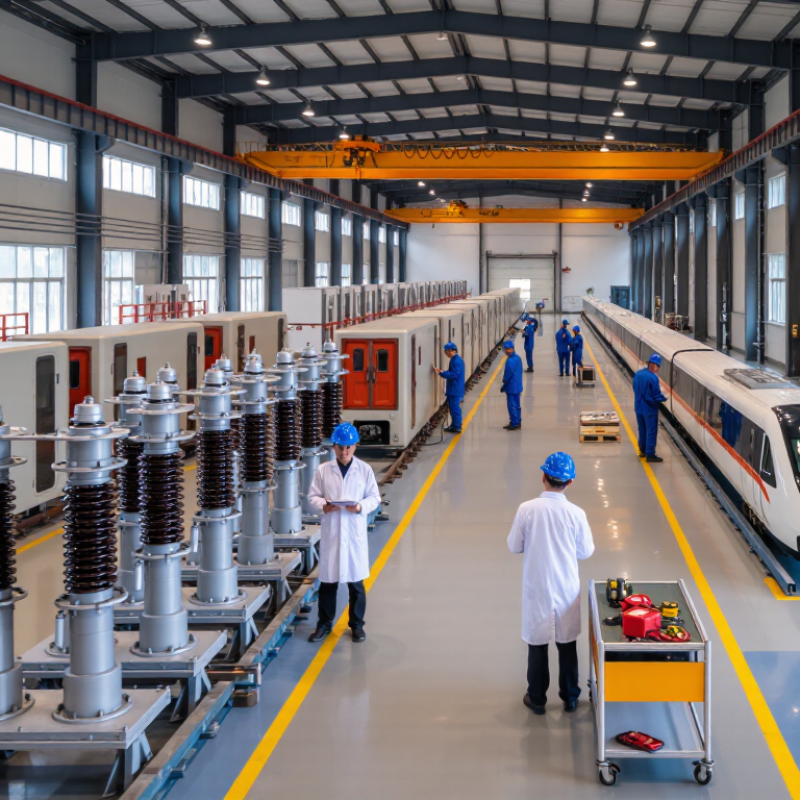
China’s polymer surge arrester industry has become an important source for modern transmission and distribution projects. Its manufacturers serve substations, renewable energy plants, railway systems, factories, and commercial facilities. Yet a supplier should not be judged by product photographs or export volume alone.

A reliable Polymer Surge Arrester combines stable zinc-oxide varistors, strong polymer housing, controlled sealing, and proven pressure-relief performance. The best manufacturers support these claims with type-test reports, routine inspections, material traceability, and clear technical documentation. They should also explain pollution resistance, creepage distance, thermal stability, and aging behavior under repeated lightning impulses. Small details matter. So does field feedback.

Professor Martin A. Darveniza, a respected high-voltage engineering researcher, captures this discipline in one sentence: “Service performance matters more than appearance.” That principle shapes this overview of China’s leading manufacturers. It encourages buyers to compare testing capability, production consistency, engineering support, and long-term reliability.

Still, no ranking is perfect. A factory may perform well in laboratory tests but lack experience with unusual climates or complex grid conditions. Another supplier may offer excellent engineering but limited overseas support. These gaps deserve honest attention.

This guide therefore considers practical evidence rather than promotional language. It examines manufacturing depth, certification, customization, quality control, and after-sales responsiveness. Readers should verify current certificates and project references before making a purchase. Careful comparison reduces technical risk and supports safer power-system operation.
China Top Polymer Surge Arrester Manufacturers

China’s Polymer Surge Arrester Manufacturers: 10–800 kV Product Scope

China’s polymer surge arrester manufacturers now cover applications from 10 kV distribution networks to 800 kV ultra-high-voltage projects. Common ratings include 10, 35, 72.5, 110, 220, 330, 500, and 800 kV. These products typically use silicone-rubber housings, zinc-oxide valve elements, and pressure-relief structures. The correct selection depends on continuous operating voltage, lightning impulse level, pollution severity, and short-circuit performance.

The International Energy Agency’s Electricity Grids and Secure Energy Transitions report states that annual global grid investment must exceed 600 billion dollars by 2030. This expansion increases demand for reliable overvoltage protection across substations, renewable-energy corridors, and long-distance transmission lines. At 800 kV, manufacturing precision becomes critical. Small sealing defects can become serious after years of electrical and environmental stress. Factory testing should include reference-voltage checks, leakage-current measurement, aging evaluation, and mechanical inspection under IEC 60099-4 requirements.

Do not judge suppliers by voltage range alone. A broad catalogue proves little. Review type-test reports, salt-fog results, thermal stability records, and traceable raw-material controls. CIGRE insulation-coordination guidance also supports studying system switching events, not only lightning impulses. One practical weakness remains: public product data can be incomplete or inconsistent. Buyers should verify test conditions, energy ratings, installation altitude, and warranty limits directly. Field experience matters, but it should be documented rather than assumed.

IEC 60099-4 Testing: Key Parameters for Polymer Surge Arresters

China Top Polymer Surge Arrester Manufacturers

IEC 60099-4 testing gives buyers a practical way to compare polymer surge arresters. The standard focuses on metal-oxide arresters without gaps for alternating-current systems. Engineers examine rated voltage, continuous operating voltage, and temporary overvoltage withstand. These values must match the network, not just the product label.

Residual voltage is a key parameter. During an impulse test, the arrester should limit voltage before insulation suffers damage. Laboratories also check switching impulses and steep-front impulses under controlled conditions. Leakage current deserves attention too. A stable resistive component usually indicates healthy varistor blocks and sound electrical grading. Small errors matter. Measuring instruments require traceable calibration.

Thermal stability testing evaluates whether the arrester can recover after absorbing energy. The test may include preheating, applied voltage, and repeated discharge duty. Polymer housings also require inspection for sealing, tracking, erosion, and mechanical damage. Outdoor units face rain, sunlight, pollution, and sudden temperature changes. Testing should therefore reflect realistic installation conditions when possible.

In production, routine checks can include reference voltage, leakage current, and visual inspection. Type-test reports should identify test circuits, impulse levels, specimen details, and acceptance criteria. A report without these details is difficult to verify. Field experience also shows a limitation: laboratory success cannot remove every installation risk. Poor grounding, excessive lead length, or loose connections can still increase protective voltage. The details matter.

ZnO Varistor Performance: 1 mA Reference Voltage and Residual Voltage

China Top Polymer Surge Arrester Manufacturers

ZnO Varistor Performance: 1 mA Reference Voltage and Residual Voltage

For polymer surge arresters, the 1 mA reference voltage, U1mA, shows the varistor’s voltage level during a controlled direct-current test. It helps engineers compare voltage grading between production batches. A higher U1mA usually supports a higher continuous operating voltage, but it does not prove complete arrester quality. Leakage current, aging, temperature, and energy capability also require attention.

Residual voltage describes the voltage remaining across the arrester during a specified surge current. The common 8/20 microsecond waveform provides a practical reference for impulse protection. Lower residual voltage generally means stronger clamping performance. However, the test current must be stated clearly. Results at 5 kA cannot be compared casually with results at 10 kA.

Testing details matter greatly.

Experienced manufacturers inspect varistor uniformity, electrode contact, sealing, and polymer housing quality. In production audits, I would request U1mA records, residual-voltage curves, leakage-current data, and thermal stability results. A single laboratory value can look impressive yet hide weak behavior after repeated surges. This is where judgment becomes necessary. I have also seen specifications become confusing when voltage tolerances or test temperatures are omitted. Clear procedures, calibrated instruments, and traceable sampling make the data more dependable for grid, industrial, and renewable-energy applications.

ZnO Varistor Performance: 1 mA Reference Voltage and Residual Voltage

Representative performance values for polymer-housed ZnO surge arresters across common distribution-voltage classes.

The 1 mA reference voltage indicates the voltage measured across the ZnO varistor when a 1 mA direct current flows through it. Residual voltage is the maximum protective voltage measured during an 8/20 μs lightning-current impulse at 5 kA. Higher-voltage arrester classes generally exhibit higher values for both parameters. Actual results depend on varistor composition, energy rating, test temperature, and applicable standards.

Manufacturer Evaluation: Leakage Current, Energy Class, and 20-Year Design Life

China Top Polymer Surge Arrester Manufacturers

Evaluating polymer surge arrester manufacturers requires more than comparing purchase prices. Leakage current is an important operating signal. Under normal voltage, technicians should measure total and resistive leakage current. The resistive component deserves closer attention. Rising values may indicate moisture, surface contamination, aging, or thermal stress. Measurements should include temperature, humidity, and system harmonics. Otherwise, the comparison can become misleading.

Energy class shows how confidently an arrester handles repeated surges. A credible manufacturer should provide discharge-current data, residual-voltage curves, thermal-stability results, and certified type-test records. The arrester must also withstand temporary overvoltage without losing stability. In field inspections, damaged housings often receive attention first. Internal zinc-oxide degradation may remain invisible. That is a weakness in many evaluations.

A claimed 20-year design life should be treated as a design target, not a guarantee. Ask how the manufacturer validates aging, ultraviolet exposure, salt pollution, sealing performance, and mechanical strength. Batch traceability and routine testing matter too. Practical inspection details matter.

A reliable supplier can explain failure margins in plain technical language. It should also disclose test conditions, not only favorable figures. I would question any document that promises identical performance in every climate.

Coastal humidity, industrial dust, and repeated switching events can shorten service life. Even a strong arrester needs periodic thermal imaging, leakage-current trending, and visual inspection.

Applications by Voltage Level: 0.4 kV Distribution to 800 kV Transmission

China Top Polymer Surge Arrester Manufacturers

Polymer surge arresters protect equipment from lightning and switching overvoltages across modern power networks. At 0.4 kV, compact arresters commonly protect distribution boards, transformers, pumps, and commercial control cabinets. Selection should consider continuous operating voltage, discharge current, grounding quality, and enclosure exposure. A low-voltage unit still needs correct coordination with upstream protection.

Medium-voltage systems, often from 6 kV to 35 kV, require stronger energy-handling capability. Polymer housings resist moisture and reduce shattering risks during severe faults. At 110 kV and 220 kV, arrester placement near transformers, cable terminations, and line entrances becomes more critical. For 500 kV and 800 kV transmission lines, manufacturers must control field stress, grading, sealing, and long-term mechanical strength. Factory testing matters. Site installation matters too. A well-designed arrester can still perform poorly after loose connections, contamination, or incorrect clearances. That part is sometimes underestimated.

Tips: Match the arrester’s MCOV with the system voltage and grounding method. Check leakage current, sealing condition, and earth connections during maintenance. At high altitude or coastal sites, request application-specific verification. Real projects are rarely perfect. Review operating records before repeating an old specification.

Copyright 2025 Fluidra S.A. | Created by BCM Marketing Agencia Privacy Policy Legal note | Cookie policy |

Technical cookies are strictly necessary for our website to work and you can navigate through it. These types of cookies are those that, for example, allow us to identify you, give you access to certain restricted parts of the page if necessary, or remember different options or services already selected by you, such as your privacy preferences. Therefore, they are activated by default, your authorization not being necessary in this regard. Through the configuration of your browser, you can block or alert the presence of this type of cookies, although such blocking will affect the proper functioning of the different functionalities of our website.


The analysis cookies allow us to study the navigation of the users of our website in general (for example, which sections of the page are the most visited, which services are used most and if they work correctly, etc.). From the statistical information on navigation on our website, we can improve both the operation of the page itself and the different services it offers. Therefore, these cookies do not have an advertising purpose, but only serve to make our website work better, adapting to our users in general. By activating them you will contribute to this continuous improvement. You can enable or disable these cookies by checking the corresponding box, being disabled by default.


Functionality cookies allow us to remember your preferences, to personalize certain characteristics and general options of our website, every time you access it (for example, the language in which the information is presented to you, the sections marked as favorites, your browser type, etc.) Therefore, this type of cookies does not have an advertising purpose, but by activating them you will improve the functionality of the website (for example, adapting to your type of browser) and the customization of it based on your preferences (for example, by presenting the information in the language that you have chosen in previous occasions), which will contribute to the ease, usability and comfort of our page during your navigation. You can enable or disable these cookies by checking the corresponding box, being disabled by default.


Advertising cookies allow us to manage the advertising spaces included in our website based on criteria such as the content shown or the frequency in which the ads are displayed. For example, if you have been shown the same ad several times on our website, and you have not shown a personal interest by clicking on it, it will not appear again. In summary, by activating this type of cookies, the advertising shown on our website will be more useful and diverse, and less repetitive. You can enable or disable these cookies by checking the corresponding box, being disabled by default.


Behavioral advertising cookies allow us to obtain information based on the observation of your browsing habits and behaviors on the web, in order to show you advertising content that best suits your personal tastes and interests. To understand it in a very simple way, we will give you a fictitious example: if your last searches on the web were related to suspense literature, we would show you advertising about suspense books. Therefore, activating this type of cookies, the advertising that we show you on our website will not be generic, but will be oriented to your searches, tastes and interests, therefore adjusting exclusively to you. You can enable or disable these cookies by checking the corresponding box, being disabled by default.
To understand it in a very simple way, we will give you a fictitious example: if your last searches on the web were related to suspense literature, we would show you advertising about suspense books. Therefore, activating this type of cookies, the advertising that we show you on our website will not be generic, but will be oriented to your searches, tastes and interests, therefore adjusting exclusively to you. You can enable or disable these cookies by checking the corresponding box, being disabled by default.

SAVE

We use our own and third-party cookies to ensure the proper functioning of the website and to analyse our services, improve your experience on our website and show you advertisements related to your interests according to profiling based on your browsing habits (e.g. websites visited). You can accept all cookies by clicking "ACCEPT" or set or reject them by clicking here. If you would like to know more about the use of cookies, please see our COOKIE POLICY.


ACCEPT ALL
Reject no essentials


