What Are the Top 10 Types of Air Conditioning?
FLUID HANDLING EXPERTS

Blog, all our news

What Are the Top 10 Types of Air Conditioning?

Air Conditioning is no longer a simple comfort purchase. It affects household budgets, indoor health, electricity grids, and global emissions. This guide examines the top 10 types of Air Conditioning, from split systems and ducted units to portable, window, VRF, evaporative, and geothermal designs. Each system behaves differently in a real building.

The International Energy Agency’s The Future of Cooling report warns that space-cooling energy demand could more than triple by 2050 without stronger efficiency measures. The report also identifies air conditioners as a major driver of future electricity demand. Fatih Birol, the IEA’s Executive Director, described this issue clearly: “The growing use of air conditioners is one of the most critical blind spots in today’s energy debate.” That warning still feels underappreciated.

The United Nations Environment Programme and IEA also connect efficient cooling with refrigerant management and climate protection. However, efficiency labels do not tell the whole story. A high-rated unit can perform poorly in a poorly insulated room. Installation quality matters. So does maintenance.

This overview compares cooling performance, installation needs, operating costs, noise, flexibility, and environmental impact. It also considers practical details, such as a compressor running beside a bedroom window or warm air leaking through an old duct. Some rankings remain debatable. Regional climate, building design, and electricity prices can change the best choice. That uncertainty deserves attention. The right system is not always the newest one.
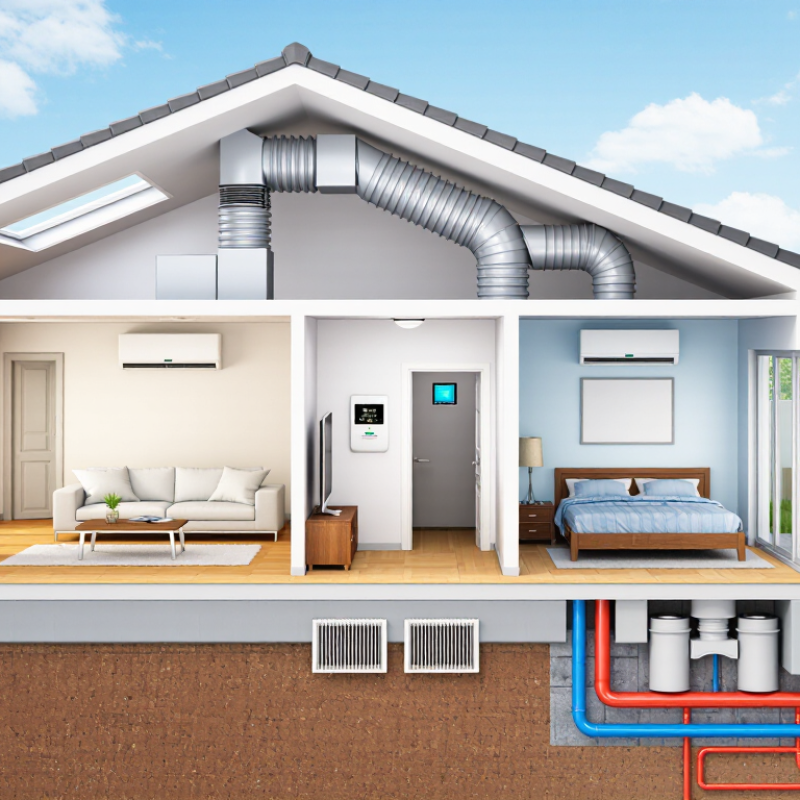
What Are the Top 10 Types of Air Conditioning?

What Defines an Air Conditioning System and Its Main Categories

What Are the Top 10 Types of Air Conditioning?

An air conditioning system moves heat, moisture, and air to create controlled indoor comfort. It normally includes a compressor, condenser, expansion device, evaporator, fan, filters, and controls. The U.S. Department of Energy explains that cooling efficiency depends strongly on equipment design, airflow, insulation, and installation quality. A powerful unit can still perform poorly when ducts leak or filters remain blocked.

The main categories include window, portable, split, multi-split, ducted split, packaged, rooftop, central, evaporative, and variable refrigerant flow systems. Window and portable units suit small spaces with limited installation options. Split and multi-split systems place noisy components outdoors. Ducted and central systems distribute conditioned air through hidden pathways. Packaged and rooftop systems combine major components in one enclosure. Evaporative systems use water and work best in dry climates. Variable refrigerant flow systems adjust refrigerant delivery across several indoor zones.

The distinction matters. Space cooling already uses roughly 10% of global electricity, according to the International Energy Agency’s The Future of Cooling report. The United Nations Environment Programme also projects cooling demand could more than triple by 2050 without stronger efficiency measures. In practice, I assess room size, climate, occupancy, humidity, noise, maintenance access, and electrical capacity before selecting a system. This classification is useful, but imperfect. Real buildings often combine several types. Efficiency ratings alone cannot predict comfort when installation quality is weak.

Central and Distributed Systems: Split, Central, and Packaged Air Conditioners

Air conditioning is easier to understand through system architecture. Split air conditioners place the compressor outdoors and the indoor coil inside. Ductless mini-splits serve individual rooms, while multi-split systems connect several indoor units to one outdoor unit. Variable refrigerant flow systems extend this idea across offices and hotels. They offer zoning, but installation requires careful refrigerant design.

Central air conditioners use one outdoor condensing unit, an indoor coil, and a duct network. They cool several rooms evenly when ducts are sealed and balanced. Poor ducts can quietly waste performance. The U.S. Department of Energy notes that duct losses can exceed 30% of energy consumption in some air-conditioning systems. Chilled-water plants provide another central option, especially for large buildings. Pumps, cooling towers, and air-handling units add complexity. Maintenance becomes a daily engineering task.

Packaged air conditioners combine major components in one cabinet. Rooftop units are common in retail spaces, workshops, and low-rise commercial buildings. They save indoor floor space and simplify replacement. Window units and portable units are smaller packaged systems for limited spaces. The International Energy Agency reports that space-cooling demand could more than triple by 2050 without efficiency improvements. The U.S. Energy Information Administration also found that about 88% of American homes used air conditioning in its 2020 survey. Numbers vary by climate and survey method. That matters. A system that works well in a dry apartment may perform poorly in a humid, poorly insulated building. Efficiency ratings help, but airflow, sizing, and maintenance still decide the real result.

Compact Solutions: Window, Portable, and Ductless Mini-Split Units

Among the ten common air-conditioning types, window, portable, and ductless mini-split units suit homes with limited installation options. Room size, window design, and daily heat exposure matter more than advertised cooling capacity. A window unit sits in an opening and usually cools one enclosed room efficiently. Its exterior side releases heat, while the indoor side pushes chilled air across the room. Measure the window carefully. A narrow gap can create drafts, noise, and water problems.

Portable units stand on the floor and connect to the outside through a hose. They are useful for renters or rooms without suitable windows. However, the hose can warm the surrounding area, especially when window insulation is thin. Some models collect moisture in a tank. That detail is easy to miss. Emptying it may become annoying during humid weather. Keep the exhaust path short and avoid sharp bends, which restrict airflow and increase energy use.

Ductless mini-splits use an outdoor condenser and one or more indoor heads. They often run quietly and provide steadier cooling than portable equipment. Professional sizing and refrigerant-line installation support safe, reliable operation. An oversized unit may cool quickly but leave the room damp. An undersized unit may run continuously on hot afternoons. Clean filters monthly, inspect drainage, and watch for unusual vibration. I still think “compact” can be misleading; the indoor head needs wall space, and the outdoor unit needs clear airflow.

Advanced Designs: Variable Refrigerant Flow and Geothermal Systems

Among the ten major air-conditioning types, variable refrigerant flow and geothermal systems stand apart. They manage energy through smarter heat movement, not simple on-and-off cooling.

A VRF system sends refrigerant through multiple indoor units from one outdoor assembly. Each zone can adjust independently, which suits hotels, offices, and large homes. On a warm afternoon, a quiet meeting room may need cooling while a shaded corridor needs almost none. Heat-recovery designs can move heat from sunny rooms to cooler spaces. However, installation requires accurate pipe sizing, oil-return planning, and careful commissioning. Small errors may cause uneven comfort months later.

Geothermal systems use stable underground temperatures through buried loops. In heating mode, the ground provides a steady heat source; in cooling mode, it accepts unwanted heat. Their seasonal efficiency can be impressive, especially on properties with suitable soil and enough land. Site testing matters. Drilling costs, groundwater conditions, loop layout, and local permits can change the project completely. No design is perfect. A geothermal system may be efficient but impractical on a compact urban lot. VRF may save space yet demand highly skilled servicing. An experienced engineer should compare load calculations, maintenance access, noise targets, and lifetime energy use before choosing either system. Even advanced equipment needs ordinary care: clean filters, verified controls, and documented performance checks.

Specialized Options: Evaporative Coolers and Hybrid Air Conditioning Systems

Among the top 10 types of air conditioning, evaporative coolers stand apart because they use water instead of conventional refrigerant cooling. A fan draws warm air through damp pads, lowering the air temperature before it enters the room. They perform best in dry climates with steady ventilation. In humid weather, cooling can feel weak and uncomfortable.

Not every room benefits. Open windows or exhaust outlets are essential, because evaporative cooling adds moisture indoors. A practical inspection should check water quality, pad condition, drainage, and airflow direction. Mineral deposits can reduce performance and create unpleasant odors. Maintenance is simple, but often neglected. That trade-off matters.

Hybrid air conditioning systems combine two cooling methods, commonly compressor-based cooling and evaporative assistance. Sensors can select the more efficient mode as temperature and humidity change. During a dry afternoon, evaporative cooling may reduce energy use. When humidity rises, mechanical cooling can provide steadier comfort. Hybrid systems sound perfect, but controls must be calibrated carefully. Poor installation may cause frequent switching, uneven temperatures, or unnecessary power consumption. Room size, insulation, local weather, and maintenance access should guide the final choice. A smaller system may struggle during heat waves, while an oversized unit can cycle too quickly and leave damp air behind.

What Are the Top 10 Types of Air Conditioning?

Indicative cooling efficiency comparison using representative coefficient of performance (COP) values under rated operating conditions.

Evaporative coolers can achieve a high thermal COP but require dry climates and water. Hybrid air conditioning systems combine vapor-compression cooling with an additional method, such as evaporative pre-cooling, to improve efficiency when outdoor conditions are suitable. Actual performance varies with climate, equipment size, maintenance, and operating conditions.

Copyright 2025 Fluidra S.A. | Created by BCM Marketing Agencia Privacy Policy Legal note | Cookie policy |

Technical cookies are strictly necessary for our website to work and you can navigate through it. These types of cookies are those that, for example, allow us to identify you, give you access to certain restricted parts of the page if necessary, or remember different options or services already selected by you, such as your privacy preferences. Therefore, they are activated by default, your authorization not being necessary in this regard. Through the configuration of your browser, you can block or alert the presence of this type of cookies, although such blocking will affect the proper functioning of the different functionalities of our website.


The analysis cookies allow us to study the navigation of the users of our website in general (for example, which sections of the page are the most visited, which services are used most and if they work correctly, etc.). From the statistical information on navigation on our website, we can improve both the operation of the page itself and the different services it offers. Therefore, these cookies do not have an advertising purpose, but only serve to make our website work better, adapting to our users in general. By activating them you will contribute to this continuous improvement. You can enable or disable these cookies by checking the corresponding box, being disabled by default.


Functionality cookies allow us to remember your preferences, to personalize certain characteristics and general options of our website, every time you access it (for example, the language in which the information is presented to you, the sections marked as favorites, your browser type, etc.) Therefore, this type of cookies does not have an advertising purpose, but by activating them you will improve the functionality of the website (for example, adapting to your type of browser) and the customization of it based on your preferences (for example, by presenting the information in the language that you have chosen in previous occasions), which will contribute to the ease, usability and comfort of our page during your navigation. You can enable or disable these cookies by checking the corresponding box, being disabled by default.


Advertising cookies allow us to manage the advertising spaces included in our website based on criteria such as the content shown or the frequency in which the ads are displayed. For example, if you have been shown the same ad several times on our website, and you have not shown a personal interest by clicking on it, it will not appear again. In summary, by activating this type of cookies, the advertising shown on our website will be more useful and diverse, and less repetitive. You can enable or disable these cookies by checking the corresponding box, being disabled by default.


Behavioral advertising cookies allow us to obtain information based on the observation of your browsing habits and behaviors on the web, in order to show you advertising content that best suits your personal tastes and interests. To understand it in a very simple way, we will give you a fictitious example: if your last searches on the web were related to suspense literature, we would show you advertising about suspense books. Therefore, activating this type of cookies, the advertising that we show you on our website will not be generic, but will be oriented to your searches, tastes and interests, therefore adjusting exclusively to you. You can enable or disable these cookies by checking the corresponding box, being disabled by default.
To understand it in a very simple way, we will give you a fictitious example: if your last searches on the web were related to suspense literature, we would show you advertising about suspense books. Therefore, activating this type of cookies, the advertising that we show you on our website will not be generic, but will be oriented to your searches, tastes and interests, therefore adjusting exclusively to you. You can enable or disable these cookies by checking the corresponding box, being disabled by default.

SAVE

We use our own and third-party cookies to ensure the proper functioning of the website and to analyse our services, improve your experience on our website and show you advertisements related to your interests according to profiling based on your browsing habits (e.g. websites visited). You can accept all cookies by clicking "ACCEPT" or set or reject them by clicking here. If you would like to know more about the use of cookies, please see our COOKIE POLICY.


ACCEPT ALL
Reject no essentials