
Top Film Coating Machine Manufacturers Worldwide
FLUID HANDLING EXPERTS

Blog, all our news

Top Film Coating Machine Manufacturers Worldwide

Choosing among the Top Film Coating Machine Manufacturers Worldwide requires more than comparing output rates. A coating pan turning under warm exhaust air may look efficient, yet spray uniformity, drying control, and cleaning access determine whether production stays consistent. Buyers should examine batch range, airflow design, automation, service coverage, and documented validation support. Small details matter.

The market context is broad, not machine-specific. Fortune Business Insights’ Pharmaceutical Equipment Market report tracks growth across a wider equipment category; its figures should not be mistaken for Film Coating Machine sales alone. For technical evaluation, the FDA’s Process Validation: General Principles and Practices guidance sets out process design, qualification, and continued verification. These principles help teams assess whether a machine can repeatedly produce the intended coating, rather than merely meet a brochure’s maximum capacity.

Manufacturing-quality expert W. Edwards Deming is often quoted: “Quality comes not from inspection, but from improvement of the production process.” That idea applies directly to coating operations, where inlet temperature, spray rate, and pan speed interact. Still, it is not a substitute for product-specific trials. A machine that performs well with one formulation may behave differently with another. This comparison will examine manufacturers through engineering capability, process control, compliance support, and service—not headline specifications alone. Some public market estimates remain broad; readers should verify equipment-level claims with suppliers and independent documentation.
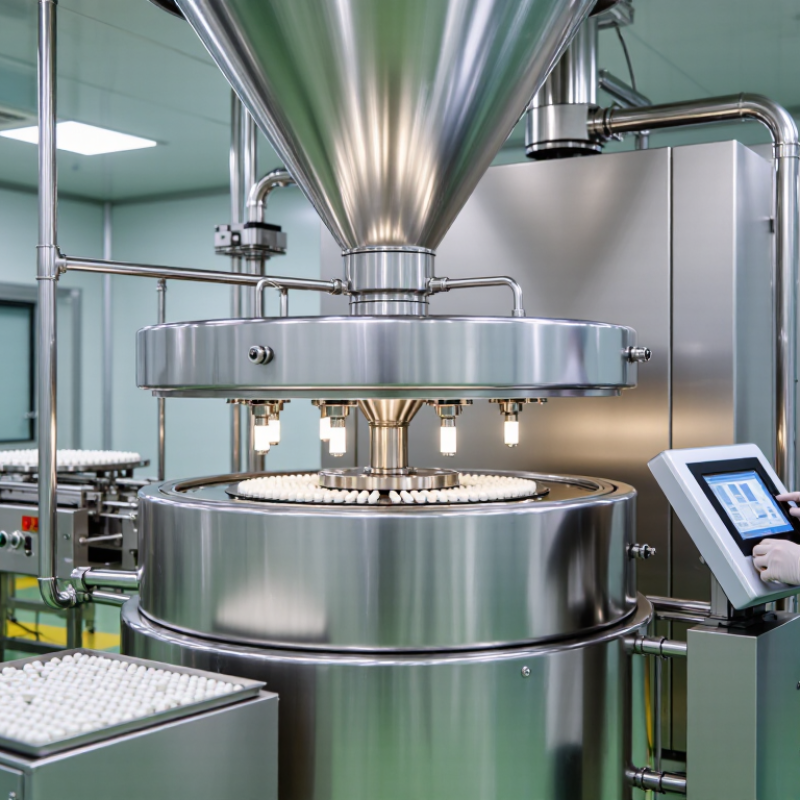
Top Film Coating Machine Manufacturers Worldwide

What Film Coating Machines Are and How They Work

A film coating machine applies a thin, even layer to tablets or other solid dosage forms. In a common design, tablets tumble inside a rotating perforated drum. Warm, filtered air passes through the moving bed, while spray guns atomize a coating liquid onto each surface. The drum’s motion helps expose different sides. Small details matter.

During operation, the operator balances pan speed, spray rate, air temperature, and airflow. If spraying exceeds drying capacity, tablets may stick or develop rough patches. If drying is too rapid, the coating can look uneven. Sensors and process records help teams monitor conditions, but readings still need context. A temperature reading alone may not describe the whole tablet bed.

The coating may protect a tablet, improve its appearance, or help control how it dissolves, depending on the formulation. Operators often check sample tablets for color consistency, surface defects, and weight gain. A brief inspection can catch problems, though it cannot replace validated testing. Real equipment also behaves differently with varying batch sizes and coating liquids. That variation is easy to underestimate.

Major Types of Film Coating Machines

Film coating machines are commonly grouped by how they move and expose a product to coating liquid. Perforated-pan coaters tumble tablets inside a rotating drum while heated air passes through perforations. This supports even drying and gives operators a clear view through the inspection window. Pan speed, spray rate, and inlet-air temperature must work together; changing one can affect the others.

Fluid-bed coaters suspend particles in moving air, then apply coating through spray nozzles. In top-spray systems, droplets coat particles as they circulate. Bottom-spray, or Wurster, systems guide particles through a spray zone for more controlled coverage. Tangential-spray designs rotate particles around a central disk. They can suit pellets, though nozzle placement and airflow need careful adjustment. Small details matter.

Continuous coating machines move tablets through a steady spray-and-dry process rather than treating one batch at a time. They may support consistent output, but setup and process monitoring remain important. A machine type alone does not guarantee a uniform film: product size, formulation, airflow, and drying time all influence results. Even experienced teams may need to refine settings after observing tackiness, color variation, or uneven edges in actual production.

Industries and Applications for Film Coating Equipment

Film coating equipment serves pharmaceutical, packaging, electronics, and renewable-energy production. In tablet plants, perforated pans or fluid-bed coaters apply thin layers that help control moisture, mask taste, or regulate release. Operators monitor spray rate, inlet-air temperature, and tablet movement; uneven airflow can leave mottled surfaces or weak edges. Small details matter.

Flexible packaging uses coated films to improve barriers against oxygen, moisture, or grease. The OECD’s Global Plastics Outlook (2022) reports that the world generated 353 million tonnes of plastic waste in 2019, with only 9% recycled. That figure puts pressure on manufacturers to reduce material use, but thinner films are not automatically more sustainable: coating chemistry, separation, and end-of-life handling also matter. Pilot trials should test the full package, not just a laboratory film.

Coating also supports functional layers in solar modules and electronic components, where uniformity can affect performance and service life. IEA PVPS’s Snapshot of Global PV Markets 2024 estimated 407–446 GW of new photovoltaic capacity in 2023, showing the scale of a sector that depends on reliable manufacturing processes. For equipment selection, compare coating width, drying capacity, line speed, and cleanability against the actual substrate. A fast line is not always a better line. Real production materials can behave differently from supplier samples.

Film Coating Equipment: Industries and Applications Worldwide

Common coating functions across industries. Values are qualitative indicators, not production volumes or market shares.

A value of 1 indicates a commonly established application; 0 indicates it is not a typical core application for that industry. Actual uses vary by product and process.

How to Evaluate Film Coating Machine Manufacturers

Top Film Coating Machine Manufacturers Worldwide

How to Evaluate Film Coating Machine Manufacturers

Choosing a film coating machine manufacturer starts with your process, not a catalogue. Define batch size, coating type, target uniformity, and cleaning needs. Then ask how the proposed pan, spray system, and airflow fit those requirements. A detailed answer should explain operating ranges, not just maximum capacity. Details matter.

Request test data from trials using materials and settings close to your own. Check coating distribution, drying time, and temperature consistency across the bed. Ask for evidence. Review equipment drawings, material specifications, safety features, and records from factory acceptance testing. A polished brochure is not proof of repeatable performance.

Service matters after installation. Clarify training, spare-parts availability, response times, and who supports commissioning. Speak with comparable users, if possible, and ask what required adjustment after startup. The first proposal may not cover every detail; that is a reason to ask more questions, not necessarily to reject the supplier. Compare total operating needs, including cleaning time, utilities, and maintenance access. Watch a live demonstration when practical, and note whether operators can inspect spray patterns and reach key components without awkward workarounds. A low purchase price can look attractive, but assumptions about support or throughput may change the calculation.

Top Film Coating Machine Manufacturers Worldwide - How to Evaluate Film Coating Machine Manufacturers
Evaluation Dimension What to Assess Evidence to Request Why It Matters
Process and product fit Suitability for the intended dosage form, batch size, coating formulation, and production scale. Documented application experience, process-trial results, and a defined product and batch-size range. Coating performance depends on the product, formulation, equipment configuration, and operating conditions.
Coating-pan design Pan geometry, baffles, loading range, access for cleaning, and the available spray and exhaust arrangements. Equipment drawings, operating-range details, and a demonstration or trial using a representative product. Pan and airflow design influence tablet movement, spray exposure, drying, and coating uniformity.
Spray system Nozzle configuration, spray-gun adjustment, atomization controls, and access for inspection and maintenance. Nozzle specifications, setup instructions, maintenance procedures, and trial data for the proposed configuration. Spray conditions affect droplet distribution, deposition, and the risk of defects such as twinning or uneven coating.
Air handling and drying Inlet-air conditioning, airflow control, exhaust handling, and measurement of relevant process conditions. Process-flow diagrams, instrument lists, control descriptions, and operating data from a product trial. Controlled air conditions support solvent or water removal and help maintain a stable coating process.
Automation and data Recipe management, alarm handling, process-parameter recording, user access controls, and data export. Control-system specifications, sample batch records, alarm lists, and a demonstration of the operator interface. Consistent controls and accessible records help operators reproduce processes and investigate deviations.
GMP and validation support Support for qualification, traceable documentation, instrument calibration, and applicable electronic-record requirements. Documentation index, calibration approach, qualification deliverables, and a clear division of responsibilities. Regulated facilities need documented evidence that equipment is installed and operates as intended.
Materials and construction Product-contact materials, surface finish, seals, weld quality, and compatibility with cleaning agents and process conditions. Material certificates, surface-finish information, equipment specifications, and cleaning-compatibility guidance. Suitable construction supports product protection, cleanability, and long-term equipment performance.
Cleaning and changeover Access to product-contact areas, cleaning procedures, removable components, and the time and resources required for changeover. Cleaning instructions, component lists, changeover demonstrations, and any available cleaning-validation support. Practical cleaning design can reduce changeover complexity and help prevent product carryover.
Safety and containment Assessment of dust, solvent, heat, and other process hazards, along with the safeguards appropriate to the application. Risk-assessment documentation, safety-system descriptions, and details of available containment or solvent-handling options. Safety requirements vary by product and process, so protective measures should be confirmed for the specific installation.
Installation and service Installation planning, operator training, spare-parts availability, service response arrangements, and remote-support options. Project schedule, training plan, service terms, recommended spare-parts list, and support coverage details. Reliable commissioning and support can reduce delays during startup and routine production.
Total cost of ownership Purchase price, installation, utilities, consumables, maintenance, cleaning resources, and expected service life. Itemized quotation, utility requirements, maintenance schedule, warranty terms, and lifecycle-cost assumptions. The initial purchase price alone does not show the full cost of operating and maintaining the equipment.
Supplier track record Relevant project history, reference installations, delivery performance, and experience with comparable applications. Customer references, project summaries, acceptance-test records, and examples of similar equipment configurations. Comparable references provide practical evidence of the supplier’s ability to deliver equipment for the intended use.

Leading Film Coating Machine Manufacturers Worldwide

Leading film coating machine manufacturers worldwide are distinguished less by polished catalogs than by repeatable production results. A capable supplier can explain how web tension, drying temperature, coating-gap adjustment, and line speed interact. These details matter when a thin film wrinkles or coating thickness drifts across a roll. Ask for trial data using material close to your own, not just a demonstration sample. Good records help. Operators should be able to review setup ranges, cleaning steps, and inspection points without relying on one engineer’s memory. Some suppliers describe precision broadly; request measurable tolerances and ask how they are verified.

Experienced manufacturers also consider the full production line, including unwinding, drying, rewinding, and inspection. Check whether equipment can handle your film width and target output without making routine adjustments difficult. Service access matters: a sensor hidden behind a guard can turn a small fault into lost production time. Discuss spare-part availability, training, and response arrangements before comparing quotations. If possible, observe a machine running and inspect coated samples under consistent lighting. A visit will not answer everything. Test conditions may differ from your plant, and supplier documentation can leave practical questions unresolved. Record those questions and ask for clear, written answers before selecting a system.

Copyright 2025 Fluidra S.A. | Created by BCM Marketing Agencia Privacy Policy Legal note | Cookie policy |

Technical cookies are strictly necessary for our website to work and you can navigate through it. These types of cookies are those that, for example, allow us to identify you, give you access to certain restricted parts of the page if necessary, or remember different options or services already selected by you, such as your privacy preferences. Therefore, they are activated by default, your authorization not being necessary in this regard. Through the configuration of your browser, you can block or alert the presence of this type of cookies, although such blocking will affect the proper functioning of the different functionalities of our website.


The analysis cookies allow us to study the navigation of the users of our website in general (for example, which sections of the page are the most visited, which services are used most and if they work correctly, etc.). From the statistical information on navigation on our website, we can improve both the operation of the page itself and the different services it offers. Therefore, these cookies do not have an advertising purpose, but only serve to make our website work better, adapting to our users in general. By activating them you will contribute to this continuous improvement. You can enable or disable these cookies by checking the corresponding box, being disabled by default.


Functionality cookies allow us to remember your preferences, to personalize certain characteristics and general options of our website, every time you access it (for example, the language in which the information is presented to you, the sections marked as favorites, your browser type, etc.) Therefore, this type of cookies does not have an advertising purpose, but by activating them you will improve the functionality of the website (for example, adapting to your type of browser) and the customization of it based on your preferences (for example, by presenting the information in the language that you have chosen in previous occasions), which will contribute to the ease, usability and comfort of our page during your navigation. You can enable or disable these cookies by checking the corresponding box, being disabled by default.


Advertising cookies allow us to manage the advertising spaces included in our website based on criteria such as the content shown or the frequency in which the ads are displayed. For example, if you have been shown the same ad several times on our website, and you have not shown a personal interest by clicking on it, it will not appear again. In summary, by activating this type of cookies, the advertising shown on our website will be more useful and diverse, and less repetitive. You can enable or disable these cookies by checking the corresponding box, being disabled by default.


Behavioral advertising cookies allow us to obtain information based on the observation of your browsing habits and behaviors on the web, in order to show you advertising content that best suits your personal tastes and interests. To understand it in a very simple way, we will give you a fictitious example: if your last searches on the web were related to suspense literature, we would show you advertising about suspense books. Therefore, activating this type of cookies, the advertising that we show you on our website will not be generic, but will be oriented to your searches, tastes and interests, therefore adjusting exclusively to you. You can enable or disable these cookies by checking the corresponding box, being disabled by default.
To understand it in a very simple way, we will give you a fictitious example: if your last searches on the web were related to suspense literature, we would show you advertising about suspense books. Therefore, activating this type of cookies, the advertising that we show you on our website will not be generic, but will be oriented to your searches, tastes and interests, therefore adjusting exclusively to you. You can enable or disable these cookies by checking the corresponding box, being disabled by default.

SAVE

We use our own and third-party cookies to ensure the proper functioning of the website and to analyse our services, improve your experience on our website and show you advertisements related to your interests according to profiling based on your browsing habits (e.g. websites visited). You can accept all cookies by clicking "ACCEPT" or set or reject them by clicking here. If you would like to know more about the use of cookies, please see our COOKIE POLICY.


ACCEPT ALL
Reject no essentials


