
How to Choose Stainless Threaded Rod?
FLUID HANDLING EXPERTS

Blog, all our news

How to Choose Stainless Threaded Rod?

Choosing the right Stainless Threaded Rod affects assembly strength, corrosion resistance, and long-term maintenance. A rod may look suitable on a product page, yet its grade, thread accuracy, and surface condition can tell a different story. In practical installation work, small details often create expensive problems. A mismatched nut is one example.

This guide examines the factors professionals check before ordering. Stainless steel grade matters because indoor fixtures, coastal structures, and chemical-processing areas face different exposure levels. Thread size and pitch must match the connected components precisely. Length also deserves attention, since excessive projection can interfere with covers, tools, or moving parts. Load requirements should be reviewed with the complete fastening system, not the rod alone.

The material certificate, manufacturing standard, and supplier inspection process can provide valuable evidence of reliability. However, paperwork should not replace physical verification. Checking the threads, measuring the diameter, and examining scratches can reveal issues before installation. Magnetic response may offer clues, but it cannot confirm the stainless grade by itself. That limitation is easy to overlook.

Real-world conditions remain important. Salt spray, moisture, vibration, heat, and contact with dissimilar metals can change performance over time. Proper washers, compatible nuts, and controlled tightening help reduce avoidable failures. Still, no single product suits every application. The best choice depends on engineering requirements, environmental exposure, and verified product quality. A careful comparison may take longer, but it usually prevents rework, premature replacement, and uncertain safety decisions.
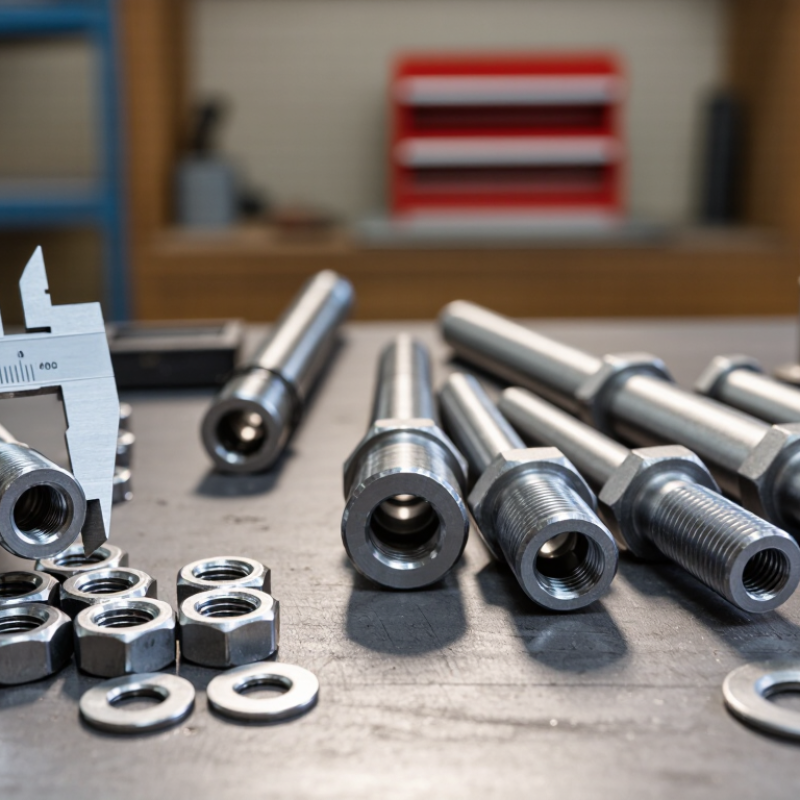
How to Choose Stainless Threaded Rod?

Define the Requirements for a Stainless Threaded Rod

How to Choose Stainless Threaded Rod?

Define the requirements before selecting a stainless threaded rod.

Record the working load, rod length, thread diameter, pitch, and installation method. A rod carrying a light bracket needs different specifications from one supporting vibration or continuous tension. Check the temperature range, too. Heat can reduce strength and accelerate oxidation.

Environment often controls the material choice. Indoor, dry applications may suit a common austenitic stainless grade. Salt spray, coastal air, and chemical washdown usually demand stronger chloride resistance. A molybdenum-bearing grade can perform better than a basic chromium-nickel grade, but it is not immune to pitting.

Corrosion changes everything. The NACE IMPACT study estimated global corrosion costs at US$2.5 trillion annually, equal to about 3.4% of global GDP. That figure makes material selection a design decision, not a purchasing detail.

Specify the required standard and documentation.

ASTM F593 covers stainless steel bolts, screws, studs, and similar fasteners, while related nut requirements appear in ASTM F594. Ask for grade identification, mechanical test results, dimensions, and heat-lot traceability. Match the nut and washer material carefully; incompatible metals may create galvanic corrosion in wet conditions.

Review thread fit after coating, cutting, or bending. Measure twice. In field inspections, specifications sometimes omit pitch or exposure conditions. That omission is easy to miss, and expensive to correct.

The International Stainless Steel Forum reported about 58.4 million tonnes of stainless steel production in 2023, yet stainless products still require application-specific engineering.

Compare Stainless Steel Grades and Corrosion Resistance

How to Choose Stainless Threaded Rod?

Stainless threaded rod is not automatically corrosion-proof. Its grade must match the environment, load, and maintenance conditions. Grade 304 works well in dry interiors, workshops, and general construction. It offers reliable corrosion resistance at a practical cost. However, salt, chlorides, and constant condensation can attack it over time. Moisture changes everything.

Grade 316 contains molybdenum, which improves resistance to chloride corrosion. It is usually a better choice near coastlines, swimming pools, wastewater areas, and chemical exposure. Grade 316L has reduced carbon content, helping limit corrosion around welded areas. For ordinary indoor fastening, this extra protection may be unnecessary. In field inspections, I have seen 304 rods discolor quickly beside salty air, while 316 remained cleaner. Still, no stainless grade should be treated as maintenance-free.

Consider crevices, trapped water, and contact with dissimilar metals. These details often cause problems before the rod itself looks damaged. A threaded rod installed inside a damp cavity may corrode faster than one exposed to rain. Keep threads clean, prevent stagnant water, and use compatible nuts and washers. Grade 410 provides higher hardness but generally less corrosion resistance than 304 or 316. That trade-off is easy to overlook. Check the actual chemical exposure, temperature, and installation method before choosing. A higher grade is not always the best answer.

Select the Correct Diameter, Length, and Thread Standard

Choosing a stainless threaded rod starts with the load, not the catalogue photograph. Diameter controls tensile capacity, bending resistance, and thread engagement. Use the effective tensile stress area, rather than the outside diameter, when estimating strength. ISO 3506-1:2020 specifies minimum tensile strengths of 700 MPa for A2-70 and 800 MPa for A4-80 fasteners. These values support comparison, but they do not replace a project-specific calculation. Corrosion, vibration, temperature, and installation torque can reduce real performance.

Length needs equal attention. Measure the complete assembly, including washers, nuts, spacers, and any required thread projection. Engagement should suit the connected material; soft materials may need longer engagement or a reinforced insert. A neat rule of thumb can mislead. I would recheck the exposed thread after tightening, because a few unused millimetres can affect safety and appearance. Avoid cutting too close to the nut unless the damaged thread can be cleaned properly.

Tips: Match the thread standard before ordering. ISO 965 covers metric screw-thread tolerances, while ASME B1.1 defines unified inch threads. Never assume a “similar” pitch will fit. Count threads with a gauge, then confirm diameter and pitch in millimetres or threads per inch. Also check the rod’s marking and certificate against ISO 3506-1. In practice, selecting A4 stainless steel for marine exposure may be sensible, but the environment still deserves careful review. Mistakes happen at the interface.

Check Strength, Fit, Surface Finish, and Environmental Compatibility

How to Choose Stainless Threaded Rod

Choosing stainless threaded rod requires more than a bright, polished appearance. Strength, fit, surface finish, and environment must work together. In field maintenance, I have seen a clean-looking rod fail because its diameter was selected without checking the joint load. Start with tensile and shear requirements, then consider bending, vibration, and installation length. A corrosion-resistant alloy is not automatically strong enough. Use published mechanical data and seek an engineer’s review for critical loads. Do not guess.

Fit should be checked before ordering a full quantity. Match the rod diameter and thread pitch with the nut, washer, coupler, or anchor. Confirm the thread system, tolerance, and usable thread length. A mismatched pitch may feel acceptable for one turn, then seize or damage both parts. Measure twice. Check straightness and cut-end condition; rough ends can prevent full nut engagement. For repeated assembly, a consistent rolled thread may perform better than a damaged or poorly finished thread. Inspect actual samples.

Surface finish affects handling, installation, and exposure resistance. Smooth threads reduce burrs and make cleaning easier, while excessive polishing cannot correct unsuitable material. In coastal air, chlorides can stain or attack stainless steel. In chemical rooms, identify chemicals, temperature, and moisture cycles before selecting an alloy. Avoid trapping water beneath washers or inside threaded cavities. I would also check for galvanic contact with dissimilar metals. This step is often overlooked. Record the grade, dimensions, test documents, and inspection results for reliable replacement.

Verify Quality, Certifications, and Supplier Reliability

How to Choose Stainless Threaded Rod?

Verify Quality, Certifications, and Supplier Reliability

When selecting stainless threaded rod, quality verification should begin with the material, not the sales description. Ask for the exact stainless grade, diameter tolerance, thread specification, and heat or lot number. A credible supplier should provide a material test report linked to the delivered batch. Check whether its chemical composition matches the stated grade. Small details matter. Examine the rod for uneven threads, deep scratches, discoloration, or flattened ends. These defects may signal poor handling or weak process control.

Certifications need careful reading. A certificate is useful only when its scope, issuing body, standard, and validity can be confirmed. Request documents for the relevant product and production site, rather than accepting a generic PDF. For load-bearing applications, review tensile strength, yield strength, hardness, and corrosion data. Thread gauges and calibrated measuring tools can verify dimensions before installation. In my experience, random sampling catches problems that attractive packaging hides. Still, sampling alone cannot prove every piece is perfect.

Supplier reliability appears through consistent records and practical communication. Ask about inspection procedures, traceability, packaging, lead times, and replacement policies. A dependable supplier answers technical questions directly and admits limits. Be cautious when promises sound absolute. One missed tolerance can delay an entire assembly. Request samples from the intended production route, then compare them with future shipments. Keep inspection records, photographs, and batch documents. That habit makes quality discussions clearer when something goes wrong.

How to Choose Stainless Threaded Rod: Quality, Certifications, and Supplier Reliability

Minimum tensile strength for common stainless steel fastener property classes under ISO 3506-1. Use the grade marking together with material certificates, inspection reports, and supplier traceability when evaluating threaded rod.

A2 generally corresponds to corrosion-resistant stainless steel based on 304, while A4 generally corresponds to 316-type stainless steel with molybdenum for improved resistance in chloride environments. The “70” and “80” property classes indicate minimum tensile strengths of 700 MPa and 800 MPa. Before purchasing, confirm the grade marking, ISO 3506-1 compliance, heat or batch traceability, dimensional inspection results, and a current supplier test certificate.

Copyright 2025 Fluidra S.A. | Created by BCM Marketing Agencia Privacy Policy Legal note | Cookie policy |

Technical cookies are strictly necessary for our website to work and you can navigate through it. These types of cookies are those that, for example, allow us to identify you, give you access to certain restricted parts of the page if necessary, or remember different options or services already selected by you, such as your privacy preferences. Therefore, they are activated by default, your authorization not being necessary in this regard. Through the configuration of your browser, you can block or alert the presence of this type of cookies, although such blocking will affect the proper functioning of the different functionalities of our website.


The analysis cookies allow us to study the navigation of the users of our website in general (for example, which sections of the page are the most visited, which services are used most and if they work correctly, etc.). From the statistical information on navigation on our website, we can improve both the operation of the page itself and the different services it offers. Therefore, these cookies do not have an advertising purpose, but only serve to make our website work better, adapting to our users in general. By activating them you will contribute to this continuous improvement. You can enable or disable these cookies by checking the corresponding box, being disabled by default.


Functionality cookies allow us to remember your preferences, to personalize certain characteristics and general options of our website, every time you access it (for example, the language in which the information is presented to you, the sections marked as favorites, your browser type, etc.) Therefore, this type of cookies does not have an advertising purpose, but by activating them you will improve the functionality of the website (for example, adapting to your type of browser) and the customization of it based on your preferences (for example, by presenting the information in the language that you have chosen in previous occasions), which will contribute to the ease, usability and comfort of our page during your navigation. You can enable or disable these cookies by checking the corresponding box, being disabled by default.


Advertising cookies allow us to manage the advertising spaces included in our website based on criteria such as the content shown or the frequency in which the ads are displayed. For example, if you have been shown the same ad several times on our website, and you have not shown a personal interest by clicking on it, it will not appear again. In summary, by activating this type of cookies, the advertising shown on our website will be more useful and diverse, and less repetitive. You can enable or disable these cookies by checking the corresponding box, being disabled by default.


Behavioral advertising cookies allow us to obtain information based on the observation of your browsing habits and behaviors on the web, in order to show you advertising content that best suits your personal tastes and interests. To understand it in a very simple way, we will give you a fictitious example: if your last searches on the web were related to suspense literature, we would show you advertising about suspense books. Therefore, activating this type of cookies, the advertising that we show you on our website will not be generic, but will be oriented to your searches, tastes and interests, therefore adjusting exclusively to you. You can enable or disable these cookies by checking the corresponding box, being disabled by default.
To understand it in a very simple way, we will give you a fictitious example: if your last searches on the web were related to suspense literature, we would show you advertising about suspense books. Therefore, activating this type of cookies, the advertising that we show you on our website will not be generic, but will be oriented to your searches, tastes and interests, therefore adjusting exclusively to you. You can enable or disable these cookies by checking the corresponding box, being disabled by default.

SAVE

We use our own and third-party cookies to ensure the proper functioning of the website and to analyse our services, improve your experience on our website and show you advertisements related to your interests according to profiling based on your browsing habits (e.g. websites visited). You can accept all cookies by clicking "ACCEPT" or set or reject them by clicking here. If you would like to know more about the use of cookies, please see our COOKIE POLICY.


ACCEPT ALL
Reject no essentials


