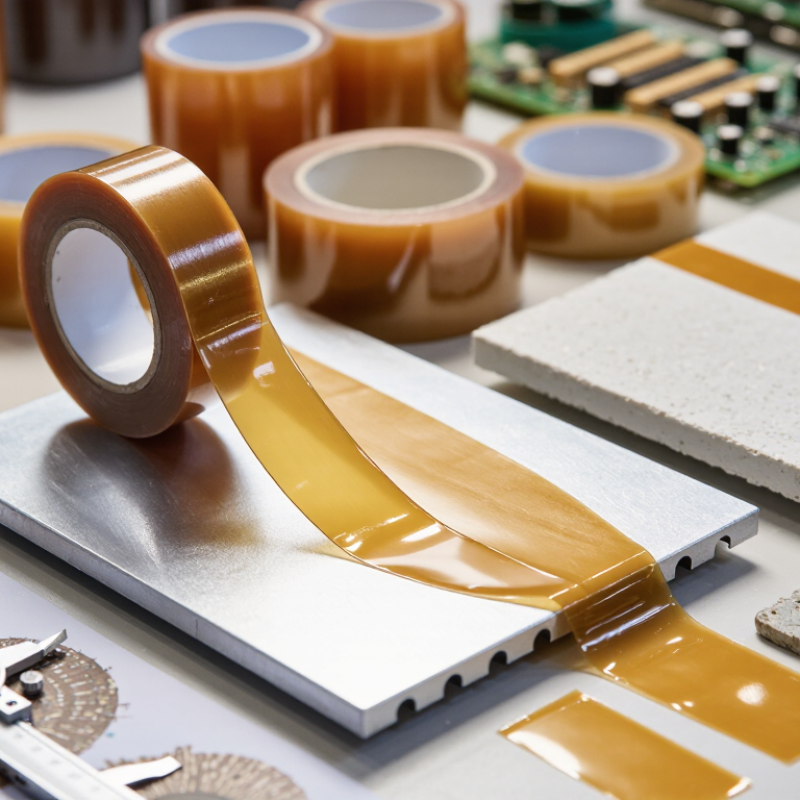
Choosing the right polyimide tape is rarely a simple matter of selecting the highest temperature rating. In practical work, the tape must match the surface, adhesive system, exposure time, and application pressure. A product used for circuit-board masking may perform differently from one used in coil insulation or 3D-printing applications. Small details matter. A smooth aluminum panel, textured polymer surface, and dusty ceramic part can demand different adhesion levels.
Start with the operating conditions. Check continuous and short-term temperature limits, dielectric strength, thickness, tensile strength, and elongation. Heat changes everything. Silicone adhesive often supports clean removal after thermal exposure, while other adhesive systems may suit different bonding requirements. Also examine chemical resistance, edge lifting, residue, and storage conditions. A thin tape may conform beautifully around a sharp corner, yet tear during removal. A thicker grade may protect better but create unwanted steps in a layered assembly.
I have seen teams choose by color and price, then discover residue after curing. That mistake is easy to repeat. A neat appearance does not prove dependable performance. Review technical data sheets from established manufacturers, and request samples for controlled testing. Apply the tape with consistent pressure, expose it to the real temperature cycle, and inspect the surface afterward. Record results, including failures. A small trial can reveal more than a confident product description. The best choice balances performance, process control, availability, and total cost. It should also fit the equipment, materials, and safety procedures used by your team. Manufacturer data helps, but your own test remains essential.
Polyimide Tape: Definition, Structure, and Key Properties
Polyimide Tape: Definition, Structure, and Key Properties
Polyimide tape is a thin, flexible adhesive tape built around a polyimide film. The film provides heat resistance, electrical insulation, and dimensional stability. A silicone adhesive layer usually bonds the tape to metal, plastic, glass, or circuit surfaces.
Its structure matters. A thicker film can improve mechanical protection, while a softer adhesive may conform better to uneven edges. The backing, adhesive, release liner, and coating must work together.
In practical applications, polyimide tape is often used for masking during soldering, protecting wire joints, and insulating electronic components. It can tolerate short periods of high temperature, but exact limits depend on adhesive formulation and exposure time. Do not trust temperature ratings alone. Check peel strength, dielectric performance, tensile strength, and residue after heating. A clean copper board may reveal adhesive transfer that is invisible on a rough surface.
Choosing the right tape requires testing the actual process. Measure the surface temperature, bend radius, contact time, and removal angle. I once treated a high-temperature rating as complete protection; the adhesive still lifted near a sharp corner. That mistake was useful. It showed why sample trials matter more than a specification sheet.
Review technical data, request test reports, and compare results under realistic conditions. No tape is perfect. The best choice balances insulation, adhesion, flexibility, thickness, and clean removal.
Identify the Temperature, Insulation, and Adhesion Requirements
How to Choose the Right Polyimide Tape?
Choosing polyimide tape starts with the actual temperature, not the film’s advertised limit. Many films tolerate high heat, but the adhesive may soften, harden, or leave residue sooner. Check both continuous and short-term temperatures. A circuit exposed to 220°C for ten minutes differs from one operating at 180°C for eight hours. Thermal cycling matters too. Repeated heating and cooling can weaken the bond.
Insulation requirements need equal attention. Identify the voltage, frequency, gap distance, and exposure time. A thin tape may insulate well, yet fail if sharp solder joints pierce it. Measure the required dielectric strength from technical data, then allow a practical safety margin. Adhesion depends on the surface. Clean metal, glass, and smooth plastics behave differently. Remove oil, dust, and moisture before application. Press the tape firmly, especially around corners and uneven edges. Small air pockets can become serious weak points.
Tips: Test a sample on the real surface. Heat it through the expected cycle, then inspect lifting, shrinkage, residue, and edge creep. Try a second tape width if the first one wrinkles. I once treated a clean-looking surface as ready, and the bond failed overnight. That mistake was avoidable. Also review storage conditions, because age and humidity can change performance. No single specification replaces a practical trial.
Compare Polyimide Tape Types, Thicknesses, and Backing Options
How to Choose the Right Polyimide Tape?
Compare Polyimide Tape Types, Thicknesses, and Backing Options
Polyimide tape types suit different electrical and thermal tasks. Standard single-sided tape works well for masking during soldering and powder coating. Antistatic versions can reduce charge buildup near sensitive components. Double-sided constructions help mount lightweight insulation, but they need clean, dry surfaces. Adhesive chemistry matters. Silicone adhesive usually handles high temperatures better than many general-purpose adhesives, though exact limits vary by product.
Thickness affects handling, insulation, and edge coverage. Thin tape conforms closely around small connectors and sharp corners. Thicker tape offers greater puncture resistance and easier removal by hand. A thicker tape is not automatically safer. It may create uneven overlaps or interfere with tight assemblies. Check the film thickness, adhesive thickness, and total thickness separately. These values are often confused.
Backing construction also deserves attention. Smooth polyimide film leaves clean edges and fits narrow spaces. A glass-cloth-backed option resists tearing and abrasion during repeated handling. Release liners can improve die-cutting and placement accuracy. In practical trials, test a short strip on the actual substrate. Apply it to a dusty or textured surface only if the process allows it. Then expose the assembly to its real heat cycle, not merely the advertised maximum temperature. Inspect lifting, residue, shrinkage, and edge curling afterward. Datasheets provide direction, but production conditions can be less forgiving. One overlooked variable is pressure during application. That small detail can change the result.
Evaluate Surface Compatibility, Application Conditions, and Durability
Choosing polyimide tape starts with the surface, not the temperature label. Clean, dry metals usually provide stable adhesion. Powder-coated parts, silicone residues, and textured plastics create weaker contact. In practical trials, I press a short strip firmly, wait 24 hours, then inspect edge lifting. Surface energy matters. A smooth surface may still fail when contaminated.
Application conditions deserve equal attention. Many technical datasheets report polyimide film service ranges near 180–260°C. However, the adhesive often limits real performance. ASTM D1000 evaluates pressure-sensitive tape properties, including adhesion and holding strength. It does not guarantee performance in every assembly. IEC 60216-1 thermal-aging methods also remind engineers to consider exposure time, not temperature alone. Short exposure at 250°C can be safer than continuous exposure at 180°C. That distinction is easy to miss.
Tips:
Match adhesive chemistry to the surface. Test the actual substrate, pressure, dwell time, and heating cycle. Keep overlaps smooth and avoid trapped air. For electrical insulation, verify dielectric strength after thermal aging; typical technical reports cite roughly 5–8 kV per mil for polyimide films, but tape construction changes the result. For durability, check peel strength after humidity, abrasion, and repeated heating. I once treated a high-temperature rating as a complete answer. It was not. The adhesive failed first.
Select the Right Supplier, Specifications, and Quality Standards
How to Choose the Right Polyimide Tape?
Select the Right Supplier, Specifications, and Quality Standards
Choosing polyimide tape starts with the supplier, not the color or price. A reliable supplier should provide traceable production records, current technical data, and consistent communication. Ask where the film and adhesive are manufactured. Request a certificate of analysis for each production lot. Small details matter.
Review the tape’s thickness, tensile strength, elongation, dielectric strength, and temperature range. Adhesive performance also depends on surface energy, pressure, curing time, and application temperature. A tape rated for high heat may still fail on dusty metal or textured plastic. Test it on the actual substrate. Keep the test conditions realistic.
Quality standards need careful interpretation. Check whether the supplier uses documented inspection procedures and calibrated equipment. Depending on the application, request evidence related to electrical insulation, flame behavior, chemical resistance, or restricted substances. ASTM or IEC methods can support comparison, but a standard does not guarantee suitability. The test method, sample size, and failure limits still matter.
Do not trust a perfect datasheet alone. Samples can expose liner wrinkles, uneven adhesive edges, or residue after removal. These issues are easy to miss during a short inspection. A supplier should explain variation instead of hiding it. In practice, I would record peel results, storage conditions, and application pressure before approval. I would also repeat the test after aging, because one early evaluation can be misleading.
How to Choose the Right Polyimide Tape?
Select the right supplier, specifications, and quality standards.
Supplier
Check traceability, batch consistency, technical support, and a quality management system such as ISO 9001.
Specifications
Confirm thickness, adhesive type, operating temperature, dielectric strength, adhesion, tensile strength, and required roll dimensions.
Quality Standards
Use relevant test methods such as ASTM D1000 or IEC 60454 for pressure-sensitive adhesive tapes, and verify product-specific test reports.
The chart shows the thermal classes defined in IEC 60085, from Class B through Class 250. These values are insulation-system reference temperatures, not universal temperature ratings for every polyimide tape. The adhesive system, dwell time, pressure, and application environment must be checked before selection.
Cepex is the brand for the fluid handling market belonging to the Fluidra group. One of the leading european manufacturer of valves and fittings in thermoplastic materials.
Dedicated to the swimming pool, irrigation and industrial markets, we distribute our products worldwide with the Fluidra commercial network and presence in 46 countries with 136 sales branches.
Your data will be processed by CEPEX S.A., with address at C. Lluís Companys, 51-53, 08400, Granollers (Barcelona), and C.I.F. nº A-08928707, to send you communications about our products based on your interests. You can consult more information about the processing of your data and how to exercise your rights as described in the Privacy Policy.
Technical cookies are strictly necessary for our website to work and you can navigate through it. These types of cookies are those that, for example, allow us to identify you, give you access to certain restricted parts of the page if necessary, or remember different options or services already selected by you, such as your privacy preferences. Therefore, they are activated by default, your authorization not being necessary in this regard. Through the configuration of your browser, you can block or alert the presence of this type of cookies, although such blocking will affect the proper functioning of the different functionalities of our website.
The analysis cookies allow us to study the navigation of the users of our website in general (for example, which sections of the page are the most visited, which services are used most and if they work correctly, etc.). From the statistical information on navigation on our website, we can improve both the operation of the page itself and the different services it offers. Therefore, these cookies do not have an advertising purpose, but only serve to make our website work better, adapting to our users in general. By activating them you will contribute to this continuous improvement. You can enable or disable these cookies by checking the corresponding box, being disabled by default.
Functionality cookies allow us to remember your preferences, to personalize certain characteristics and general options of our website, every time you access it (for example, the language in which the information is presented to you, the sections marked as favorites, your browser type, etc.) Therefore, this type of cookies does not have an advertising purpose, but by activating them you will improve the functionality of the website (for example, adapting to your type of browser) and the customization of it based on your preferences (for example, by presenting the information in the language that you have chosen in previous occasions), which will contribute to the ease, usability and comfort of our page during your navigation. You can enable or disable these cookies by checking the corresponding box, being disabled by default.
Advertising cookies allow us to manage the advertising spaces included in our website based on criteria such as the content shown or the frequency in which the ads are displayed. For example, if you have been shown the same ad several times on our website, and you have not shown a personal interest by clicking on it, it will not appear again. In summary, by activating this type of cookies, the advertising shown on our website will be more useful and diverse, and less repetitive. You can enable or disable these cookies by checking the corresponding box, being disabled by default.
Behavioral advertising cookies allow us to obtain information based on the observation of your browsing habits and behaviors on the web, in order to show you advertising content that best suits your personal tastes and interests. To understand it in a very simple way, we will give you a fictitious example: if your last searches on the web were related to suspense literature, we would show you advertising about suspense books. Therefore, activating this type of cookies, the advertising that we show you on our website will not be generic, but will be oriented to your searches, tastes and interests, therefore adjusting exclusively to you. You can enable or disable these cookies by checking the corresponding box, being disabled by default. To understand it in a very simple way, we will give you a fictitious example: if your last searches on the web were related to suspense literature, we would show you advertising about suspense books. Therefore, activating this type of cookies, the advertising that we show you on our website will not be generic, but will be oriented to your searches, tastes and interests, therefore adjusting exclusively to you. You can enable or disable these cookies by checking the corresponding box, being disabled by default.
We use our own and third-party cookies to ensure the proper functioning of the website and to analyse our services, improve your experience on our website and show you advertisements related to your interests according to profiling based on your browsing habits (e.g. websites visited). You can accept all cookies by clicking "ACCEPT" or set or reject them by clicking here. If you would like to know more about the use of cookies, please see our COOKIE POLICY.