
How to Choose Food Wrapping Paper for Your Business?
FLUID HANDLING EXPERTS

Blog, all our news

How to Choose Food Wrapping Paper for Your Business?

Choosing the right Food Wrapping Paper is a practical decision, not merely a branding exercise. The sheet must protect food, support safe handling, and reflect your business identity. A bakery may need grease resistance for warm pastries. A sandwich shop may require stronger paper that withstands moisture and pressure. Small details matter.

Walter Soroka, a respected packaging educator, describes packaging as “the science, art, and technology of enclosing and protecting products for distribution, storage, sale, and use.” His definition remains useful here. Food Wrapping Paper should protect the product while supporting storage, transport, presentation, and customer experience. A printed wrapper that looks attractive but leaks oil can damage trust quickly.

Start by examining the food itself. Is it hot, oily, frozen, acidic, or highly moist? Then check paper weight, coating, folding performance, grease resistance, and heat tolerance. Ask suppliers for product specifications, food-contact documentation, and clear printing details. Test the paper with your actual menu items, not only with water or empty samples. A warm croissant may expose weaknesses that a clean test cannot reveal.

There is no perfect sheet.

Cost also deserves careful thought. The cheapest option may create waste, stains, or repeated customer complaints. Yet an expensive material may offer little practical value. Recyclability claims can be confusing, especially when coatings or food residue are involved. Review supplier evidence and local disposal guidance before making promises. Your first choice may be imperfect. That is normal. Measure performance, listen to staff and customers, then improve the specification.
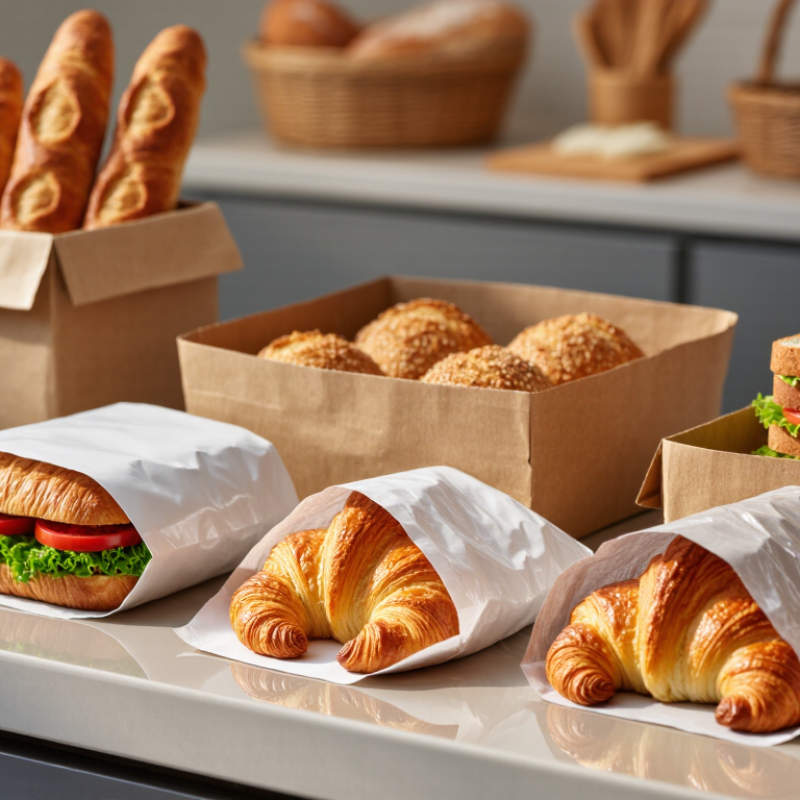
How to Choose Food Wrapping Paper for Your Business?

Define Food-Safety Requirements Under FDA 21 CFR and EU 1935/2004

How to Choose Food Wrapping Paper for Your Business?

Food safety starts with intended use, not a “food-grade” label. Under FDA 21 CFR, paper components must meet applicable requirements, including 21 CFR 176.170 for aqueous or fatty foods and 21 CFR 176.180 for dry foods. Adhesives, inks, coatings, and recycled fibers need separate review. FDA 21 CFR 174.5 also expects safe use under good manufacturing practice. Record the food type, temperature, contact time, and contact area. Small details matter. Hot, oily pastries challenge paper differently than dry sandwiches. Smithers’ 2024 food-packaging analysis also identifies compliance and material performance as major purchasing considerations.

The EU approach is broader. Regulation (EC) No 1935/2004, Article 3, requires materials to avoid harmful migration and unacceptable changes in food. Article 15 covers identification and labeling. Article 16 may require a written Declaration of Compliance. Apply Regulation (EC) No 2023/2006 for good manufacturing practice. Then request migration evidence from the converter. WHO’s Estimates of the Global Burden of Foodborne Diseases reports 600 million illnesses and 420,000 deaths yearly. Wrapping paper is not the only safety control, but it is a real one. A common mistake is accepting a test report without matching its conditions to production. That assumption needs challenging. Ask for lot traceability, test methods, and worst-case scenarios. Paper may look clean. It can still transfer odor, grease, or chemicals.

Match Paper Weight, Strength, and GSM Ranges to Each Food Type

Choosing food wrapping paper starts with the food, not the design. GSM means grams per square metre. It indicates basis weight, but not complete performance. A 30–40 GSM sheet suits dry pastries, cookies, and light bakery items. It folds easily and keeps portions visible. For sandwiches, use about 40–55 GSM, especially when fillings add moisture. A thin sheet can split at the corners. It happens quickly.

Greasy foods need more protection. Burgers, fried chicken, and loaded wraps often perform better with 50–70 GSM grease-resistant paper. A coated or treated surface can reduce oil transfer, but check its food-contact suitability. For hot, heavier servings, 60–90 GSM paper offers better tear resistance and handling strength. Yet thicker is not always better. It may resist folding and increase material use. I once selected a heavy grade for a delicate pastry; the package looked secure, but the customer struggled to open it.

Test paper with the actual portion, temperature, and holding time. Test it hot. Press the wrap around sharp edges and inspect the folded seams. Check wet strength after ten minutes, not just during packing. For dry snacks, 35–45 GSM may be enough; for saucy foods, move toward 60–80 GSM or use an approved barrier structure. Fit matters too. Confirm supplier specifications, migration data, and local food-contact requirements. Real service conditions can expose assumptions. Measure before ordering thousands.

Measure Moisture and Grease Resistance with Cobb60 and Kit Ratings

How to Choose Food Wrapping Paper for Your Business?

Moisture and grease resistance should guide your paper selection. A paper that feels strong may still fail under a hot sandwich. In testing, Cobb60 measures water absorption over 60 seconds. The result is reported in grams per square metre. Lower values generally indicate better resistance. TAPPI T 441 is commonly used for this test. For bakery items, chilled foods, or sauces, compare results under realistic temperatures. A laboratory sample is not the whole story.

Kit ratings measure resistance to grease and oil. TAPPI T 559 uses graded chemical solutions, usually from 1 to 12. Higher ratings suggest stronger grease resistance. However, a high Kit rating does not guarantee complete protection during long contact. Folding, pinholes, printing pressure, and heat can change performance. Test the finished package, not only the paper roll.

This matters because food loss remains substantial. The FAO reports that 13.2% of food is lost between harvest and retail. The UNEP Food Waste Index Report 2024 estimates 1.05 billion tonnes of food waste in 2022. Packaging cannot solve every loss problem, but poor moisture control can worsen quality. In practical trials, place warm food inside the wrap, wait 30 minutes, and inspect the underside. Measure again after refrigeration. I would not rely on one impressive number. Real use is messier.

Assess Printing, Heat Sealing, and Migration Limits for Food Contact

Choosing food wrapping paper is not only a design decision. Printing, heat sealing, and migration control can affect safety and production efficiency.

Start with the printed side. Ask whether ink can set fully before rewinding, cutting, or folding. The European Commission’s 2023 RASFF report identified chemical contamination as a recurring food-safety concern. This supports a practical rule: keep printing inks away from direct food contact whenever possible. Request ink declarations, curing records, and testing for set-off. I once saw a package pass visual inspection but fail after stacked storage. Appearance can mislead.

Heat sealing needs equal attention. Test the paper at the real machine speed, pressure, and temperature. A seal that works in a laboratory may open beside a hot filling line. Check seal strength, peel behavior, and odor after heating. Include worst-case conditions, not only the comfortable settings.

Migration testing should match the actual food. Acidic, fatty, and wet foods can extract different substances. For plastic-coated layers, EU Regulation 10/2011 sets an overall migration limit of 10 mg/dm², while specific substances may have lower limits. Paper itself is not fully harmonized across the European Union, so buyers often review national guidance, such as BfR Recommendation XXXVI. Ask for test reports using suitable simulants, contact time, and temperature. Do not accept “food grade” as complete evidence. It is too vague. Recheck the specification when ink, coating, supplier, or sealing conditions change.

Compare FSC Certification, Recyclability Rates, MOQ, and Total Cost

How to Choose Food Wrapping Paper for Your Business?

FSC certification shows that paper comes from responsibly managed forests. However, it does not automatically mean the wrapping paper is recyclable. Ask for the certificate scope and chain-of-custody details. Also check whether coatings, inks, and adhesives affect recycling. A supplier may claim high recyclability, but local facilities might not accept the material. Request test results or written guidance for your target market. Small details matter, especially when paper touches greasy food.

Compare recyclability rates carefully. “Recyclable” is not the same as “widely recycled.” Ask how the rate was measured and under which conditions. In my purchasing reviews, uncoated paper often created fewer disposal questions. Yet it sometimes absorbed oil and required thicker material. That increased material use. The greener option was not always the thinnest one.

MOQ can change your total cost quickly. A low unit price may require thousands of sheets and expensive storage. Include printing setup, tooling, freight, inspection, damaged stock, and disposal fees. Calculate the cost per usable wrap, not per printed sheet. A simple spreadsheet helps. I once preferred a cheaper quote, then noticed its oversized cartons consumed valuable warehouse space. That decision looked efficient on paper, but it was not. Ask for a small trial order when possible. Measure wrapping speed, leakage, paper waste, and customer handling before committing to a large MOQ.

How to Choose Food Wrapping Paper for Your Business?

Comparison of FSC certification pathways, material-level recyclability, minimum order quantity efficiency, and relative total cost.

Uncoated paper generally offers the simplest recycling route and lowest procurement cost. Water-based coatings can improve grease resistance while preserving more recycling options than plastic or foil laminates. FSC certification applies to the responsible sourcing and traceability of fiber, while actual recycling performance depends on local collection systems and the final package structure. MOQ and cost figures are non-brand planning benchmarks and should be confirmed with supplier quotations.

Reference basis: FSC Chain of Custody principles and public paper-packaging recycling guidance. Recyclability values are indicative material-level benchmarks; MOQ efficiency is scored inversely from benchmark order quantities.

Copyright 2025 Fluidra S.A. | Created by BCM Marketing Agencia Privacy Policy Legal note | Cookie policy |

Technical cookies are strictly necessary for our website to work and you can navigate through it. These types of cookies are those that, for example, allow us to identify you, give you access to certain restricted parts of the page if necessary, or remember different options or services already selected by you, such as your privacy preferences. Therefore, they are activated by default, your authorization not being necessary in this regard. Through the configuration of your browser, you can block or alert the presence of this type of cookies, although such blocking will affect the proper functioning of the different functionalities of our website.


The analysis cookies allow us to study the navigation of the users of our website in general (for example, which sections of the page are the most visited, which services are used most and if they work correctly, etc.). From the statistical information on navigation on our website, we can improve both the operation of the page itself and the different services it offers. Therefore, these cookies do not have an advertising purpose, but only serve to make our website work better, adapting to our users in general. By activating them you will contribute to this continuous improvement. You can enable or disable these cookies by checking the corresponding box, being disabled by default.


Functionality cookies allow us to remember your preferences, to personalize certain characteristics and general options of our website, every time you access it (for example, the language in which the information is presented to you, the sections marked as favorites, your browser type, etc.) Therefore, this type of cookies does not have an advertising purpose, but by activating them you will improve the functionality of the website (for example, adapting to your type of browser) and the customization of it based on your preferences (for example, by presenting the information in the language that you have chosen in previous occasions), which will contribute to the ease, usability and comfort of our page during your navigation. You can enable or disable these cookies by checking the corresponding box, being disabled by default.


Advertising cookies allow us to manage the advertising spaces included in our website based on criteria such as the content shown or the frequency in which the ads are displayed. For example, if you have been shown the same ad several times on our website, and you have not shown a personal interest by clicking on it, it will not appear again. In summary, by activating this type of cookies, the advertising shown on our website will be more useful and diverse, and less repetitive. You can enable or disable these cookies by checking the corresponding box, being disabled by default.


Behavioral advertising cookies allow us to obtain information based on the observation of your browsing habits and behaviors on the web, in order to show you advertising content that best suits your personal tastes and interests. To understand it in a very simple way, we will give you a fictitious example: if your last searches on the web were related to suspense literature, we would show you advertising about suspense books. Therefore, activating this type of cookies, the advertising that we show you on our website will not be generic, but will be oriented to your searches, tastes and interests, therefore adjusting exclusively to you. You can enable or disable these cookies by checking the corresponding box, being disabled by default.
To understand it in a very simple way, we will give you a fictitious example: if your last searches on the web were related to suspense literature, we would show you advertising about suspense books. Therefore, activating this type of cookies, the advertising that we show you on our website will not be generic, but will be oriented to your searches, tastes and interests, therefore adjusting exclusively to you. You can enable or disable these cookies by checking the corresponding box, being disabled by default.

SAVE

We use our own and third-party cookies to ensure the proper functioning of the website and to analyse our services, improve your experience on our website and show you advertisements related to your interests according to profiling based on your browsing habits (e.g. websites visited). You can accept all cookies by clicking "ACCEPT" or set or reject them by clicking here. If you would like to know more about the use of cookies, please see our COOKIE POLICY.


ACCEPT ALL
Reject no essentials