
Why Choose CNC Devices for Precision Manufacturing?
FLUID HANDLING EXPERTS

Blog, all our news

Why Choose CNC Devices for Precision Manufacturing?

Cnc Devices turn digital designs into repeatable physical parts. Their value becomes clear when a component needs a precise bore, a flat mating surface, or several holes aligned within tight tolerances. A calibrated machine can follow the same toolpath across a production run, reducing variation between parts. Small errors still matter.

W. Edwards Deming, a manufacturing quality expert, is often credited with the observation: “Quality comes not from inspection, but from improvement of the production process.” That principle helps explain why choosing Cnc Devices involves more than comparing spindle speeds or price tags. Buyers should examine machine rigidity, controller capability, tool condition, calibration routines, and the materials they plan to cut. A lightweight machine may perform well on aluminum yet struggle with tougher alloys. The details matter.

Good equipment does not guarantee perfect results. Setup, operator skill, maintenance, and measurement methods all influence the finished part. A shop might machine a shaft, measure it with a micrometer, then discover that heat or tool wear shifted the final dimension. That is frustrating, but useful. It reveals where the process needs attention. This guide explores how CNC devices support precision manufacturing, what features deserve close review, and where their limitations should shape purchasing decisions. The goal is not to promise flawless output. It is to help manufacturers make more informed choices and build a process they can verify, refine, and trust.
Why Choose CNC Devices for Precision Manufacturing?

What CNC Devices Are and How They Work

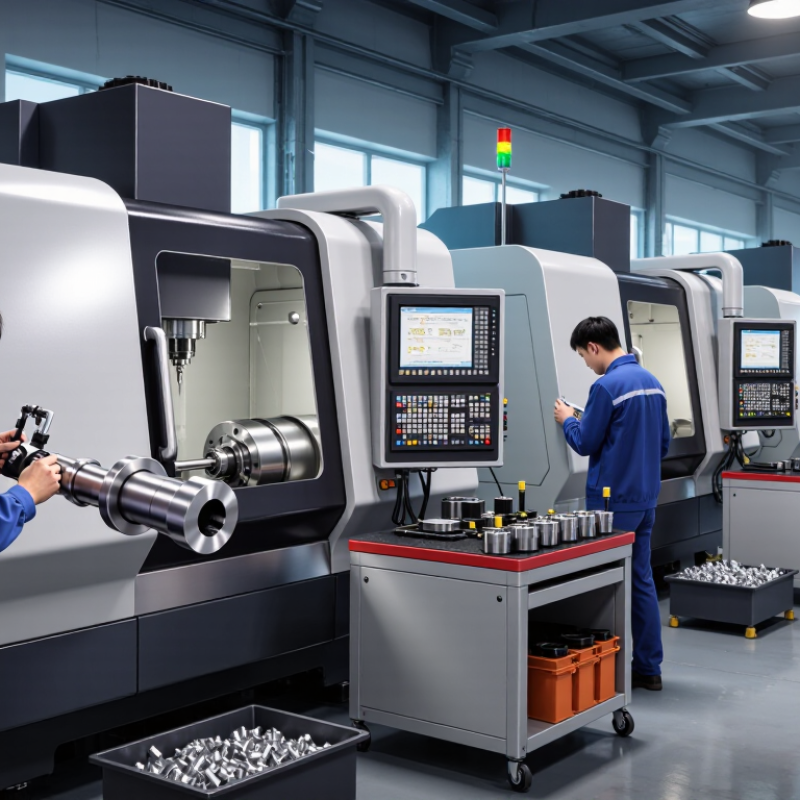
CNC devices are machine tools guided by a computer numerical control system. Common examples include mills, lathes, routers, and grinders. Each has a controller, motors, a spindle, cutting tools, and a way to hold the workpiece. Small details matter: a loose clamp can spoil an otherwise accurate cut.

A part’s digital design is translated into toolpaths, often through CAM software. The controller reads machine instructions, commonly G-code or a controller-specific format, then coordinates axis movement, spindle speed, and feed rate. Motors move the tool or workpiece while feedback sensors help track position. The cutter removes material in measured passes. It is not magic. Tool wear, heat, vibration, and setup errors can still shift dimensions, so operators check parts with gauges or measuring instruments.

Automation is expanding around these processes. The International Federation of Robotics’ World Robotics 2024 report counted 4,281,585 industrial robots operating worldwide in 2023. That figure covers robots, not CNC machines, but it shows the scale of factory automation. CNC equipment may work alongside robots that load parts or move finished components. A useful reality check: a precise program cannot fix a poor setup. The first cut often teaches something the screen cannot.

How CNC Machining Achieves High Precision

Why Choose CNC Devices for Precision Manufacturing?
How CNC Machining Achieves High Precision

CNC machining turns a digital toolpath into controlled movements, but precision depends on more than the program. A rigid setup, sharp tool, and securely clamped workpiece help prevent vibration and movement. Even a small amount of tool runout can leave a visible mark or push a bore outside its specified size. Small changes matter.

Operators also manage heat. Cutting warms both the tool and workpiece, causing slight expansion that can affect measurements. A careful process may include probing, tool-wear offsets, and checks with a micrometer or coordinate-measuring machine. Still, a machine’s repeatability is not the same as accuracy. A process can repeat the same incorrect dimension.

ISO 286-1:2010 defines 20 standard IT tolerance grades for limits and fits, giving engineers a shared way to specify dimensional requirements. Those grades do not guarantee that every machine or material can meet a particular tolerance; testing the actual setup matters. Deloitte and MAPI’s 2024 Smart Manufacturing Survey found that 86% of surveyed manufacturers viewed smart-manufacturing solutions as future competitiveness drivers. Digital monitoring can help flag drift, but it cannot replace sound fixturing and measurement. That distinction is easy to overlook.

Key Benefits of CNC Devices in Manufacturing

CNC devices turn digital instructions into repeatable cutting, drilling, and milling movements. That consistency helps manufacturers hold tight dimensions across a production run. A machined aluminum bracket, for example, can keep its hole spacing stable from the first part to the hundredth. Less variation means fewer fitting problems during assembly. It also makes inspection easier. Operators can compare measured parts against the same drawing and adjust offsets when readings drift. Small differences still matter.

Automated tool paths can produce slots, curved surfaces, and patterns that are difficult to machine consistently by hand. Once a job is set up, the machine can repeat it with limited manual intervention. Skilled workers can monitor quality, prepare tools, or support another operation. This can shorten lead times, especially for parts with many repeated features.

Yet CNC equipment is not a guarantee of accuracy. A worn cutter, poor workholding, or incorrect program can spoil a batch quickly. Material behavior can be less predictable than the drawing suggests. Regular calibration, sound fixturing, and in-process checks remain essential. Setup takes practice.

Industries That Rely on CNC Precision

Why Choose CNC Devices for Precision Manufacturing?

Industries That Rely on CNC Precision

Aerospace shops machine turbine components, brackets, and housings where a small mismatch can complicate assembly. Medical manufacturers use CNC machining for surgical instruments and durable device components. Automotive and electronics suppliers also depend on repeatable parts, from transmission fixtures to compact heat sinks. Small errors matter. Yet CNC is not a cure-all: a worn tool or incorrect setup can repeat the same defect across an entire batch.

The International Federation of Robotics’ World Robotics 2024 report recorded 541,302 industrial robot installations worldwide in 2023. Automotive accounted for 25% of installations, while electrical and electronics accounted for 23%. These figures describe robot installations, not CNC use; they do, however, show how heavily these sectors rely on precise, automated production. CNC machining helps create robot components, production fixtures, and replacement parts that must fit consistently.

Tip: Match the machining process to the part’s function. Check material, tolerance, and surface-finish requirements before programming, then inspect the first piece with calibrated measuring tools. Keep a record of tool wear and setup changes. That step is easy to skip on a busy shift, but it can reveal why later parts drift from spec.

Factors to Consider When Choosing CNC Equipment

Why Choose CNC Devices for Precision Manufacturing?

Factors to Consider When Choosing CNC Equipment

Choosing CNC equipment starts with the part, not the machine’s advertised speed. List the materials, tolerances, batch sizes, and operations you actually expect. A compact mill may suit small aluminum housings, while long shafts need more reach and support. Check spindle power, tool capacity, axis travel, and workholding against your largest regular job. Measure twice. For tight tolerances, ask how thermal drift and vibration are monitored during a full shift. Peak cutting speed is easy to overvalue; it says little about consistency across a long run.

Control software matters just as much. Operators should be able to set offsets, check tool paths, and recover safely after a stopped cycle. Request a demonstration using a representative part, then inspect its finish and repeatability across several runs. Compare installation needs too: floor space, electrical supply, coolant handling, extraction, and service access. These can outweigh a faster cutting rate. Training and maintenance need realistic estimates; missed calibration can quietly spoil good-looking parts. No machine fits every workflow, and some unused capacity may be preferable to complexity that rarely earns its keep. It is worth reviewing that assumption as production changes.

Why Choose CNC Devices for Precision Manufacturing?

Typical achievable tolerance ranges by process (± micrometers). Use these as general guidance: actual results depend on material, part geometry, machine condition, tooling, and setup.

When selecting CNC equipment, compare the required tolerance with the process capability, then consider workpiece size, materials, production volume, and setup requirements.

Article Source:

Copyright 2025 Fluidra S.A. | Created by BCM Marketing Agencia Privacy Policy Legal note | Cookie policy |

Technical cookies are strictly necessary for our website to work and you can navigate through it. These types of cookies are those that, for example, allow us to identify you, give you access to certain restricted parts of the page if necessary, or remember different options or services already selected by you, such as your privacy preferences. Therefore, they are activated by default, your authorization not being necessary in this regard. Through the configuration of your browser, you can block or alert the presence of this type of cookies, although such blocking will affect the proper functioning of the different functionalities of our website.


The analysis cookies allow us to study the navigation of the users of our website in general (for example, which sections of the page are the most visited, which services are used most and if they work correctly, etc.). From the statistical information on navigation on our website, we can improve both the operation of the page itself and the different services it offers. Therefore, these cookies do not have an advertising purpose, but only serve to make our website work better, adapting to our users in general. By activating them you will contribute to this continuous improvement. You can enable or disable these cookies by checking the corresponding box, being disabled by default.


Functionality cookies allow us to remember your preferences, to personalize certain characteristics and general options of our website, every time you access it (for example, the language in which the information is presented to you, the sections marked as favorites, your browser type, etc.) Therefore, this type of cookies does not have an advertising purpose, but by activating them you will improve the functionality of the website (for example, adapting to your type of browser) and the customization of it based on your preferences (for example, by presenting the information in the language that you have chosen in previous occasions), which will contribute to the ease, usability and comfort of our page during your navigation. You can enable or disable these cookies by checking the corresponding box, being disabled by default.


Advertising cookies allow us to manage the advertising spaces included in our website based on criteria such as the content shown or the frequency in which the ads are displayed. For example, if you have been shown the same ad several times on our website, and you have not shown a personal interest by clicking on it, it will not appear again. In summary, by activating this type of cookies, the advertising shown on our website will be more useful and diverse, and less repetitive. You can enable or disable these cookies by checking the corresponding box, being disabled by default.


Behavioral advertising cookies allow us to obtain information based on the observation of your browsing habits and behaviors on the web, in order to show you advertising content that best suits your personal tastes and interests. To understand it in a very simple way, we will give you a fictitious example: if your last searches on the web were related to suspense literature, we would show you advertising about suspense books. Therefore, activating this type of cookies, the advertising that we show you on our website will not be generic, but will be oriented to your searches, tastes and interests, therefore adjusting exclusively to you. You can enable or disable these cookies by checking the corresponding box, being disabled by default.
To understand it in a very simple way, we will give you a fictitious example: if your last searches on the web were related to suspense literature, we would show you advertising about suspense books. Therefore, activating this type of cookies, the advertising that we show you on our website will not be generic, but will be oriented to your searches, tastes and interests, therefore adjusting exclusively to you. You can enable or disable these cookies by checking the corresponding box, being disabled by default.

SAVE

We use our own and third-party cookies to ensure the proper functioning of the website and to analyse our services, improve your experience on our website and show you advertisements related to your interests according to profiling based on your browsing habits (e.g. websites visited). You can accept all cookies by clicking "ACCEPT" or set or reject them by clicking here. If you would like to know more about the use of cookies, please see our COOKIE POLICY.


ACCEPT ALL
Reject no essentials


