
How to Choose 304 Stainless Steel Cookware for Wholesale?
FLUID HANDLING EXPERTS

Blog, all our news

How to Choose 304 Stainless Steel Cookware for Wholesale?

Choosing 304 Stainless Steel Cookware for wholesale requires more than comparing prices and polished product photos. Buyers must examine material quality, manufacturing consistency, performance, and supplier reliability. A dependable pan should show an even finish, stable handles, secure rivets, and a lid that closes without excessive movement. Small details matter. During supplier evaluations, inspect samples under bright light and check for rough edges, uneven welds, or discoloration around the base.

304 Stainless Steel Cookware is widely selected because it offers strong corrosion resistance and practical durability for everyday kitchens. However, “304” alone does not guarantee excellent cookware. Ask for material documentation, production records, and suitable food-contact testing from credible laboratories. Check whether the body thickness matches the listed specification. A thin saucepan may look attractive, yet it can heat unevenly and dent during transport. An induction-compatible base should also be tested on the intended cooktops, not merely described in a catalog.

Wholesale decisions should include minimum order quantities, packaging strength, replacement policies, and delivery reliability. Request several samples from different production batches when possible. This reveals whether quality remains stable over time. Supplier audits can provide stronger evidence than promises. Still, no checklist is perfect. Even experienced buyers can overlook packaging damage or minor dimensional changes. Keep written inspection standards, photograph accepted samples, and confirm every critical detail before production. A careful process protects margins, customer trust, and long-term brand reputation.
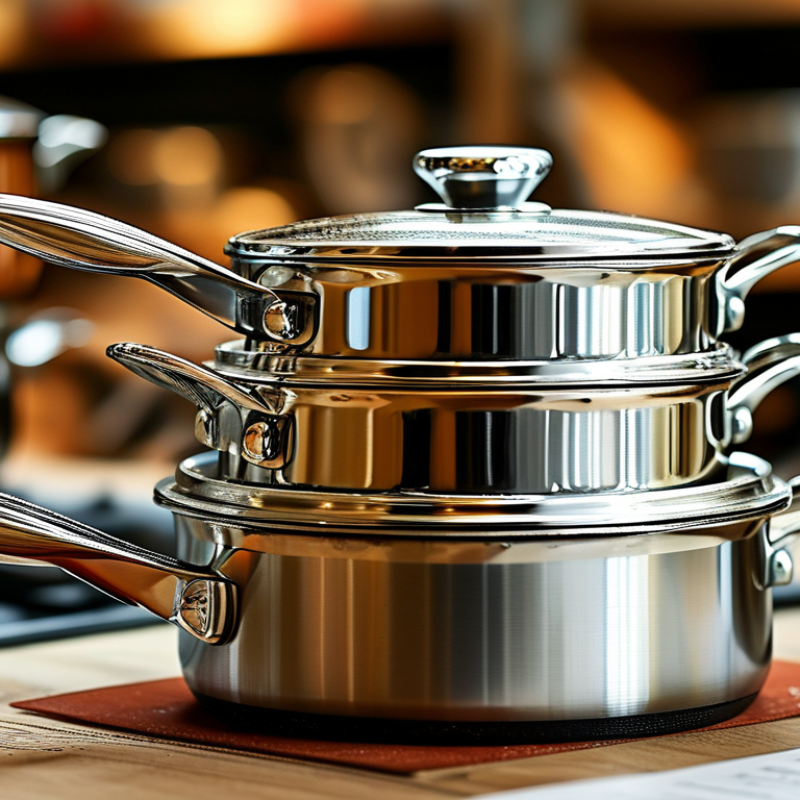
How to Choose 304 Stainless Steel Cookware for Wholesale?

Understanding 304 Stainless Steel and Its Cookware Advantages

How to Choose 304 Stainless Steel Cookware for Wholesale?

304 stainless steel is more than a “rust-resistant” label. Its typical composition includes about 18% chromium and 8% nickel. Chromium forms a passive oxide film that helps protect the surface during daily cooking. Nickel improves corrosion resistance and supports a smoother, less reactive cooking surface. The Nickel Institute’s technical guidance identifies 304 as a common food-contact stainless grade. It is widely used for pots, pans, bowls, and commercial kitchen equipment.

Supply is substantial. The International Stainless Steel Forum reported 58.4 million tonnes of global stainless crude steel production in 2023. This supports broad sourcing and stable fabrication capacity. However, market volume does not prove cookware quality. Buyers should request material certificates, thickness measurements, weld inspection records, and surface-finish details.

A bright surface can hide weak forming or uneven heat distribution. Check the base construction carefully. A bonded aluminum core usually spreads heat better than a thin single-layer base.

304 performs well with water, oils, and many acidic foods. Salt can still cause pitting, especially when residue dries on the surface. That detail is easy to overlook.

I would not promise “corrosion-proof” cookware. It is an attractive shortcut, but technically inaccurate.

For wholesale evaluation, test sample pieces with realistic washing, heating, and stacking conditions. Also verify handle joints, rim strength, lid fit, and compatibility with the intended cooktops. 304 is dependable, but manufacturing discipline decides the final experience.

Evaluating Cookware Construction, Thickness, and Heat Distribution

Wholesale buyers should inspect three linked variables: construction, thickness, and heat distribution. 304 stainless steel resists corrosion, but it conducts heat poorly. ASM Handbook, Volume 2, reports approximately 16.2 W/m·K at 20°C for 304 stainless steel. That is far below aluminum, so a single-layer 304 pan may create hot rings. Not ideal.

A bonded aluminum or copper core spreads heat beneath the cooking surface. For many stock programs, a 0.6–0.8 mm 304 wall balances rigidity and material cost. A 3–5 mm encapsulated base can reduce scorching on gas and electric stoves. These figures are practical starting points, not universal rules. Pan diameter, induction compatibility, and handle weight still change performance.

Ask suppliers for cross-section photos, alloy certificates, and thickness tolerances. ASTM A240 defines requirements for 304 stainless sheet and plate. It does not prove even heating. That distinction matters. Test a sample batch, not one polished showroom piece. Fill each pan with one liter of water, then measure center and edge temperatures after five minutes. A thermocouple grid is more reliable than infrared readings on reflective steel. The International Stainless Steel Forum reported 58.4 million tonnes of stainless crude steel production in 2023. Large supply does not guarantee consistent cookware construction. Reject samples with rocking bases, exposed cores, or uneven rivet contact. This process feels slow. It is cheaper than returns.

How to Choose 304 Stainless Steel Cookware for Wholesale? - Evaluating Cookware Construction, Thickness, and Heat Distribution
Cookware Construction Typical Total Thickness Typical Material Structure Heat Distribution Durability and Weight Wholesale Evaluation Focus Recommended Use
Single-layer 304 stainless steel 0.6–1.0 mm 304 stainless steel only; thermal conductivity is approximately 16 W/m·K at room temperature. Low to moderate Lightweight and corrosion-resistant, but more susceptible to hot spots and warping when the base is thin. Check base flatness, rim strength, handle attachment, and whether the product is intended for low-to-medium heat. Stockpots, steamers, inserts, and budget-oriented items.
Impact-bonded aluminum-base construction 1.5–3.0 mm total base thickness 304 stainless steel body with an aluminum heat-spreading disc bonded to the underside. Moderate to high Good balance of cost, weight, and heating performance; the bond quality is critical. Verify disc diameter, bonding uniformity, base flatness, and resistance to separation after thermal cycling. Fry pans, saucepans, sauté pans, and entry-level commercial cookware.
Three-layer clad construction 2.5–3.2 mm total wall thickness 304 stainless steel interior and exterior with an aluminum core extending across the base and sidewalls. High and consistent More responsive and evenly heated than single-layer designs; moderately heavier and more expensive. Confirm continuous sidewall cladding, layer bonding, edge finishing, and dimensional consistency between batches. Premium frying pans, saucepans, sauté pans, and general-purpose cookware sets.
Five-layer clad construction 3.0–4.5 mm total wall thickness Alternating stainless-steel and aluminum layers, usually with a 304 stainless-steel cooking surface. High, with strong heat retention Rigid and durable, but heavier and generally more costly than three-layer products. Assess actual layer thickness, total weight, handle ergonomics, edge sealing, and packaging strength. High-end cookware, professional kitchens, and premium wholesale programs.
Copper-core clad construction 2.5–4.0 mm total wall thickness 304 stainless steel cooking surface with an internal copper layer, often combined with aluminum layers. Very high responsiveness Excellent thermal response; higher material cost and weight may limit mass-market suitability. Verify copper-layer continuity, weld or bond quality, induction compatibility, and protection against exposed-core damage. Specialty cookware and premium culinary applications.
Thick encapsulated base 2.0–5.0 mm base thickness; thinner sidewalls 304 stainless steel body with a multi-metal base attached or formed beneath the cooking surface. High at the base; moderate on sidewalls Stable on flat cooktops and efficient for bottom-heated recipes; sidewall heating is less uniform than full cladding. Measure base coverage, inspect the transition between base and sidewall, and test for rocking on a flat surface. Stockpots, casseroles, saucepans, and induction-compatible wholesale ranges.
Purchasing notes: 304 stainless steel provides good corrosion resistance and is commonly used for food-contact cookware, but stainless steel itself transfers heat less efficiently than aluminum or copper. For wholesale comparison, request measured thickness and weight data, inspect the flatness of the base, confirm the cladding or bonding method, and test temperature uniformity using the same burner setting and pan size. Actual performance varies with diameter, burner power, layer thickness, and manufacturing tolerances.

Checking Safety, Compatibility, and Product Quality Standards

How to Choose 304 Stainless Steel Cookware for Wholesale?

When checking 304 stainless steel cookware, ask for material records, not attractive claims. A reliable supplier should provide composition reports, food-contact declarations, and batch traceability. The steel should resist common acids, salt, and moisture during normal cooking. Still, “304” alone does not prove a safe finished product. Inspect the inner surface, welds, rivets, and polishing quality. Rough seams can trap food residue and complicate cleaning. A clean edge matters.

I have found that small samples reveal problems earlier than catalog photographs. Fill a saucepan with water, heat it, and examine the handle connection afterward. Check for loose parts, discoloration, sharp edges, or unusual odors from attached components. A polished surface can fool me. It is not a complete quality test. Ask for migration testing and independent inspection records when available. Documentation should match the actual production batch.

Compatibility also affects wholesale returns. Confirm whether each item works on induction, gas, electric, and ceramic cooktops. Test the base for flatness after heating and cooling. Ask about oven limits, dishwasher use, lid materials, and handle temperature resistance. Some cookware looks universal but performs poorly on induction. Packaging should protect rims and prevent scratches during transport. Sample testing takes time, but skipping it can create expensive surprises.

Comparing Suppliers, Customization Options, Pricing, and Order Terms

How to Choose 304 Stainless Steel Cookware for Wholesale?

Supplier selection should begin with traceable material, not a low quotation. World Stainless reported global stainless steel production of about 58.4 million tonnes in 2023. This scale does not guarantee consistent 304 quality. Request a heat number, material certificate, and third-party PMI test. Check wall thickness, flatness, weld quality, and food-contact documentation. Inspect samples under strong light. Uneven polishing often appears before production problems.

Customization changes the real cost. Ask whether tooling, engraving, handle design, lid fitting, and packaging are included. A smaller batch may need higher tooling fees. Compare the same specification across suppliers: 1.0 mm thickness, mirror or satin finish, induction compatibility, and carton protection. Pricing should show steel weight, labor, tooling, inspection, freight, and payment fees separately. The International Stainless Steel Forum’s market data shows stainless demand remains sensitive to energy and raw-material costs. Therefore, a quote should include its validity period. Some buyers overlook this detail.

Tips: Set a written approval sample. Define acceptable scratches and dimensional tolerance. Confirm MOQ, lead time, payment stages, Incoterms, inspection rights, and replacement terms. Ask for production photos and a packing test. Do not rely on certificates alone. They can be genuine, but incomplete. A small pilot order may cost more per unit, yet it can expose weak handles or warped bases before a large commitment. Be careful with promises of “customization at no cost”; the expense may simply move into the unit price.

Inspecting Samples and Establishing Wholesale Quality Control

How to Choose 304 Stainless Steel Cookware for Wholesale?

Inspecting samples is where wholesale quality control becomes practical. The International Stainless Steel Forum reported about 58.4 million tonnes of global stainless steel production in 2023. That scale makes traceability important, even for small cookware orders. Ask suppliers for heat numbers, material certificates, and production records. Confirm that the body uses 304 stainless steel, rather than relying on a polished appearance. A bright surface proves almost nothing.

Compare samples under consistent conditions. Check wall thickness at the rim, base, and sidewall with a micrometer. Measure handle alignment and test rivets for movement. Examine welds closely. They should be smooth, clean, and free from visible pinholes.

ASTM A240/A240M can guide verification of stainless flat-rolled material, but it does not replace finished-product inspection. The sample must still perform on a burner. Test heating, deformation, lid fit, and cleaning resistance.

Quality teams can use ISO 2859-1 for lot sampling and acceptance criteria. Keep photos, measurements, and defect records for every batch. Critical defects need zero acceptance. Cosmetic defects require agreed limits. Be careful with supplier-selected samples. They may represent the best pieces. That is a weakness.

A simple test is useful. It is not enough. Salt, acidic food, and repeated washing can reveal problems that a showroom check misses. I would also review failed samples, not hide them. Honest records often improve the next production run more than attractive inspection reports.

Copyright 2025 Fluidra S.A. | Created by BCM Marketing Agencia Privacy Policy Legal note | Cookie policy |

Technical cookies are strictly necessary for our website to work and you can navigate through it. These types of cookies are those that, for example, allow us to identify you, give you access to certain restricted parts of the page if necessary, or remember different options or services already selected by you, such as your privacy preferences. Therefore, they are activated by default, your authorization not being necessary in this regard. Through the configuration of your browser, you can block or alert the presence of this type of cookies, although such blocking will affect the proper functioning of the different functionalities of our website.


The analysis cookies allow us to study the navigation of the users of our website in general (for example, which sections of the page are the most visited, which services are used most and if they work correctly, etc.). From the statistical information on navigation on our website, we can improve both the operation of the page itself and the different services it offers. Therefore, these cookies do not have an advertising purpose, but only serve to make our website work better, adapting to our users in general. By activating them you will contribute to this continuous improvement. You can enable or disable these cookies by checking the corresponding box, being disabled by default.


Functionality cookies allow us to remember your preferences, to personalize certain characteristics and general options of our website, every time you access it (for example, the language in which the information is presented to you, the sections marked as favorites, your browser type, etc.) Therefore, this type of cookies does not have an advertising purpose, but by activating them you will improve the functionality of the website (for example, adapting to your type of browser) and the customization of it based on your preferences (for example, by presenting the information in the language that you have chosen in previous occasions), which will contribute to the ease, usability and comfort of our page during your navigation. You can enable or disable these cookies by checking the corresponding box, being disabled by default.


Advertising cookies allow us to manage the advertising spaces included in our website based on criteria such as the content shown or the frequency in which the ads are displayed. For example, if you have been shown the same ad several times on our website, and you have not shown a personal interest by clicking on it, it will not appear again. In summary, by activating this type of cookies, the advertising shown on our website will be more useful and diverse, and less repetitive. You can enable or disable these cookies by checking the corresponding box, being disabled by default.


Behavioral advertising cookies allow us to obtain information based on the observation of your browsing habits and behaviors on the web, in order to show you advertising content that best suits your personal tastes and interests. To understand it in a very simple way, we will give you a fictitious example: if your last searches on the web were related to suspense literature, we would show you advertising about suspense books. Therefore, activating this type of cookies, the advertising that we show you on our website will not be generic, but will be oriented to your searches, tastes and interests, therefore adjusting exclusively to you. You can enable or disable these cookies by checking the corresponding box, being disabled by default.
To understand it in a very simple way, we will give you a fictitious example: if your last searches on the web were related to suspense literature, we would show you advertising about suspense books. Therefore, activating this type of cookies, the advertising that we show you on our website will not be generic, but will be oriented to your searches, tastes and interests, therefore adjusting exclusively to you. You can enable or disable these cookies by checking the corresponding box, being disabled by default.

SAVE

We use our own and third-party cookies to ensure the proper functioning of the website and to analyse our services, improve your experience on our website and show you advertisements related to your interests according to profiling based on your browsing habits (e.g. websites visited). You can accept all cookies by clicking "ACCEPT" or set or reject them by clicking here. If you would like to know more about the use of cookies, please see our COOKIE POLICY.


ACCEPT ALL
Reject no essentials


