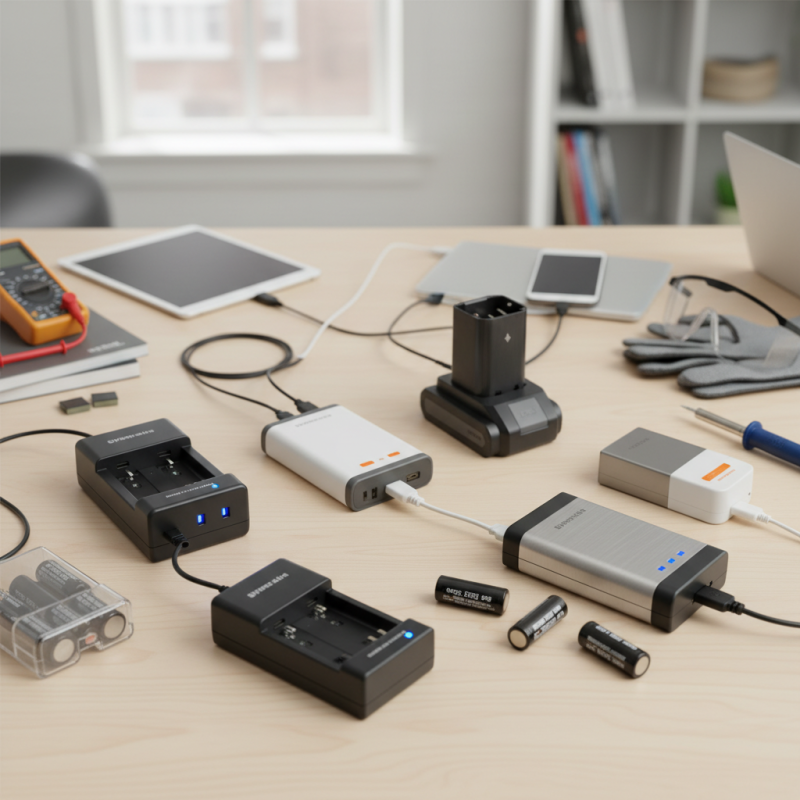
2026 How to Choose the Best Lithium Ion Charger for Your Needs
Choosing the right Lithium-ion charger is crucial for maintaining battery health and performance. With various options available, finding the best charger can be challenging. A high-quality Lithium-ion charger ensures efficiency, safety, and longevity. It is more than just a convenience; it can significantly impact the lifespan of your devices.
Consider your specific needs. Different devices require different charging speeds and voltages. A mismatch could damage your battery or decrease its life. Research the compatibility of chargers with your devices. Look for features like overcharge protection and temperature control. These details can enhance safety and reliability.
You might feel overwhelmed by the choices. Sometimes, a cheaper option seems tempting, but it might lack essential safety features. It’s essential to weigh the pros and cons of various chargers. Consult reliable sources or consumer reviews for guidance. A well-informed decision will lead to better outcomes in the long run.
Understanding Lithium Ion Batteries and Their Charging Requirements
Understanding lithium-ion batteries is crucial for effective charging. These batteries power many devices, from smartphones to electric vehicles. They require specific charging conditions to ensure safety and longevity.
Lithium-ion batteries need precise voltage levels. Overcharging can lead to overheating and possible damage. Using a compatible charger is essential. Look for chargers that match the battery specifications. This practice enhances battery life and improves performance.
Charging speed is another factor. Fast chargers can be convenient but may generate heat. Too much heat can degrade battery health over time. Therefore, it's often better to opt for standard charging. It takes longer but maintains the battery's integrity longer. Remember, knowing your battery's needs is key to making informed decisions.
Types of Lithium Ion Chargers and Their Key Features
Choosing the right lithium-ion charger can be daunting. Several types of chargers exist, each with unique features tailored to various needs. Understanding these options will help you select the best fit.
Smart chargers are popular among users. They come with microchip technology that optimizes charging. This feature helps prevent overcharging and prolongs battery life. On the other hand, universal chargers provide versatility. They can charge various lithium-ion batteries, making them ideal for those with multiple devices. Additionally, portable chargers offer convenience. These compact units allow for on-the-go charging, which is essential for busy lifestyles.
Tips: Consider the device you need to charge. Ensure the charger matches the battery specifications. Always check user reviews for reliability and performance insights. Warranty details are also necessary for assurance regarding the product's quality. Finally, conduct regular checks on charger cables and plugs for any wear over time to ensure safety and effectiveness.
Factors to Consider When Choosing a Lithium Ion Charger
Choosing the right lithium-ion charger is crucial for optimal battery performance. One key factor is the charger's output voltage and current. Most lithium-ion batteries require a specific voltage range, typically between 3.6V to 4.2V per cell. A mismatch can lead to inefficient charging or even battery damage. Additionally, consider the charger's amp rating; a higher current can reduce charging time but may affect battery life if too high.
Another important aspect is the safety features integrated into the charger. Look for options that include overcharge protection, short circuit prevention, and temperature control. A report from the International Electrotechnical Commission highlights that improper charging can result in a 30% degradation in battery life. Ensuring you have these safety mechanisms can help maintain battery health and longevity.
Finally, evaluate the compatibility with your devices. Not all chargers work with all lithium-ion batteries. Using an incompatible charger can not only lead to inefficiencies but also potential risks. Ensure you choose a charger that matches the specific requirements of your device’s battery specifications. Making these informed choices can significantly enhance both your charging experience and battery performance.
2026 How to Choose the Best Lithium Ion Charger for Your Needs - Factors to Consider When Choosing a Lithium Ion Charger
Feature
Description
Importance
Example Value
Output Voltage
The voltage provided by the charger, must match the battery specifications.
Critical
4.2V
Current Rating
The charging current; higher values can lead to faster charging.
High
2A
Charge Time
The time it takes to fully charge the battery.
Moderate
2-3 hours
Safety Features
Features like overcharge protection, temperature control, etc.
Critical
Yes
Compatibility
The range of battery types the charger can handle.
High
Li-ion, LiPo
Portability
The size and weight of the charger for travel.
Moderate
Compact
Price
The cost of the charger based on its features.
High
$20-$50
Warranty
The manufacturer's warranty period for the charger.
Moderate
1-2 years
Safety Features to Look for in Lithium Ion Chargers
When selecting a lithium-ion charger, safety features should be a primary concern. Overheating is a common issue; look for chargers with over-temperature protection. According to a 2022 industry report, improper charging can lead to thermal runaway, which causes fires in 4% of lithium-ion battery incidents. A charger with built-in thermal control significantly reduces this risk.
Short-circuit protection is another critical feature. A sudden surge can damage both the charger and the battery. Research from the Battery Safety Council indicates that short-circuit incidents account for nearly 7% of battery failures. Opt for chargers that incorporate advanced circuitry to prevent these mishaps.
Consider chargers with automatic shut-off functionality. This feature halts charging once the battery is full. The International Electrotechnical Commission states that overcharging can shorten battery life by up to 20%. A charger with this capability enhances safety while ensuring longevity for your battery.
Assessing Compatibility with Your Devices and Power Sources
When choosing a lithium-ion charger, compatibility is crucial. Not all chargers work with every device. Check your device's specifications before purchasing. Chargers can vary in voltage and current output. A mismatch could damage your device.
Tips: Always look for a charger that matches the voltage and amperage of your device. Using a charger with too high of an output can be risky. Also, consider how often you will use it. For infrequent use, a simpler model might be sufficient.
Power sources also play a role. Different chargers may perform poorly with certain outlets. Ensure your primary power source is reliable. It is worth testing on multiple outlets, if possible. This could save frustration later. Some chargers may be affected by long extension cords or power strips.
Tips: Try to use chargers close to the power source. Avoid overladen sockets. If a charger gets too hot, it’s a red flag. Pay attention to these details to find the best charger for your needs.
Cepex is the brand for the fluid handling market belonging to the Fluidra group. One of the leading european manufacturer of valves and fittings in thermoplastic materials.
Dedicated to the swimming pool, irrigation and industrial markets, we distribute our products worldwide with the Fluidra commercial network and presence in 46 countries with 136 sales branches.
Your data will be processed by CEPEX S.A., with address at C. Lluís Companys, 51-53, 08400, Granollers (Barcelona), and C.I.F. nº A-08928707, to send you communications about our products based on your interests. You can consult more information about the processing of your data and how to exercise your rights as described in the Privacy Policy.
Technical cookies are strictly necessary for our website to work and you can navigate through it. These types of cookies are those that, for example, allow us to identify you, give you access to certain restricted parts of the page if necessary, or remember different options or services already selected by you, such as your privacy preferences. Therefore, they are activated by default, your authorization not being necessary in this regard. Through the configuration of your browser, you can block or alert the presence of this type of cookies, although such blocking will affect the proper functioning of the different functionalities of our website.
The analysis cookies allow us to study the navigation of the users of our website in general (for example, which sections of the page are the most visited, which services are used most and if they work correctly, etc.). From the statistical information on navigation on our website, we can improve both the operation of the page itself and the different services it offers. Therefore, these cookies do not have an advertising purpose, but only serve to make our website work better, adapting to our users in general. By activating them you will contribute to this continuous improvement. You can enable or disable these cookies by checking the corresponding box, being disabled by default.
Functionality cookies allow us to remember your preferences, to personalize certain characteristics and general options of our website, every time you access it (for example, the language in which the information is presented to you, the sections marked as favorites, your browser type, etc.) Therefore, this type of cookies does not have an advertising purpose, but by activating them you will improve the functionality of the website (for example, adapting to your type of browser) and the customization of it based on your preferences (for example, by presenting the information in the language that you have chosen in previous occasions), which will contribute to the ease, usability and comfort of our page during your navigation. You can enable or disable these cookies by checking the corresponding box, being disabled by default.
Advertising cookies allow us to manage the advertising spaces included in our website based on criteria such as the content shown or the frequency in which the ads are displayed. For example, if you have been shown the same ad several times on our website, and you have not shown a personal interest by clicking on it, it will not appear again. In summary, by activating this type of cookies, the advertising shown on our website will be more useful and diverse, and less repetitive. You can enable or disable these cookies by checking the corresponding box, being disabled by default.
Behavioral advertising cookies allow us to obtain information based on the observation of your browsing habits and behaviors on the web, in order to show you advertising content that best suits your personal tastes and interests. To understand it in a very simple way, we will give you a fictitious example: if your last searches on the web were related to suspense literature, we would show you advertising about suspense books. Therefore, activating this type of cookies, the advertising that we show you on our website will not be generic, but will be oriented to your searches, tastes and interests, therefore adjusting exclusively to you. You can enable or disable these cookies by checking the corresponding box, being disabled by default. To understand it in a very simple way, we will give you a fictitious example: if your last searches on the web were related to suspense literature, we would show you advertising about suspense books. Therefore, activating this type of cookies, the advertising that we show you on our website will not be generic, but will be oriented to your searches, tastes and interests, therefore adjusting exclusively to you. You can enable or disable these cookies by checking the corresponding box, being disabled by default.
We use our own and third-party cookies to ensure the proper functioning of the website and to analyse our services, improve your experience on our website and show you advertisements related to your interests according to profiling based on your browsing habits (e.g. websites visited). You can accept all cookies by clicking "ACCEPT" or set or reject them by clicking here. If you would like to know more about the use of cookies, please see our COOKIE POLICY.