
What Is the Best Greenhouse Covering Film in 2026?
FLUID HANDLING EXPERTS

Blog, all our news

What Is the Best Greenhouse Covering Film in 2026?

In 2026, the best Greenhouse Covering Film is not automatically the clearest, thickest, or most expensive option. It is the film that suits your crop, local weather, greenhouse design, and replacement budget. A grower in a windy coastal area may value tear resistance and secure installation. A tomato producer facing intense summer sun may care more about heat control and light diffusion. Details matter.

Greenhouse materials specialist Dr. Merle H. Jensen has long studied controlled-environment horticulture. Rather than assign him an unverified quotation, this guide uses a practical selection principle: “Choose the covering for the crop and climate—not the sales claim.” Treat that as a buyer’s rule of thumb, not a direct quotation. Product labels can sound reassuring, yet performance depends on film composition, thickness, UV treatment, and real growing conditions. Even a promising specification deserves a closer look.

This guide compares common film types, including polyethylene options with different light and thermal properties. It also considers service life, installation, and the trade-offs growers may overlook. No covering performs perfectly in every greenhouse. That is worth remembering. A film that reduces heat loss may affect daytime temperatures; a highly diffusive film may change how sunlight reaches the crop. The right choice starts with measurable needs, not a simple “best” label.
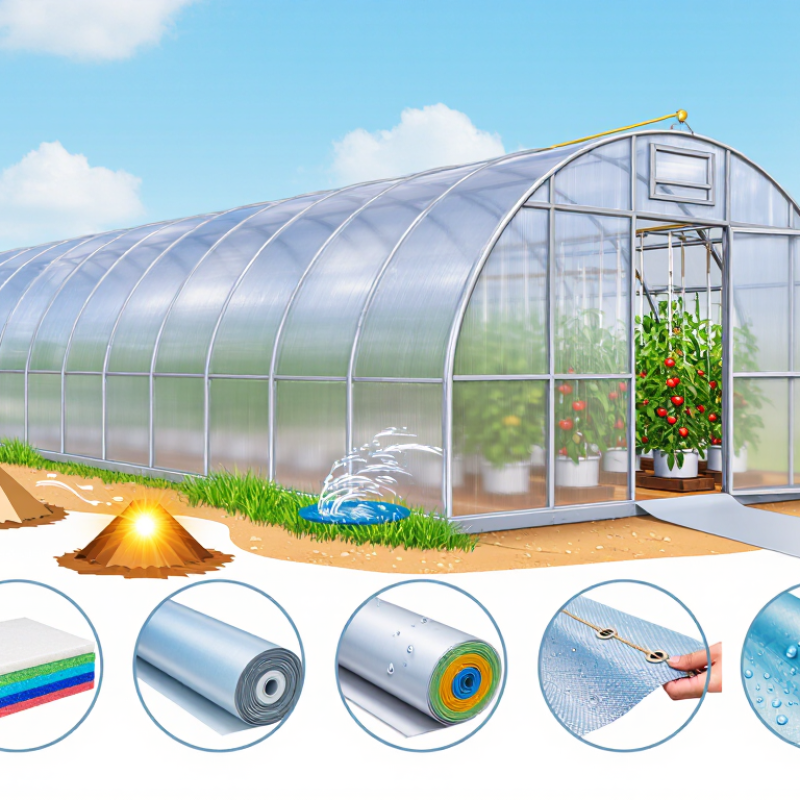
What Is the Best Greenhouse Covering Film in 2026?

Define Greenhouse Covering Film and Its Key Performance Metrics

What Is the Best Greenhouse Covering Film in 2026?

Greenhouse covering film is a flexible sheet fitted over a frame to admit light while protecting crops from wind and rain. It also helps regulate heat and humidity. Unlike rigid glazing, film is lightweight and can be replaced, but its performance changes with weather, installation, and aging. There is no single best film for every greenhouse.

Key metrics include light transmission, which indicates how much usable light reaches plants, and light diffusion, which spreads sunlight more evenly. Thermal performance matters too: infrared retention can reduce heat loss on cold nights. Check UV stability, tear strength, thickness, and stated service life. Anti-drip properties can limit droplets falling onto leaves. Compare figures measured using similar test methods; a high rating in one category does not guarantee better crop conditions. I would also consider local climate and crop needs, not just the product sheet.

Tips: Inspect the film after installation and during each growing season. Look for loose edges, cloudy patches, or small tears near fasteners. Keep records of replacement dates and crop conditions. They may not explain every yield change, but they make future choices less guesswork.

Compare PE, EVA, and PVC Films Using 85–90% Light-Transmission Benchmarks

An 85–90% light-transmission figure is a useful screening range, not a guarantee of crop performance. Ask whether the measurement refers to total light or direct transmission, and check the film’s thickness and test conditions. A clean, new sheet can perform differently from one coated with dust or condensation.

PE film is widely used because clear greenhouse grades can reach this range at suitable thicknesses. It is light and straightforward to install, though its service life depends on formulation, weather, and handling. EVA films can also offer high transmission, with flexibility and light diffusion that may soften harsh sun patches. That can help distribute light across leaves, but diffusion is not the same as more total light. PVC films vary considerably by formulation; compare a product’s measured transmission rather than assuming clarity from its name. Check haze, too.

Look at samples in daylight. Notice the sharpness of a roof beam through each film, then compare the technical data. I would not pick a covering from one percentage alone; that feels tidy, but misses too much. Dust buildup, stretching during installation, and local heat can change what plants actually receive. For a small test bay, record midday readings beneath the film and near the crop canopy. The result may be imperfect, yet it is more useful than treating 85–90% as a universal rule.

Assess 150–200 μm Film Thickness, UV Stabilization, and Service Life

For greenhouse film in 2026, 150–200 μm is a practical range to assess, not a guarantee. It equals roughly 6–8 mil. The thicker end can better resist punctures from clips, crop ties, and wind-blown grit, but thickness alone does not ensure longer service. It may also affect light transmission and handling. Check the film’s stated light transmission and whether it is designed for single- or double-layer use.

UV stabilization matters because sunlight gradually weakens polyethylene. FAO’s 2013 Good Agricultural Practices for Greenhouse Vegetable Crops guidance gives a general service-life range of about two to four years for polyethylene covers, with conditions and formulation influencing results. That range is a planning guide, not a promise. In high-UV regions, poor ventilation or chemical exposure may shorten useful life. Look for documented UV-resistance testing and installation guidance; EN 13206:2017 provides a framework for classifying agricultural thermoplastic films by durability.

Inspect the film before each growing season. Watch for brittle folds, yellowing, pinholes, and loose edges near vents. Small details matter. A film that still looks clear can already be weak at its creases. Keep purchase records and note replacement dates; field conditions rarely match a neat catalog estimate.

Evaluate PAR (400–700 nm), Diffusion, IR Retention, and Anti-Drip Features

Choosing greenhouse film means balancing light quality, heat, and water behavior—not chasing one headline number. PAR measures usable light from 400 to 700 nanometers, the range plants use for photosynthesis. Ask for measured PAR transmission, not a vague “high light” claim. Total light transmission alone can hide differences in useful wavelengths. That matters on cloudy mornings. Diffusion spreads direct sunlight and softens sharp shadows across leaves. It can reduce hot spots, though too much haze may lower direct transmission. Match diffusion to the crop and structure; tall plants often benefit from more even light.

IR retention helps limit heat loss after sunset, but performance depends on the film’s construction and local temperatures. Compare stated IR properties with your night-time heating needs. Anti-drip treatments encourage condensation to form a thin sheet rather than droplets that fall onto foliage. Their effectiveness can fade with age, dust, or cleaning. A specification sheet cannot capture every site, and real conditions sometimes surprise you.

Tips: Check test methods, film thickness, and warranty terms before comparing figures. Inspect a sample in morning and midday light. Look for clear, even coverage—not just a glossy finish. If condensation control matters, ask how long the treatment is expected to last.

Select the Best Film by Crop, Climate, and Annual Cost of Use

What Is the Best Greenhouse Covering Film in 2026?
Select the Best Film by Crop, Climate, and Annual Cost of Use

The best film depends on what you grow and what your weather demands. Light-hungry seedlings and fruiting crops benefit from high photosynthetically active radiation transmission. The University of Massachusetts Amherst Extension guide to greenhouse coverings reports typical light transmission of about 85% for single-layer polyethylene and 75–80% for double-layer polyethylene. Actual performance changes with film age, dirt, condensation, and installation. Small details matter. A dusty roof can reduce the light reaching leaves, even when the film specification looks excellent.

In cold regions, compare heating savings with replacement and installation costs. The University of Kentucky Cooperative Extension’s greenhouse energy guidance reports that double polyethylene can reduce heat loss by about 30% compared with single-layer covering. That advantage may matter less in a mild climate, where ventilation and summer heat control are bigger concerns. Estimate annual cost as purchase and installation cost divided by expected service years, plus heating, repairs, and any crop losses. Then compare that figure across films. I would not trust a payback estimate without checking leaks and local energy prices; small errors add up. For leafy greens, prioritize even light and temperature control. For heat-sensitive crops, consider diffusing film and reliable ventilation. No film fixes poor management.

What Is the Best Greenhouse Covering Film in 2026?

Compare illustrative annualized material costs, then choose by crop and climate.

How to read this chart: Annualized cost is an illustrative planning estimate: assumed film purchase cost divided by assumed service life. It excludes installation, heating, replacement labor, and disposal; local prices and film life vary.

  • Standard UV-stabilized polyethylene: A low-cost general-purpose option for many crops and mild-to-moderate conditions.
  • IR/thermal polyethylene: Consider where reducing nighttime heat loss is useful, especially in cool climates.
  • Diffused polyethylene: Diffused light can help distribute sunlight more evenly through a crop canopy.
  • EVA-containing polyethylene: Often selected for light transmission and flexibility; compare specifications and local availability.
Copyright 2025 Fluidra S.A. | Created by BCM Marketing Agencia Privacy Policy Legal note | Cookie policy |

Technical cookies are strictly necessary for our website to work and you can navigate through it. These types of cookies are those that, for example, allow us to identify you, give you access to certain restricted parts of the page if necessary, or remember different options or services already selected by you, such as your privacy preferences. Therefore, they are activated by default, your authorization not being necessary in this regard. Through the configuration of your browser, you can block or alert the presence of this type of cookies, although such blocking will affect the proper functioning of the different functionalities of our website.


The analysis cookies allow us to study the navigation of the users of our website in general (for example, which sections of the page are the most visited, which services are used most and if they work correctly, etc.). From the statistical information on navigation on our website, we can improve both the operation of the page itself and the different services it offers. Therefore, these cookies do not have an advertising purpose, but only serve to make our website work better, adapting to our users in general. By activating them you will contribute to this continuous improvement. You can enable or disable these cookies by checking the corresponding box, being disabled by default.


Functionality cookies allow us to remember your preferences, to personalize certain characteristics and general options of our website, every time you access it (for example, the language in which the information is presented to you, the sections marked as favorites, your browser type, etc.) Therefore, this type of cookies does not have an advertising purpose, but by activating them you will improve the functionality of the website (for example, adapting to your type of browser) and the customization of it based on your preferences (for example, by presenting the information in the language that you have chosen in previous occasions), which will contribute to the ease, usability and comfort of our page during your navigation. You can enable or disable these cookies by checking the corresponding box, being disabled by default.


Advertising cookies allow us to manage the advertising spaces included in our website based on criteria such as the content shown or the frequency in which the ads are displayed. For example, if you have been shown the same ad several times on our website, and you have not shown a personal interest by clicking on it, it will not appear again. In summary, by activating this type of cookies, the advertising shown on our website will be more useful and diverse, and less repetitive. You can enable or disable these cookies by checking the corresponding box, being disabled by default.


Behavioral advertising cookies allow us to obtain information based on the observation of your browsing habits and behaviors on the web, in order to show you advertising content that best suits your personal tastes and interests. To understand it in a very simple way, we will give you a fictitious example: if your last searches on the web were related to suspense literature, we would show you advertising about suspense books. Therefore, activating this type of cookies, the advertising that we show you on our website will not be generic, but will be oriented to your searches, tastes and interests, therefore adjusting exclusively to you. You can enable or disable these cookies by checking the corresponding box, being disabled by default.
To understand it in a very simple way, we will give you a fictitious example: if your last searches on the web were related to suspense literature, we would show you advertising about suspense books. Therefore, activating this type of cookies, the advertising that we show you on our website will not be generic, but will be oriented to your searches, tastes and interests, therefore adjusting exclusively to you. You can enable or disable these cookies by checking the corresponding box, being disabled by default.

SAVE

We use our own and third-party cookies to ensure the proper functioning of the website and to analyse our services, improve your experience on our website and show you advertisements related to your interests according to profiling based on your browsing habits (e.g. websites visited). You can accept all cookies by clicking "ACCEPT" or set or reject them by clicking here. If you would like to know more about the use of cookies, please see our COOKIE POLICY.


ACCEPT ALL
Reject no essentials


