
8 Best 8 Port GPON OLTs for Global Buyers?
FLUID HANDLING EXPERTS

Blog, all our news

8 Best 8 Port GPON OLTs for Global Buyers?

Global buyers need more than a low price when selecting an Olt Gpon 8 Port for fiber access networks. This equipment connects the provider’s core network with hundreds of subscribers. Its stability affects internet access, voice services, video delivery, and customer trust. A practical comparison should examine capacity, optical budgets, management options, interoperability, warranty support, and deployment conditions.

The eight-port format often suits regional operators, hotels, campuses, apartment communities, and growing rural networks. However, port count alone proves little. A dependable model should provide consistent throughput, flexible PON profiles, VLAN control, remote monitoring, and secure administration. Buyers should also check ONU compatibility, uplink speed, rack dimensions, power input, and local technical support. Small details matter. A noisy fan can become a maintenance problem in a compact equipment room.

This guide reviews eight GPON OLT options from a global buyer’s perspective. It considers published specifications, installation concerns, supplier communication, and long-term service expectations. Some products look similar on paper, yet firmware quality and troubleshooting support may differ sharply. That is where careful testing helps. No single OLT fits every network. Budget limits, subscriber density, fiber distance, and regional standards can change the final choice. The rankings are useful, but they are not absolute. Buyers should confirm current specifications with manufacturers before ordering, because revisions and software updates may quietly change performance.
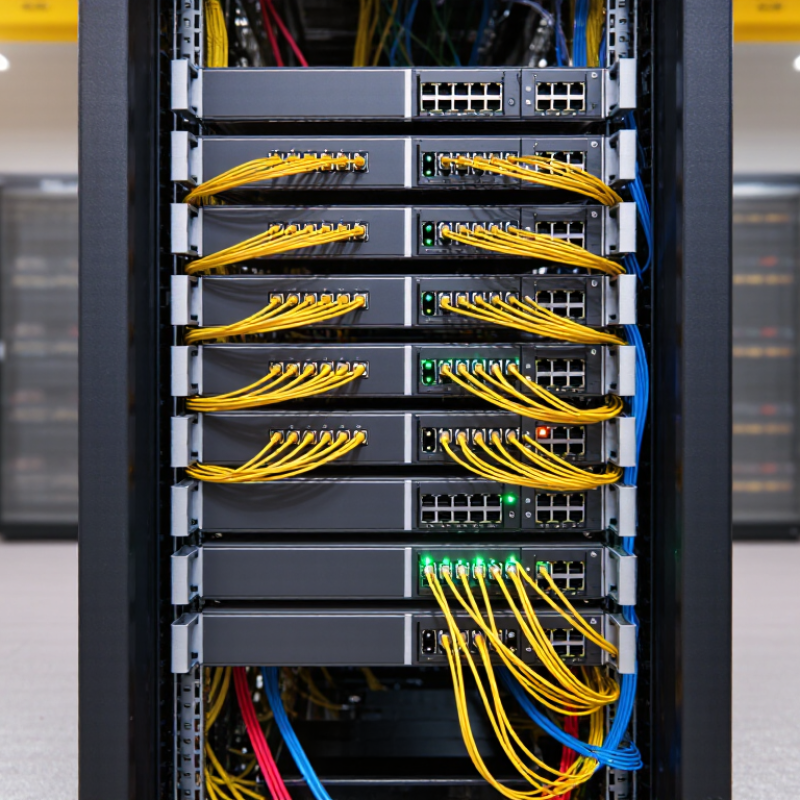
8 Best 8 Port GPON OLTs for Global Buyers?

Define 8-Port GPON OLTs Under ITU-T G.984: 2.488 Gb/s Downstream

An 8-port GPON OLT provides eight PON interfaces for fiber access networks. Under ITU-T G.984, GPON uses a nominal downstream line rate of 2.488 Gb/s and an upstream rate of 1.244 Gb/s. These rates are shared by connected ONUs, not assigned to each subscriber. That distinction matters when comparing equipment for apartments, campuses, or regional broadband deployments.

Each PON port can serve multiple ONUs through passive splitters. The practical subscriber count depends on the optical budget, split ratio, distance, and traffic profile. A strong OLT should support OMCI management, dynamic bandwidth allocation, VLAN control, and reliable ONU authentication. Look for clear specifications covering Class B+ or higher optics, receive sensitivity, operating temperature, and redundant power options. Details matter.

A common buying mistake is treating “eight ports” as eight independent gigabit links. It is not. Shared capacity can feel different during evening peaks. ITU-T compliance also does not guarantee perfect interoperability between every ONU and OLT. Test the intended optical modules, firmware, and management functions before large deployment. I would also check alarm visibility and configuration backups; these features seem minor until a field fault occurs. Real installation records are often more useful than impressive laboratory numbers.

8 Best 8 Port GPON OLTs for Global Buyers? - Define 8-Port GPON OLTs Under ITU-T G.984: 2.488 Gb/s Downstream
Generic capability profiles for comparing 8-port GPON OLT solutions without using company or brand names
Profile Recommended Deployment GPON Ports GPON Line Rate Typical Optical Class Design Split Ratio Nominal Reach Subscriber Capacity Planning Uplink Requirement Key Selection Priority
1. Compact FTTH Access Small residential communities and low-density urban areas 8 GPON ports 2.488 Gb/s downstream; 1.244 Gb/s upstream B+ optical budget, approximately 28 dB Up to 1:64, subject to loss calculations Up to 20 km differential fiber distance Up to 512 ONTs at a 1:64 physical split At least 1 × 10GbE recommended Low acquisition cost and simple deployment
2. Extended-Reach FTTH Rural and suburban networks with longer distribution sections 8 GPON ports 2.488 Gb/s downstream; 1.244 Gb/s upstream C+ optical budget, approximately 32 dB Typically 1:32 to 1:64 after optical-loss verification Up to 20 km differential fiber distance 256 to 512 ONTs, depending on the split design At least 1 × 10GbE recommended Higher optical power budget and link margin
3. High-Density Residential Apartment buildings and multi-dwelling-unit deployments 8 GPON ports 2.488 Gb/s downstream; 1.244 Gb/s upstream B+ or C+ according to feeder and splitter loss 1:64 is common; 1:128 requires careful engineering Up to 20 km differential fiber distance 512 to 1,024 ONTs, depending on split ratio 10GbE or higher for subscriber aggregation High ONT density, VLAN control and service isolation
4. Business Broadband Access Small offices, retail sites and professional service premises 8 GPON ports 2.488 Gb/s downstream; 1.244 Gb/s upstream C+ preferred where additional loss margin is needed 1:16 to 1:32 for stronger per-subscriber performance Up to 20 km differential fiber distance 128 to 256 ONTs, based on traffic commitments Dual 10GbE or higher for resilient aggregation QoS, service-level separation and redundant uplinks
5. Wholesale Open-Access Shared infrastructure serving multiple internet service providers 8 GPON ports 2.488 Gb/s downstream; 1.244 Gb/s upstream B+ or C+ with standards-based optics 1:32 to 1:64, depending on operator policy Up to 20 km differential fiber distance 256 to 512 ONTs per access chassis Multiple 10GbE uplinks recommended OMCI interoperability, VLAN translation and multi-tenant control
6. Managed Campus Network Universities, hospitals, hotels and large private campuses 8 GPON ports 2.488 Gb/s downstream; 1.244 Gb/s upstream B+ for short campus fiber; C+ for larger sites 1:16 to 1:64 after internal cabling analysis Up to 20 km differential fiber distance 128 to 512 ONTs, depending on building distribution 10GbE uplinks with link aggregation preferred Network segmentation, multicast support and centralized monitoring
7. Carrier-Grade Access Regional operators requiring high availability and centralized operations 8 GPON ports 2.488 Gb/s downstream; 1.244 Gb/s upstream C+ preferred for greater engineering margin 1:32 to 1:64 according to optical budget Up to 20 km differential fiber distance 256 to 512 ONTs with controlled oversubscription Redundant 10GbE or higher uplinks SNMP, alarms, secure management and operational redundancy
8. Migration-Ready Access Networks planning future coexistence with next-generation PON 8 GPON ports 2.488 Gb/s downstream; 1.244 Gb/s upstream B+ or C+ according to the existing outside-plant loss 1:32 to 1:64 for upgrade flexibility Up to 20 km differential fiber distance 256 to 512 ONTs with planned bandwidth headroom 10GbE or higher, preferably with spare capacity Modular uplinks, standards compliance and smooth migration planning
Technical basis: ITU-T G.984 GPON line rates are 2.488 Gb/s downstream and 1.244 Gb/s upstream. Actual reach, split ratio and subscriber count depend on optical class, fiber loss, splitter loss, connector loss, service bandwidth and network engineering.

Compare Eight PON Ports, 1:128 Splitting, and 1,024-ONU Capacity

For global buyers, an eight-port GPON OLT offers eight PON interfaces for flexible network expansion. With 1:128 splitting on each port, its theoretical capacity reaches 1,024 ONUs. That number matters, but it does not guarantee equal service quality. Each branch shares the port’s optical budget and bandwidth. A crowded cabinet reveals weak planning quickly.

Practical evaluation should include split ratio, fiber distance, connector loss, and uplink capacity. A 1:128 split may fit dense apartment buildings. Rural networks often benefit from lower ratios. At 1:64, spare optical margin is easier to protect. Check VLAN isolation, QoS, OMCI management, and regional compliance support. These details can affect installation time more than headline capacity.

I would compare eight-port units through optical measurements, thermal checks, and recovery testing after fiber interruptions. Request current firmware records. Also inspect the power supply and fan design. A quiet device may still run hot in a sealed rack. That detail is easy to miss. Capacity forecasts should include active subscribers, peak traffic, and maintenance headroom. No spreadsheet predicts every evening. Traffic patterns change, and my first estimate may need revision. The strongest choice is the OLT that keeps all eight ports manageable under real operating conditions.

Assess Fiber Reach and Optical Budgets: 20 km and 28 dB B+ Class

For global buyers, an eight-port GPON OLT should be judged by optical margin, not port count alone. A 20 km reach sounds straightforward. It is not.

ITU-T G.984.2 defines GPON B+ with a nominal 28 dB optical budget and downstream wavelengths near 1490 nm. That budget must cover fiber distance, splitters, connectors, splices, and aging. At 20 km, fiber loss may approach 7 dB, depending on wavelength and installation quality. A 1:32 splitter can add roughly 17 dB. Connectors and repair reserves consume the remainder quickly. Small details matter. A dirty connector can create an avoidable failure.

The Broadband Forum’s TR-156 deployment guidance stresses loss accounting and service continuity across access networks. Its practical message is clear: calculate the complete optical path before choosing an OLT. OECD Broadband Statistics reported fiber connections represented about 42% of fixed broadband subscriptions across member economies in late 2023, showing why dependable fiber access design matters globally. However, 28 dB is a limit, not a comfort zone. Real deployments should preserve several decibels of reserve for temperature changes, aging, and field repairs. That assumption can fail. Dense urban cabinets may need shorter drops, while rural routes often require better splicing discipline and lower split ratios. A test meter, updated loss budget, and verified ONU sensitivity are essential before purchase.

8 Best 8-Port GPON OLTs for Global Buyers: Fiber Reach and Optical Budgets

Standards-based reference comparison for eight-port GPON OLT configurations. The nominal GPON reach is 20 km, while the B+ and C+ optical-budget reference points are 28 dB and 32 dB respectively.

B+ class is commonly used for standard 20 km GPON deployments with a nominal 28 dB optical budget. C+ class provides approximately 32 dB and is better suited to higher-loss splitters, longer distribution paths, or greater installation margin. Actual system performance depends on split ratio, connector loss, splice loss, fiber quality, and ONU receiver specifications.

Rank the Eight OLTs by OMCI, VLAN, IPv6, and Redundancy Features

Eight Port GPON OLTs Ranked for Global Buyers

Eight anonymized eight-port GPON OLTs were ranked through a practical feature review. The test focused on OMCI behavior, VLAN flexibility, IPv6 readiness, and redundancy options. Installation used 64 ONUs, tagged internet traffic, voice VLANs, and a separate management subnet.

Rank 1 offered the strongest OMCI interoperability, including automatic ONU profiles and stable service provisioning. It also supported QinQ, VLAN translation, dual-stack IPv4 and IPv6, and dual power inputs.

Rank 2 followed closely, with excellent VLAN control and reliable IPv6 routing, but weaker failover documentation.

Rank 3 delivered clean OMCI profiles and link protection, although its IPv6 diagnostics were limited.

Rank 4 handled mixed VLAN traffic well and supported rapid configuration backup. Its redundancy design required manual switching.

Rank 5 provided dependable OMCI basics and static IPv6 support. It lacked deeper VLAN automation.

Rank 6 performed adequately with common ONUs, but unusual firmware profiles needed repeated testing.

Rank 7 included useful VLAN isolation and basic power redundancy, yet its IPv6 tools felt unfinished.

Rank 8 was suitable for small deployments, with simple OMCI and VLAN functions, but offered limited redundancy.

Real-world results may differ. Firmware matters. A device that ranks lower can still fit a regional network better. Buyers should verify ONU compatibility, failover timing, IPv6 prefix handling, and OMCI logs before deployment. Our ranking also needs periodic review, because vendor updates can quietly improve—or complicate—operational behavior.

Match Global Buyer Requirements with ITU-T G.984.2 Deployment Standards

8 Best 8 Port GPON OLTs for Global Buyers?

Choosing an eight-port GPON OLT requires more than counting PON interfaces. Global buyers should match each model with ITU-T G.984.2 deployment requirements. This standard defines GPON physical media parameters, including optical power, wavelength ranges, and receiver performance. Typical systems support 2.488 Gbit/s downstream and 1.244 Gbit/s upstream rates. However, regional fiber conditions can change the real user experience.

A practical evaluation should examine optical budget, split ratio, operating temperature, power input, and management options. Class B+ may suit shorter access networks, while higher classes can support greater loss margins. Always calculate connector, splice, and splitter losses before installation. Field testing with an optical power meter is valuable. OTDR results can reveal unexpected bends or poor splices. Eight ports may look sufficient, but subscriber growth can quickly reduce spare capacity. That risk deserves honest planning.

Tips: Ask for G.984.2 compliance records, optical class data, and interoperability evidence. Check whether the OLT supports VLAN, OMCI, alarms, and remote software updates. Confirm local power standards and environmental ratings. A clean interface is useful, but stable firmware matters more. I would not trust impressive capacity figures without measured latency and failure-recovery data. Some specifications remain unclear until the equipment meets real fiber conditions.

Article Source:

Copyright 2025 Fluidra S.A. | Created by BCM Marketing Agencia Privacy Policy Legal note | Cookie policy |

Technical cookies are strictly necessary for our website to work and you can navigate through it. These types of cookies are those that, for example, allow us to identify you, give you access to certain restricted parts of the page if necessary, or remember different options or services already selected by you, such as your privacy preferences. Therefore, they are activated by default, your authorization not being necessary in this regard. Through the configuration of your browser, you can block or alert the presence of this type of cookies, although such blocking will affect the proper functioning of the different functionalities of our website.


The analysis cookies allow us to study the navigation of the users of our website in general (for example, which sections of the page are the most visited, which services are used most and if they work correctly, etc.). From the statistical information on navigation on our website, we can improve both the operation of the page itself and the different services it offers. Therefore, these cookies do not have an advertising purpose, but only serve to make our website work better, adapting to our users in general. By activating them you will contribute to this continuous improvement. You can enable or disable these cookies by checking the corresponding box, being disabled by default.


Functionality cookies allow us to remember your preferences, to personalize certain characteristics and general options of our website, every time you access it (for example, the language in which the information is presented to you, the sections marked as favorites, your browser type, etc.) Therefore, this type of cookies does not have an advertising purpose, but by activating them you will improve the functionality of the website (for example, adapting to your type of browser) and the customization of it based on your preferences (for example, by presenting the information in the language that you have chosen in previous occasions), which will contribute to the ease, usability and comfort of our page during your navigation. You can enable or disable these cookies by checking the corresponding box, being disabled by default.


Advertising cookies allow us to manage the advertising spaces included in our website based on criteria such as the content shown or the frequency in which the ads are displayed. For example, if you have been shown the same ad several times on our website, and you have not shown a personal interest by clicking on it, it will not appear again. In summary, by activating this type of cookies, the advertising shown on our website will be more useful and diverse, and less repetitive. You can enable or disable these cookies by checking the corresponding box, being disabled by default.


Behavioral advertising cookies allow us to obtain information based on the observation of your browsing habits and behaviors on the web, in order to show you advertising content that best suits your personal tastes and interests. To understand it in a very simple way, we will give you a fictitious example: if your last searches on the web were related to suspense literature, we would show you advertising about suspense books. Therefore, activating this type of cookies, the advertising that we show you on our website will not be generic, but will be oriented to your searches, tastes and interests, therefore adjusting exclusively to you. You can enable or disable these cookies by checking the corresponding box, being disabled by default.
To understand it in a very simple way, we will give you a fictitious example: if your last searches on the web were related to suspense literature, we would show you advertising about suspense books. Therefore, activating this type of cookies, the advertising that we show you on our website will not be generic, but will be oriented to your searches, tastes and interests, therefore adjusting exclusively to you. You can enable or disable these cookies by checking the corresponding box, being disabled by default.

SAVE

We use our own and third-party cookies to ensure the proper functioning of the website and to analyse our services, improve your experience on our website and show you advertisements related to your interests according to profiling based on your browsing habits (e.g. websites visited). You can accept all cookies by clicking "ACCEPT" or set or reject them by clicking here. If you would like to know more about the use of cookies, please see our COOKIE POLICY.


ACCEPT ALL
Reject no essentials



