
Buying a Water Cooled Condenser is not simply a matter of choosing the lowest quoted price. The decision affects cooling capacity, water consumption, maintenance effort, noise, and long-term operating costs. A condenser may look impressive on a supplier’s website, yet perform poorly when water quality, seasonal temperatures, and actual load conditions are ignored.
Professor Reinhard Radermacher, a respected refrigeration researcher, has emphasized a practical principle: “The performance of a refrigeration system depends on how well all its components work together.” That idea should guide every purchase. A suitable Water Cooled Condenser must match the compressor, refrigerant, cooling tower, pump, and control system. Check the details carefully. Small mismatches can create large losses.
This guide presents seven practical tips for making a more informed choice. It considers heat-transfer capacity, construction materials, water-side pressure drop, fouling resistance, service access, energy efficiency, and supplier support. Look beyond the catalogue number. Ask for test conditions, flow requirements, pressure ratings, and maintenance recommendations. A stainless-steel shell may resist corrosion better, but it can increase the initial budget. A compact design may save space, yet leave technicians struggling with tube cleaning.
There is no perfect purchase. I have seen buyers focus heavily on efficiency while overlooking local water chemistry. That mistake can shorten equipment life. Real operating conditions matter more than polished specifications. Choose evidence over assumptions, and leave room for professional inspection before installation.
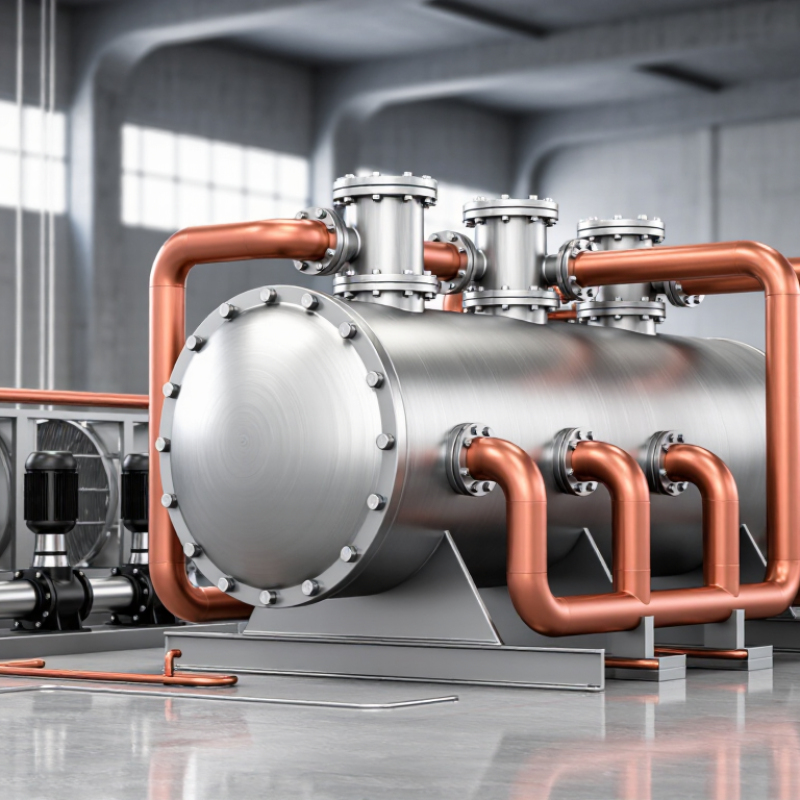
Choosing a water-cooled condenser starts with a clear capacity estimate. Do not size it from compressor cooling capacity alone. The condenser must reject the evaporator load plus compressor heat and motor losses. A practical design should also consider entering water temperature, fouling, refrigerant conditions, and seasonal operation.
Water temperature rise is a useful field check. Many systems are designed around a 7–12°C rise across the condenser. For example, rejecting 100 kW with a 10°C rise requires roughly 2.4 kg/s of water, based on water’s specific heat. The actual flow may change with water quality, pump limits, and allowable pressure drop. Too little flow can produce high condensing pressure and unstable operation. Excessive flow wastes pumping energy and may cause erosion.
I have seen capacity calculations look correct on paper but perform poorly after installation. The selected condenser was technically adequate, yet the cooling tower delivered warmer water than expected. Leave reasonable margin, but avoid oversizing without purpose. A very large condenser may reduce temperature difference and complicate control. Check the manufacturer’s performance tables, then verify water flow, inlet temperature, and heat rejection at the real operating point. Measure it during commissioning. Small errors matter.
| Estimated Refrigeration Load (kW) | Planning Allowance | Estimated Condenser Duty (kW) | Water Flow at 7°C Rise (m³/h) | Water Flow at 10°C Rise (m³/h) | Water Flow at 12°C Rise (m³/h) | Selection Guidance |
|---|---|---|---|---|---|---|
| 50 | 15% | 58 | 7.1 | 5.0 | 4.2 | Suitable for small refrigeration systems, process coolers, or compact comfort-cooling applications. |
| 100 | 15% | 115 | 14.1 | 9.9 | 8.2 | Allow sufficient flow capacity for stable heat rejection during peak operating conditions. |
| 250 | 15% | 288 | 35.3 | 24.8 | 20.6 | Check water-side pressure drop, pump capacity, fouling allowance, and control-valve range. |
| 500 | 15% | 575 | 70.5 | 49.5 | 41.2 | Consider parallel condenser circuits or multiple units for better turndown and service continuity. |
| 1,000 | 15% | 1,150 | 140.7 | 98.9 | 82.3 | Verify cooling-tower capacity, water-treatment requirements, piping size, and available installation space. |

When buying a water-cooled condenser, compare the condensing-water approach before shell size or price. The approach is the difference between refrigerant condensing temperature and leaving-water temperature. A target of 2.8–5.6°C often indicates effective heat transfer, but it is not a universal pass mark. Confirm the value at full-load and part-load conditions. Ask for entering water temperature, flow rate, refrigerant, and fouling assumptions.
A smaller approach can reduce condensing temperature and compressor lift. That may improve efficiency during long operating hours. Yet tighter performance often requires more surface area, cleaner water, or higher flow. Higher flow can increase pump energy and pressure drop. Check the complete system, not only the data sheet. Measure water temperatures with calibrated sensors under stable load. Small errors matter.
Inspect tube material, service access, and water-side cleaning arrangements. Scale on tube walls can quietly push a 3°C approach toward 5°C or 6°C. Water treatment deserves equal attention. Filtered water does not always stay clean. Review alarms for high condensing temperature and low flow. A 2.8°C target may look attractive, but it can be unrealistic in a dusty plant or warm climate. Allow for seasonal variation. Test under load. Keep records.
Compare Efficiency: Target a 2.8–5.6°C Condensing-Water Approach
The condensing-water approach is the temperature difference between the refrigerant condensing temperature and the leaving condenser-water temperature. A lower approach generally indicates better heat transfer and can reduce compressor lift, while the practical target range is approximately 2.8–5.6°C. When comparing condensers, also review water flow, pressure drop, fouling allowance, materials, cleanability, and performance at the actual design conditions.
When buying a water-cooled condenser, check whether the tube design includes a 0.5–1.5 mm fouling allowance. This deposit layer can reduce heat transfer and restrict water flow. It is not the same as corrosion allowance.
The TEMA Standards express fouling through thermal resistance, rather than a universal deposit thickness. Therefore, a 0.5 mm allowance may suit treated closed-loop water, while 1.5 mm is safer for dirty open-loop water. ASHRAE Handbook—HVAC Systems and Equipment 2024 stresses that water quality, velocity, and maintenance strongly influence fouling performance. Ask the supplier to show the assumed water temperature, velocity, and fouling resistance.
Tube material also matters. Copper alloys transfer heat efficiently, but aggressive water chemistry can accelerate corrosion. Stainless steel offers stronger resistance in many applications, although it may require thicker walls or larger surfaces. The Hydraulic Institute notes that poor flow control can encourage deposits and uneven heat transfer. Keep tube velocity within the manufacturer’s tested range.
A practical inspection uses a clean tube and a fouled tube. Measure the deposit with a calibrated gauge. Do not rely only on catalog claims. I have seen designs treat 1.0 mm as adequate, then underperform because the water contained suspended solids. That assumption needed review. Request factory performance data, cleaning access details, and the calculation behind the selected 0.5–1.5 mm allowance.
Buying a water-cooled condenser requires more than comparing capacity and price. Verify water flow before approving the unit. Maintain tube velocity between 1.5 and 2.5 m/s to limit scaling, sediment, and uneven heat transfer. Calculate velocity from actual flow and the tube’s net cross-sectional area. Do not rely only on the pump nameplate.
Check the design flow, tube diameter, pass arrangement, and pressure drop. Confirm that the cooling-water temperature matches the manufacturer’s selection conditions.
ASHRAE Handbook guidance links condenser performance with water temperature, flow rate, fouling, and pressure loss. The U.S. Department of Energy also identifies condenser-water optimization as a practical energy-saving measure in chilled-water systems.
Measure flow during commissioning. A spreadsheet can be wrong.
Inspect the water-treatment plan and filtration requirements. Ask for fouling-factor assumptions, tube material, allowable pressure, and cleaning access. The Cooling Technology Institute reports that cooling-water quality strongly affects heat-transfer reliability and maintenance intervals.
Install balancing valves, thermometers, pressure gauges, and flow measurement points. Keep service records. A small error matters.
In real installations, operators may reduce pump speed to save electricity, then unknowingly lower tube velocity below the scaling-control target. Review that decision under low-load conditions. A condenser that performs well on paper may struggle after months of mineral buildup.
A water-cooled condenser should be selected for service conditions, not only its catalog capacity. A 10–20% pressure-drop margin helps absorb fouling, aging strainers, and seasonal water-temperature changes. It is not permission to operate with excessive resistance.
During site inspections, check the condenser water inlet and outlet pressures. Compare current readings with the clean design condition. A rising differential often signals scale, biological deposits, or blocked tubes. Small details matter.
The U.S. Department of Energy reports that pumping systems can represent roughly 25% of industrial motor-system energy use, so unnecessary pressure loss can increase operating costs. ASHRAE’s HVAC guidance also stresses maintaining design water flow and controlling fouling to preserve heat-transfer performance.
Choose a condenser with accessible tube sheets, removable covers, and clearly marked isolation valves. These features shorten cleaning work and reduce maintenance errors. TEMA standards provide established practices for exchanger construction, inspection, and mechanical service access. Ask the supplier to state pressure drop at both clean and fouled conditions. That request is practical, but often missed.
Do not oversize blindly. A larger shell may lower pressure loss, yet it can raise water volume, cost, and cleaning time. Review pump curves with the condenser pressure drop included. Leave room for uncertainty. Water quality, installation debris, and future flow changes can defeat an otherwise careful calculation. In some projects, 10% is adequate; difficult water conditions may justify the full 20%.

Cepex is the brand for the fluid handling market belonging to the Fluidra group. One of the leading european manufacturer of valves and fittings in thermoplastic materials.
Dedicated to the swimming pool, irrigation and industrial markets, we distribute our products worldwide with the Fluidra commercial network and presence in 46 countries with 136 sales branches.


