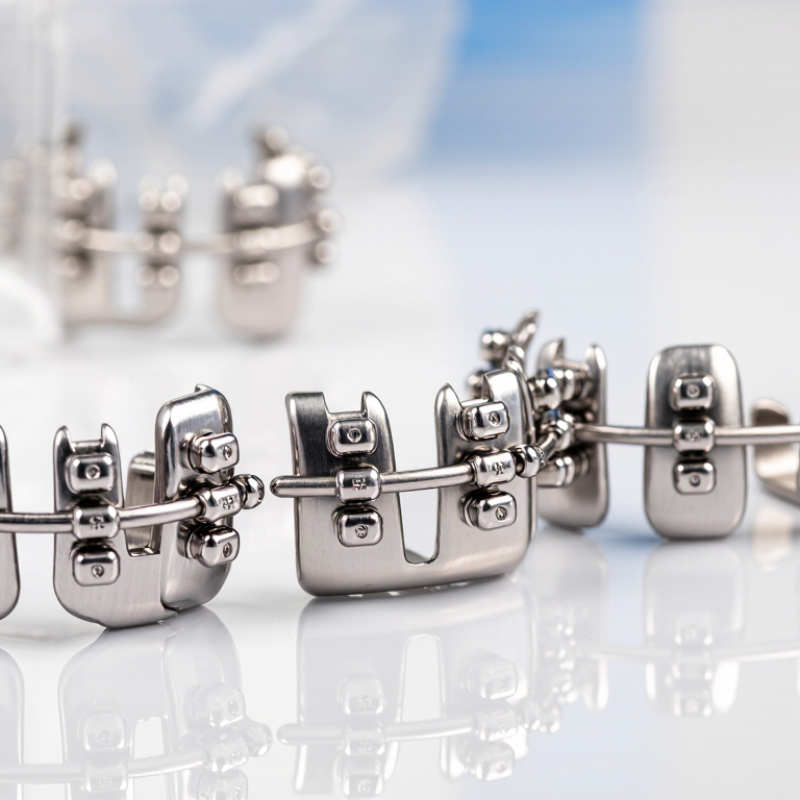
Choosing the right Roth Brackets Orthodontics system in 2026 requires more than comparing prices or polished product photographs. Bracket geometry, prescription accuracy, slot dimensions, base design, and bonding consistency can influence clinical control. Small errors matter. A bracket that looks precise may still perform poorly when its torque, angulation, or adhesive interface is inconsistent.
Market forecasts support continued demand for orthodontic supplies. Grand View Research identifies rising malocclusion awareness, expanding orthodontic treatment access, and product innovation as major market drivers. Fortune Business Insights also reports steady growth across the global orthodontics market, supported by adult treatment and digital workflow adoption. These reports describe commercial direction, not clinical proof. That distinction deserves attention.
This guide examines Roth prescription brackets through a practical, evidence-informed lens. It considers stainless steel quality, manufacturing tolerances, laser marking, pad adaptation, slot smoothness, and packaging integrity. It also reviews supplier documentation, regulatory status, sterilization guidance, warranty terms, and batch traceability. The U.S. Food and Drug Administration and relevant national regulators should be checked before purchase or clinical use. ISO 13485 certification can indicate a controlled medical-device quality system, but it does not guarantee superior clinical outcomes.
Experienced orthodontic teams often evaluate brackets beside a model arch, checking base fit and slot clarity under magnification. That hands-on step remains valuable. However, it is not a substitute for peer-reviewed evidence or verified instructions for use. No single bracket suits every case, practice, or clinician. Pricing tables can mislead. Forecasts can change. This 2026 buying guide therefore compares measurable specifications with real clinical demands, while acknowledging the evidence gaps that still deserve better research.
What Roth Brackets Are and How Their Prescription Works
2026 Top Roth Brackets Orthodontics Buying Guide
What Roth Brackets Are and How Their Prescription Works
Roth brackets are fixed orthodontic attachments designed around a specific tooth-position prescription. Each slot carries planned values for torque, angulation, rotation, and in-out thickness. These values guide archwire movement toward a three-dimensional finish. The prescription is not a promise. It is a starting map.
A clinician selects bracket size, material, slot dimension, and placement position for each patient. Small placement errors can change the final tooth position. A bracket placed too high may alter vertical control. A rotated bracket can create unwanted tooth rotation. Clinical judgment still matters, even with accurate manufacturing. The American Association of Orthodontists reports that about four million people receive orthodontic treatment in the United States each year, showing the scale of appliance selection and monitoring. However, a Cochrane review found no consistent evidence that one fixed-appliance system is universally superior. That finding deserves attention.
Tips: Ask how the prescription matches your facial pattern, extraction history, and bite goals. Check whether the clinician uses digital setup or direct placement verification. Review wire changes during visits, not only the bracket chart. A lower-profile bracket may feel more comfortable, but comfort alone does not prove better treatment. I would also question “faster” claims. Biology rarely follows advertising timelines. The prescription can guide movement, but bone response, hygiene, wear, and appointment quality remain decisive. Data from the American Association of Orthodontists and peer-reviewed evidence should support decisions, not replace an individualized examination.
Key Features to Compare When Choosing Roth Brackets
2026 Top Roth Brackets Orthodontics Buying Guide
When comparing Roth brackets, start with prescription accuracy, not appearance. Roth torque and angulation values should match the treatment philosophy and wire sequence used in your clinic. Slot size matters too. Compare 0.018-inch and 0.022-inch systems for wire control, finishing space, and handling comfort. A larger slot is not automatically better.
Inspect the bracket base closely. A well-contoured mesh should seat evenly on the tooth and support reliable bonding. Check bond strength data, debonding behavior, and adhesive cleanup requirements. Small differences become obvious around crowded lower incisors. Consider bracket profile, wing shape, tie access, and the position of auxiliary hooks. They affect ligation speed and soft-tissue irritation. They also affect gloves.
Material deserves careful review. Stainless steel offers familiar handling, while ceramic options may improve appearance but require stricter debonding control. Ask for dimensional tolerances, lot traceability, sterilization information, and biocompatibility documentation. ISO 13485 certification supports quality management, but it does not guarantee clinical performance by itself. The U.S. Food and Drug Administration emphasizes proper device controls and labeling for dental appliances (FDA, Quality System Regulation). The American Association of Orthodontists reports that approximately four million people receive orthodontic treatment in North America, increasing the need for consistent clinical workflows (AAO, orthodontic practice statistics). I would not overtrust a polished brochure. Compare independent test data, sample brackets, and actual chairside handling. Procurement decisions can still be imperfect. Track adjustments after the first cases.
2026 Top Roth Brackets Orthodontics Buying Guide
Key Features to Compare When Choosing Roth Brackets
The chart shows commonly referenced Roth prescription torque values by tooth group. Positive values indicate labial crown torque, while negative values indicate lingual crown torque. Actual specifications can vary by slot size, manufacturing tolerance, bracket material, and prescription system.
When comparing Roth brackets, review the prescription accuracy, 0.018-inch or 0.022-inch slot option, bracket material, base adaptation, tie-wing design, identification marks, and compatibility with your preferred archwire sequence.
Roth Bracket Materials, Sizes, and Slot Options Explained
Choosing a Roth bracket in 2026 starts with material, not marketing. Stainless steel remains the practical standard because it offers strength, predictable slot geometry, and reliable wire engagement. Polycrystalline ceramic brackets provide a less visible appearance, but they can be more brittle and friction may vary with wire type. A 2024 review in The Angle Orthodontist reported that friction depends on bracket material, ligation, surface finish, and wire dimensions. Material alone does not decide clinical performance.
Size affects handling and biomechanics. Standard brackets provide more tie-wing space, while mini and low-profile designs may improve comfort around crowded teeth. However, smaller brackets can make rotation control and ligation less convenient. Measure the patient’s enamel space carefully. A compact bracket is not automatically superior. The American Association of Orthodontists reports that millions of people receive orthodontic treatment annually in the United States, yet patient anatomy still varies widely.
Slot selection deserves equal attention. Roth systems commonly use 0.018-inch or 0.022-inch slots. The larger slot accepts heavier working wires and offers more wire-play management, while the smaller slot may support earlier control with lighter wires. ISO 27020:2023 provides relevant dimensional guidance for orthodontic brackets and tubes. Still, real-world accuracy can differ between production batches. I would verify slot dimensions, base design, prescription values, and sterilization compatibility before purchasing. Small errors matter. Procurement teams should also compare documented test data, not attractive catalog photographs.
How to Evaluate Quality, Compatibility, and Manufacturer Standards
2026 Top Roth Brackets Orthodontics Buying Guide
Roth brackets should be evaluated by measurable details, not polished packaging. Check slot dimensions, torque, angulation, bracket thickness, and identification markings. A reliable product should match its published specification across the full set. Small variations can affect archwire engagement and clinical control. Fit matters.
Inspect the bonding base under magnification. Its mesh or retention pattern should appear even, without bent edges, blocked areas, or loose particles. Ask for material disclosures, manufacturing records, lot traceability, and shelf-life information. Quality systems should support consistent production, documented inspections, and controlled packaging. Review the instructions for use carefully. Compatibility includes the bracket, archwire dimensions, bonding system, instruments, and sterilization workflow.
Do not judge performance from one attractive sample. Compare several brackets from different lots when possible. A caliper can reveal dimensional differences that the eye misses. I would also test how easily the bracket seats and how cleanly it debonds during a supervised evaluation. No inspection is perfect. That is worth admitting. Clinical feedback may expose problems that laboratory checks overlook. Manufacturer responses should be specific, timely, and supported by evidence rather than broad promises. Keep records of product codes, lot numbers, inspection dates, and observed defects. This creates a practical quality trail and helps distinguish an isolated issue from a recurring manufacturing concern.
2026 Buying Considerations: Cost, Suppliers, and Product Selection
2026 Top Roth Brackets Orthodontics Buying Guide
Cost, supplier reliability, and product fit should guide every Roth bracket purchase in 2026. Grand View Research estimates the global orthodontic supplies market will continue growing through 2030, with digital workflows driving demand. Growth does not guarantee better clinical value. A low unit price may hide weak adhesive performance, inconsistent slot dimensions, or difficult returns.
Build a complete cost sheet. Include brackets, tubes, instruments, shipping, replacement units, and chair time. A practical comparison should measure cost per completed case, not cost per box. The American Association of Orthodontists reports that millions of patients receive orthodontic care in the United States each year. Small handling problems can therefore create repeated expenses across a busy practice. Ask suppliers for lot traceability, storage guidance, warranty terms, and documented quality controls, such as ISO 13485 certification.
Product selection needs clinical discipline. Roth prescription brackets should match the practitioner’s treatment philosophy, archwire sequence, bonding method, and patient age range. Check base design, hook position, slot accuracy, identification marks, and debonding behavior. Request samples before placing a large order. Test them on ordinary clinical cases, not only ideal models.
Do not trust polished brochures alone. Independent evidence matters. A 2023 systematic review in the European Journal of Orthodontics found that bracket performance can vary with design and bonding conditions. That finding deserves attention. Supplier support also matters, although it is easy to undervalue during purchasing. Reassess after three months. Some assumptions will prove wrong.
Cepex is the brand for the fluid handling market belonging to the Fluidra group. One of the leading european manufacturer of valves and fittings in thermoplastic materials.
Dedicated to the swimming pool, irrigation and industrial markets, we distribute our products worldwide with the Fluidra commercial network and presence in 46 countries with 136 sales branches.
Your data will be processed by CEPEX S.A., with address at C. Lluís Companys, 51-53, 08400, Granollers (Barcelona), and C.I.F. nº A-08928707, to send you communications about our products based on your interests. You can consult more information about the processing of your data and how to exercise your rights as described in the Privacy Policy.
Technical cookies are strictly necessary for our website to work and you can navigate through it. These types of cookies are those that, for example, allow us to identify you, give you access to certain restricted parts of the page if necessary, or remember different options or services already selected by you, such as your privacy preferences. Therefore, they are activated by default, your authorization not being necessary in this regard. Through the configuration of your browser, you can block or alert the presence of this type of cookies, although such blocking will affect the proper functioning of the different functionalities of our website.
The analysis cookies allow us to study the navigation of the users of our website in general (for example, which sections of the page are the most visited, which services are used most and if they work correctly, etc.). From the statistical information on navigation on our website, we can improve both the operation of the page itself and the different services it offers. Therefore, these cookies do not have an advertising purpose, but only serve to make our website work better, adapting to our users in general. By activating them you will contribute to this continuous improvement. You can enable or disable these cookies by checking the corresponding box, being disabled by default.
Functionality cookies allow us to remember your preferences, to personalize certain characteristics and general options of our website, every time you access it (for example, the language in which the information is presented to you, the sections marked as favorites, your browser type, etc.) Therefore, this type of cookies does not have an advertising purpose, but by activating them you will improve the functionality of the website (for example, adapting to your type of browser) and the customization of it based on your preferences (for example, by presenting the information in the language that you have chosen in previous occasions), which will contribute to the ease, usability and comfort of our page during your navigation. You can enable or disable these cookies by checking the corresponding box, being disabled by default.
Advertising cookies allow us to manage the advertising spaces included in our website based on criteria such as the content shown or the frequency in which the ads are displayed. For example, if you have been shown the same ad several times on our website, and you have not shown a personal interest by clicking on it, it will not appear again. In summary, by activating this type of cookies, the advertising shown on our website will be more useful and diverse, and less repetitive. You can enable or disable these cookies by checking the corresponding box, being disabled by default.
Behavioral advertising cookies allow us to obtain information based on the observation of your browsing habits and behaviors on the web, in order to show you advertising content that best suits your personal tastes and interests. To understand it in a very simple way, we will give you a fictitious example: if your last searches on the web were related to suspense literature, we would show you advertising about suspense books. Therefore, activating this type of cookies, the advertising that we show you on our website will not be generic, but will be oriented to your searches, tastes and interests, therefore adjusting exclusively to you. You can enable or disable these cookies by checking the corresponding box, being disabled by default. To understand it in a very simple way, we will give you a fictitious example: if your last searches on the web were related to suspense literature, we would show you advertising about suspense books. Therefore, activating this type of cookies, the advertising that we show you on our website will not be generic, but will be oriented to your searches, tastes and interests, therefore adjusting exclusively to you. You can enable or disable these cookies by checking the corresponding box, being disabled by default.
We use our own and third-party cookies to ensure the proper functioning of the website and to analyse our services, improve your experience on our website and show you advertisements related to your interests according to profiling based on your browsing habits (e.g. websites visited). You can accept all cookies by clicking "ACCEPT" or set or reject them by clicking here. If you would like to know more about the use of cookies, please see our COOKIE POLICY.