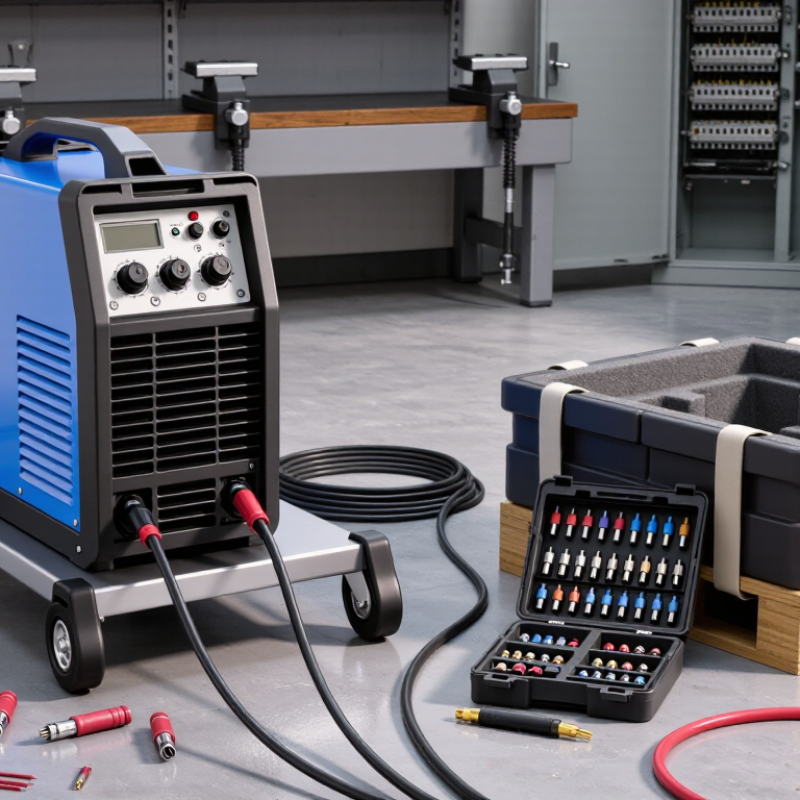
Buying welding equipment across borders requires more than comparing prices and power ratings. For global buyers, Stick Welding machines must match local electrical systems, workshop conditions, and practical repair needs. A compact inverter may appear ideal, yet poor duty-cycle information can cause overheating during long fabrication jobs. Supplier claims deserve careful checking.
This guide presents ten practical tips for evaluating Stick Welding equipment before placing an international order. It covers output stability, electrode compatibility, input voltage, duty cycle, portability, cooling design, and replacement-part availability. Buyers should also review product certifications, test reports, warranty terms, and packaging quality. A damaged front panel or loose internal component can turn a promising purchase into an expensive delay.
Small details matter. Check whether the machine supports common electrodes such as E6013 and E7018. Confirm its performance at the voltage available in the destination workshop. Ask for clear photos of labels, connectors, control panels, and shipping protection. Experienced suppliers should explain technical limits without hiding behind vague marketing language.
No checklist removes every risk. A machine that performs well in one factory may struggle in a dusty construction site. I have seen buyers focus on maximum amperage and overlook cable length, ventilation, or service access. That mistake is understandable, but costly. Reliable purchasing depends on evidence, realistic application testing, and honest communication between buyer and supplier. These tips are designed to make that process clearer, safer, and more dependable.
Define Welding Needs with AWS D1.1, ISO 2560, Material, and Joint Data
10 Stick Welding Tips for Global Buyers
Define the welding need before comparing electrode prices. AWS D1.1 fits many structural steel applications, while ISO 2560 classifies covered electrodes for unalloyed and fine-grained steels. These standards are not interchangeable. Confirm the required code, edition, and acceptance criteria. World Steel Association reported 1.89 billion tonnes of crude steel production in 2023, showing the scale of steel fabrication worldwide. Yet volume does not define your job. Record the steel grade, thickness, yield strength, joint design, root gap, weld position, and service temperature. Include drawings and photos. Small missing details create expensive assumptions.
Ask for electrode classification, diameter, polarity, welding current range, coating type, and storage instructions. Check hydrogen control when cracking could threaten a restrained joint. Match the electrode to the base metal, not only to the machine. Verify whether the weld requires visual inspection, bend testing, tensile testing, or impact testing. The U.S. Bureau of Labor Statistics projects 2% employment growth for welders from 2023 to 2033, so qualified labor remains important. Request welding procedure specifications and batch traceability. Keep a trial coupon. It reveals handling problems quickly. A practical weakness remains: buyers often specify a standard but omit joint restraint. Reconsider that habit. Joint data can change preheat, pass sequence, and electrode choice. Your supplier should answer with test evidence, not confident wording.
Match Rod Diameter and Current: 2.5 mm at 60–90 A, 3.2 mm at 90–130 A
For global buyers, rod diameter is a practical purchasing decision, not a catalog detail.
A 2.5 mm electrode commonly runs at 60–90 A.
A 3.2 mm electrode usually needs 90–130 A.
These ranges suit many general-purpose mild-steel electrodes in flat or horizontal work. They are starting points.
The American Welding Society’s Welding Handbook, Volume 1, explains that electrode classification, polarity, position, and joint design affect amperage selection.
AWS A5.1/A5.1M requires usable classification information, but it does not make one current range universal. ISO 2560 guidance also separates covered electrodes by type and performance. Check the technical sheet before shipment.
At 75 A, a 2.5 mm rod can feel smooth.
At 60 A, thick steel may show weak fusion.
In field trials, raise current in five-amp steps when the arc sticks or the bead becomes narrow. Lower it when the pool becomes too fluid, undercut grows, or spatter increases.
Travel speed matters. A fast hand can imitate low amperage. A slow hand can overheat thin sheet.
Buyers should specify diameter, electrode classification, polarity, welding position, and target current in purchase documents.
Suitable rods can still fail when these details are missing. That gap deserves review.
Control Moisture: Recondition Low-Hydrogen Electrodes at 260–430°C
Low-hydrogen electrodes demand disciplined moisture control, especially during international transport. Humid warehouses, open containers, and sudden temperature changes can increase coating moisture. The result may include porosity, wormholes, or hydrogen-related cracking. Small storage mistakes matter.
Keep unopened electrode packages sealed until the welding area is ready. Store them in a heated cabinet when conditions are damp. A practical holding temperature is often around 120–150°C, but the product specification must control. Never guess with critical welds. Inspect damaged, swollen, or heavily exposed coatings before use.
Reconditioning usually means heating suitable low-hydrogen electrodes at 260–430°C. Use the exact temperature and time listed in the technical documentation. Many electrodes require controlled heating for one to two hours, followed by protected holding. Avoid placing cold electrodes directly into a very hot oven. The coating can crack or lose strength. Let them warm gradually.
A calibrated oven is essential. Record batch numbers, heating times, and cabinet temperatures. These records support traceability for buyers, inspectors, and fabricators. Field teams sometimes recondition electrodes repeatedly, assuming every cycle is harmless. That assumption needs review. Excessive heating may damage the coating, while insufficient heating may leave moisture inside. When documentation is missing, quarantine the batch and request technical confirmation. A quick shortcut can become an expensive weld repair.
Check Power and Safety: IEC 60974-1, 220/380 V, Duty Cycle, and IP Rating
Global buyers should treat IEC 60974-1 as a purchasing checkpoint, not decorative paperwork. This standard covers welding power-source safety and performance. Confirm rated input voltage, frequency, output current, and thermal tests. A 220 V machine is not automatically suitable for a 380 V workshop. Verify single-phase or three-phase supply first. Check the local voltage tolerance, too. Small errors become expensive repairs.
Tips:1. Match input voltage precisely. 2. Confirm 50 or 60 Hz operation. 3. Check electrode diameter against output range.
4. Read duty cycle at 40°C. A 60% duty cycle means six welding minutes within ten minutes. It does not mean continuous welding. Higher amperage may reduce usable time. That detail is often missed.
5. Compare rated output, not maximum output. 6. Inspect cable length and connector ratings. IEC 60974-1 gives useful technical boundaries, but installation conditions still matter.
Tips: 7. Select an IP rating under IEC 60529. IP21S offers limited indoor protection, while IP23S suits more demanding sheltered work. Neither rating makes equipment waterproof. 8. Keep vents away from grinding dust. 9. Require over-temperature protection. 10. Check earthing instructions and service documents.
The International Labour Organization reports about 2.78 million work-related deaths annually. Welding hazards are only one part of that figure, but they deserve serious controls. I would also question unclear test certificates. A neat label is not proof of safe performance.
Compare Productivity: 20–30% Duty Cycle and 1–8 kg/h Deposition Rates
Stick welding productivity varies sharply between workshop estimates and field results. A 20–30% duty cycle means welding for only two or three minutes during a ten-minute period. The remaining time covers electrode changes, slag removal, inspection, and cooling. I have seen production plans fail because they counted arc time as total working time. Record actual arc-on minutes before comparing suppliers or machines.
Deposition rates of 1–8 kg/h require careful interpretation. Lower rates usually match smaller electrodes, low currents, vertical work, or frequent starts. Higher rates need larger electrodes, stable amperage, flat-position welding, and experienced operators. Keep the arc short. Use a consistent travel angle. Clean slag completely between passes. Preheat thick steel when the qualified procedure requires it. Poor fit-up can erase any gain from faster deposition.
For global buyers, request test data from the same electrode size, joint design, welding position, and operator skill level. A ten-minute timed trial is useful. Weigh the deposited metal, not the unused electrode. Include grinding, rework, and cooling delays in the calculation. My early estimates were too optimistic when I ignored cable length and difficult access. That mistake still matters. A practical production sheet should track current, electrode consumption, arc time, rejection rate, and kilograms accepted per shift. Small details change the result.
10 Stick Welding Tips for Global Buyers? - Compare Productivity: 20–30% Duty Cycle and 1–8 kg/h Deposition Rates
No.
Productivity Dimension
Practical Stick Welding Tip
Typical Reference Range
What Global Buyers Should Check
Productivity Impact
1
Duty cycle
Compare the rated duty cycle at the actual welding current, not only the machine’s maximum output. A lower current setting generally permits longer continuous welding.
Compact and light-duty stick welders commonly list approximately 20–30% duty cycle at maximum rated current, measured over a 10-minute test period.
Request test conditions, ambient temperature, current, voltage, and the complete duty-cycle curve.
Reduces thermal shutdowns and unexpected production pauses.
2
Electrode diameter
Select the electrode size according to material thickness, joint design, and available current. Do not choose a larger rod only to increase deposition.
Common diameters include 2.5 mm, 3.2 mm, 4.0 mm, and 5.0 mm. A 3.2 mm electrode often operates around 90–140 A, depending on classification and polarity.
Check recommended amperage, polarity, electrode storage requirements, and local availability.
Balances deposition rate, penetration, arc control, and defect risk.
3
Deposition rate
Use deposition rate as a planning estimate rather than a guaranteed output. It varies with electrode type, current, welding position, operator skill, and arc-on time.
Approximately 1–8 kg/h may be encountered across common manual stick welding conditions, from smaller electrodes and lower currents to larger electrodes and higher currents.
Ask whether the quoted figure is electrode consumption, deposited metal, or an ideal laboratory result.
Provides a realistic basis for labor and consumable-cost calculations.
4
Arc-on time
Separate arc-on time from total shift time. Electrode changes, slag removal, joint repositioning, fit-up, inspection, and machine cooling all reduce effective production.
Manual stick welding often has a substantially lower effective arc-on percentage than the machine’s duty-cycle rating.
Use time studies or a sample production test instead of relying only on catalog figures.
Improves the accuracy of capacity and delivery estimates.
5
Polarity and arc stability
Follow the electrode manufacturer’s recommended AC, DC electrode-positive, or DC electrode-negative setting. Incorrect polarity can cause spatter, poor penetration, or unstable starts.
Many common low-hydrogen electrodes use DC electrode-positive or AC, while requirements vary by electrode classification.
Verify output type, open-circuit voltage, arc-start performance, and polarity markings.
Reduces rework and improves bead consistency.
6
Electrode storage
Keep moisture-sensitive low-hydrogen electrodes sealed and store or rebake them according to the applicable classification and manufacturer instructions.
Low-hydrogen electrodes are commonly supplied in moisture-resistant packaging and may require controlled storage after opening.
Helps prevent hydrogen-related cracking, porosity, and rejected welds.
7
Travel speed and arc length
Maintain a short, controlled arc and steady travel speed. Excessive arc length increases spatter and atmospheric contamination, while slow travel can produce an overly wide bead.
Use the electrode maker’s recommended amperage and technique as the primary reference because travel speed is joint-specific.
Evaluate bead profile, penetration, spatter, and weld discontinuities during a practical trial.
Improves deposition efficiency and limits grinding or repair work.
8
Joint preparation
Clean oil, paint, rust, and moisture from the weld area. Match groove angle, root opening, and pass sequence to the material thickness and welding procedure.
Joint dimensions should be taken from the approved welding procedure rather than a universal setting.
Confirm fit-up tolerances, preheat requirements, interpass temperature, and inspection criteria.
Reduces excess passes, lack of fusion, and corrective work.
9
Power supply and input compatibility
Match the welder to local voltage, frequency, phase, generator capacity, and site conditions. Allow sufficient input capacity for the intended current range.
Portable units may use single-phase input, while larger industrial units can require higher-capacity single-phase or three-phase supplies.
Verify input voltage tolerance, frequency, plug standard, cable length, protection rating, and generator compatibility.
Prevents nuisance trips, unstable output, and installation delays.
10
Cooling, cables, and maintenance
Keep ventilation openings clear, use correctly sized welding and work-return cables, inspect connections, and remove slag between passes.
Cable size should be selected for welding current, cable length, insulation rating, and the applicable electrical standard.
Check thermal protection, fan operation, cable cross-section, grounding, spare-part availability, and service documentation.
Supports stable output, longer service life, and safer continuous operation.
Benchmark note: Duty-cycle and deposition-rate figures are typical planning ranges, not universal guarantees. Actual productivity depends on electrode classification and diameter, welding current, polarity, joint design, position, operator technique, arc-on time, ambient conditions, and the applicable welding procedure.
Cepex is the brand for the fluid handling market belonging to the Fluidra group. One of the leading european manufacturer of valves and fittings in thermoplastic materials.
Dedicated to the swimming pool, irrigation and industrial markets, we distribute our products worldwide with the Fluidra commercial network and presence in 46 countries with 136 sales branches.
Your data will be processed by CEPEX S.A., with address at C. Lluís Companys, 51-53, 08400, Granollers (Barcelona), and C.I.F. nº A-08928707, to send you communications about our products based on your interests. You can consult more information about the processing of your data and how to exercise your rights as described in the Privacy Policy.
Technical cookies are strictly necessary for our website to work and you can navigate through it. These types of cookies are those that, for example, allow us to identify you, give you access to certain restricted parts of the page if necessary, or remember different options or services already selected by you, such as your privacy preferences. Therefore, they are activated by default, your authorization not being necessary in this regard. Through the configuration of your browser, you can block or alert the presence of this type of cookies, although such blocking will affect the proper functioning of the different functionalities of our website.
The analysis cookies allow us to study the navigation of the users of our website in general (for example, which sections of the page are the most visited, which services are used most and if they work correctly, etc.). From the statistical information on navigation on our website, we can improve both the operation of the page itself and the different services it offers. Therefore, these cookies do not have an advertising purpose, but only serve to make our website work better, adapting to our users in general. By activating them you will contribute to this continuous improvement. You can enable or disable these cookies by checking the corresponding box, being disabled by default.
Functionality cookies allow us to remember your preferences, to personalize certain characteristics and general options of our website, every time you access it (for example, the language in which the information is presented to you, the sections marked as favorites, your browser type, etc.) Therefore, this type of cookies does not have an advertising purpose, but by activating them you will improve the functionality of the website (for example, adapting to your type of browser) and the customization of it based on your preferences (for example, by presenting the information in the language that you have chosen in previous occasions), which will contribute to the ease, usability and comfort of our page during your navigation. You can enable or disable these cookies by checking the corresponding box, being disabled by default.
Advertising cookies allow us to manage the advertising spaces included in our website based on criteria such as the content shown or the frequency in which the ads are displayed. For example, if you have been shown the same ad several times on our website, and you have not shown a personal interest by clicking on it, it will not appear again. In summary, by activating this type of cookies, the advertising shown on our website will be more useful and diverse, and less repetitive. You can enable or disable these cookies by checking the corresponding box, being disabled by default.
Behavioral advertising cookies allow us to obtain information based on the observation of your browsing habits and behaviors on the web, in order to show you advertising content that best suits your personal tastes and interests. To understand it in a very simple way, we will give you a fictitious example: if your last searches on the web were related to suspense literature, we would show you advertising about suspense books. Therefore, activating this type of cookies, the advertising that we show you on our website will not be generic, but will be oriented to your searches, tastes and interests, therefore adjusting exclusively to you. You can enable or disable these cookies by checking the corresponding box, being disabled by default. To understand it in a very simple way, we will give you a fictitious example: if your last searches on the web were related to suspense literature, we would show you advertising about suspense books. Therefore, activating this type of cookies, the advertising that we show you on our website will not be generic, but will be oriented to your searches, tastes and interests, therefore adjusting exclusively to you. You can enable or disable these cookies by checking the corresponding box, being disabled by default.
We use our own and third-party cookies to ensure the proper functioning of the website and to analyse our services, improve your experience on our website and show you advertisements related to your interests according to profiling based on your browsing habits (e.g. websites visited). You can accept all cookies by clicking "ACCEPT" or set or reject them by clicking here. If you would like to know more about the use of cookies, please see our COOKIE POLICY.